
Carbon Economy Seminar Held at PHBS, Shenzhen
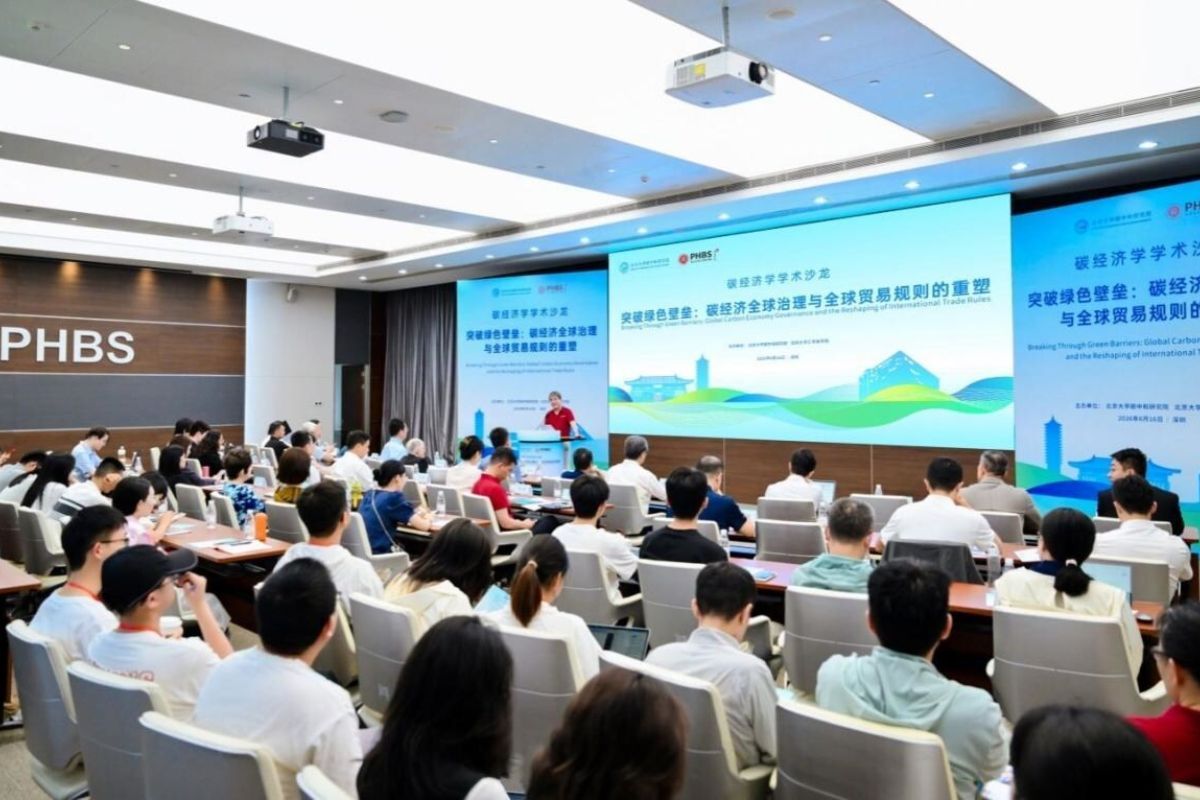
The link between climate change and the trade sector has become a strategic challenge in the Asia-Pacific region, serving as the focus of the Carbon Economy Salon Series held at Peking University HSBC Business School (PHBS) in Shenzhen. The event, which took place just weeks before the APEC Forestry Ministerial Meeting, gathered nearly 100 academics, policymakers, and industry leaders to discuss the theme ‘Breaking through Green Barriers: Carbon Economy Governance and the Reshaping of International Trade Rules’.
Participants examined three interconnected issues: the increasing implementation of unilateral climate-related trade policies, disparities in carbon market development across nations, and the growing role of artificial intelligence in carbon governance. These topics are expected to feature prominently in the APEC discussions in November.
In his opening remarks, Piao Shilong, Vice President of Peking University and Dean of ICN-PKU, alongside Hai Wen, Vice Chair of the Peking University Council and Founding Dean of PHBS, stressed the importance of a more inclusive global carbon governance system. Wang Pengfei, Boya Distinguished Professor and Dean of PHBS, called for strengthened carbon pricing mechanisms and the expansion of market-based instruments.
Nobel Laureate Thomas J. Sargent, Honorary Director of the PHBS Sargent Institute, delivered a keynote address, arguing that uncertainty should accelerate investment in green technology research, emission reductions, and forest conservation. Jiang Kejun, Professor and Head of Carbon Neutrality and Climate Change at HKUST (Guangzhou), identified the 2030–2035 period as a decisive phase for China’s energy transition, driven by rapid growth in renewable energy and electric vehicles. Shenzhen University Professor Wu Dengsheng noted that China now ranks second globally in scientific publications on carbon economics.
Two panel discussions explored the impact of unilateral climate policies on global trade fairness and opportunities for carbon market cooperation with Global South nations. Zhang Haibin, Boya Distinguished Professor and Associate Dean of ICN-PKU, concluded the event by emphasising the need to strengthen cross-disciplinary dialogue as a foundation for effective carbon governance.
The seminar underscored that carbon governance is no longer solely an environmental issue but is increasingly shaped by international trade rules, technological progress, and multilateral cooperation. It also reinforced collaboration between PHBS and ICN-PKU in advancing discourse on global climate governance and China’s dual carbon targets.