
Carbon Economy Opens Opportunities for Added Value from Forests and Mangroves
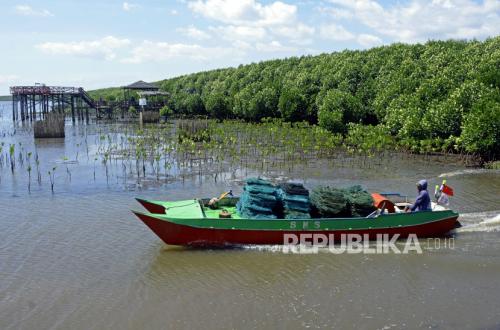
The carbon economy is seen as opening opportunities for Indonesia to create added value from its preserved natural wealth, including forests, mangroves, and peatlands. This shift encourages the development of an economic model that not only relies on the exploitation of natural resources but also places value on efforts to maintain carbon stocks, biodiversity, and ecosystem services.
Founder and CEO of PT Visi Carbon Indonesia (VCarboN), Heppy Trenggono, stated that nature now holds increasingly broad economic value as the carbon economy develops. "The world is beginning to pay not just for what we take from nature, but for what we manage to preserve. Indonesia possesses extraordinary natural wealth. The challenge is how science, technology, entrepreneurship, and integrity come together to transform this wealth into national economic strength," Heppy said while delivering a keynote speech at the NGOBRASREK #4 forum, a casual discussion with the rector themed "Carbon Trade and the Future of a Green Indonesia," organised by the Professors’ Council of Universitas Brawijaya on Friday (7/8/2026).
According to Heppy, the carbon economy is not solely related to environmental issues. Carbon pricing, carbon intensity-based trading, capital flows, regulation, technology, and natural capital are beginning to influence changes in the global economic structure. He noted that Indonesia has a significant opportunity due to its extensive forests, peatlands, and mangroves. However, this opportunity requires support from science, technology, governance, and human resources so that natural wealth can provide added value without neglecting its sustainability.
The development of the carbon economy also requires cross-disciplinary collaboration. VCarboN’s experience in developing mangrove and peatland-based carbon projects in South Sumatra demonstrates the involvement of various fields, ranging from forestry, hydrology, ecology, GIS, law, economics and finance, to engineering, remote sensing, artificial intelligence, biodiversity, community empowerment, MRV, and investment. "In the field, we found that the carbon economy cannot be built by a single discipline. One carbon project brings together so many areas of expertise. Therefore, we see that universities hold a very strategic position in building the future of Indonesia’s carbon economy," Heppy remarked.
In light of this opportunity, Universitas Brawijaya and VCarboN have initiated exploratory collaboration in the development of the carbon economy, natural capital, climate technology, research, and human resources. Universitas Brawijaya Rector Widodo stated that several areas could be developed through this partnership, including applied research, carbon data and MRV, remote sensing and AI, natural capital, biodiversity, and talent development. "The scope for collaboration includes applied research, carbon data and MRV, remote sensing and AI, natural capital, biodiversity, talent development, as well as the involvement of academics and students in research and learning based on real-world problems in the field," Widodo said.
According to Widodo, the collaboration can bring together Universitas Brawijaya’s research strengths with VCarboN’s implementation experience in developing nature-based carbon projects. The discussion was also attended by the Chair of the Professors’ Council, the Chair of the Academic Senate, and senior professors and academics from Universitas Brawijaya. The discussion was moderated by Sukoso, a Professor from the Faculty of Fisheries and Marine Science, with Cahyo Prayogo, a Professor from the Faculty of Agricultural and Forestry Bio-Industry at Universitas Brawijaya, serving as a discussant.
Heppy, who also leads the Gerakan Bela dan Beli Indonesia movement, stated that the development of the carbon economy must place sustainability and governance as its foundation so that the economic value generated remains aligned with environmental conservation efforts. "This meeting carries one important message: that the future of Indonesia’s green economy requires a convergence of nature, science, technology, business, and integrity, so that Indonesia’s natural capital can create economic value while remaining preserved for future generations," Heppy concluded.