
Capital Market Anniversary: Two Issuers Have Paid Dividends from the Soeharto to Prabowo Era
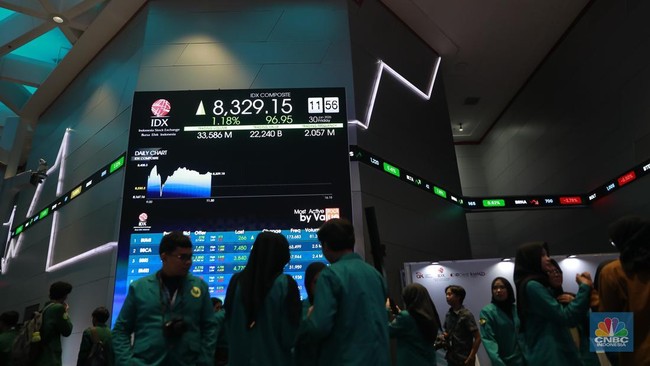
The Indonesian capital market celebrates its anniversary today. Throughout the long history of the capital market, there are issuers that have never missed a dividend payment.
The Indonesian capital market turned 49 years old on 10 August 2026. However, that age does not mean the history of the Indonesian capital market only began in 1977. Its roots stretch back more than a century, since the first stock exchange was established in Batavia in December 1912.
After being halted several times due to war, changes of power, the nationalisation of Dutch companies, and economic and political turmoil, the government reactivated the capital market on 10 August 1977. That momentum was marked by the listing of shares in PT Semen Cibinong, which is now PT Solusi Bangun Indonesia Tbk (SMCB).
The journey continued with the privatisation of the Jakarta Stock Exchange on 13 July 1992, before the Jakarta Stock Exchange merged with the Surabaya Stock Exchange in 2007 to create the Indonesia Stock Exchange (IDX). The capital market is therefore an ecosystem that brings together issuers, investors, regulators, and supporting institutions, while the IDX is the organiser of securities trading within that ecosystem.
In long-term investment strategy, cash dividends are one of the important indicators of a company’s financial health. Consistency in dividend payments is often a primary consideration for investors who prioritise passive cash flow over short-term share price fluctuations.
Based on historical data from the Indonesia Stock Exchange (IDX) going back to the early 1990s, there are differences in dividend payment patterns among a number of large-capitalisation issuers. Two issuers have an unbroken record of dividend payments since 1992, while several other large companies temporarily halted profit distributions due to the impact of the 1998 monetary crisis.
The data show that PT Semen Indonesia (Persero) Tbk (SMGR) and PT Unilever Indonesia Tbk (UNVR) are the two issuers that have consistently paid cash dividends every year for more than three decades, including through the 1997-1998 economic crisis and across the eras of Soeharto, B.J. Habibie, Megawati, Gus Dur, Susilo Bambang Yudhoyono, Joko Widodo, and Prabowo Subianto.
As the market leader in the national cement industry, SMGR (formerly Semen Gresik) has maintained a disciplined dividend policy since 1992. The company’s cash flow resilience was tested during the 1998 crisis, when it was still able to distribute profits to shareholders. When adjusted for the 1:10 stock split in 2007, the data show that SMGR’s dividend yield has varied in line with commodity and construction cycles, but the regularity has been maintained. In Indonesia’s latest era, under Prabowo, Semen Indonesia paid a cash dividend of Rp28.33 per share in May 2026.
In the consumer goods sector, UNVR is recorded as one of the issuers with the highest dividend payout ratio. Since 1992, the company has regularly distributed most of its net profit to shareholders. Along the way, UNVR has carried out several stock splits (in 2003 and 2020) to maintain share liquidity. Under Prabowo, Unilever Indonesia paid a cash dividend of Rp47 per share in July 2025. Unilever even paid dividends twice in 2025, with an interim dividend of Rp87 per share paid on 16 December 2025, and a dividend of Rp114 per share for the 2025 financial year paid on 12 June.
Not only SMGR and UNVR, the Indonesian capital market also has other legendary issuers worth considering. Although their dividend records were briefly interrupted by the 1998 monetary crisis, the fundamental resilience of these companies proved capable of turning things around. After the crisis, they recovered and became consistent contributors of jumbo dividends for investors to this day.
PT Astra International Tbk (ASII) is often regarded as a barometer of the Indonesian economy because of its broad business diversification, ranging from automotive and heavy equipment to financial services. The company has a very generous dividend policy towards shareholders, with a routine of paying twice a year, namely interim and final dividends. Nevertheless, Astra’s dividend record was interrupted during the 1998 monetary crisis. At that time, the sharp depreciation of the rupiah caused the company’s foreign-currency debt burden to swell significantly. Management decided to carry out a massive debt restructuring and suspend dividends to preserve business continuity. After the economic recovery, Astra returned to being a company that regularly distributes profits with a healthy payout ratio.
In the consumer goods sector, particularly the cigarette industry, PT H.M. Sampoerna Tbk (HMSP) is known as a company with strong and defensive cash flow. Since listing on the exchange in 1990, HMSP has been a favourite among investors because of its consistency in distributing profits. However, historical data record that the stability of the company’s dividend distribution was also disrupted at the peak of the economic crisis in the late 1990s. After passing through that difficult period, especially following its acquisition by Philip Morris International in 2005, HMSP’s dividend policy became very aggressive. The company often records a high dividend payout ratio, sometimes exceeding 100% of net profit for the current year by drawing on retained earnings. To this day, HMSP remains one of the largest dividend contributors in the Indonesian capital market.
PT Selamat Sempurna Tbk (SMSM), a producer of automotive components under the Sakura brand, is known as a highly disciplined and export-oriented issuer. For long-term investors, SMSM has a unique appeal because of its above-average dividend frequency, which can reach four times in one financial year. Despite having a solid record of dividend growth, SMSM’s famously prudent management also took the step of retaining earnings during the 1998 crisis to secure working capital. That decision proved correct because the company survived and subsequently recorded consistently rising dividend growth year after year in line with the expansion of its export markets.