
Cancer Disappears After Biopsy: Rare Medical Case in a 59-Year-Old Woman Astonishes Doctors
A 59-year-old woman in Wisconsin, United States, astonished her medical team when a lump suspected to be cancer on her forearm disappeared spontaneously. This phenomenon, known as spontaneous regression, is extremely rare and refers to the partial or complete disappearance of cancer without any medical treatment.
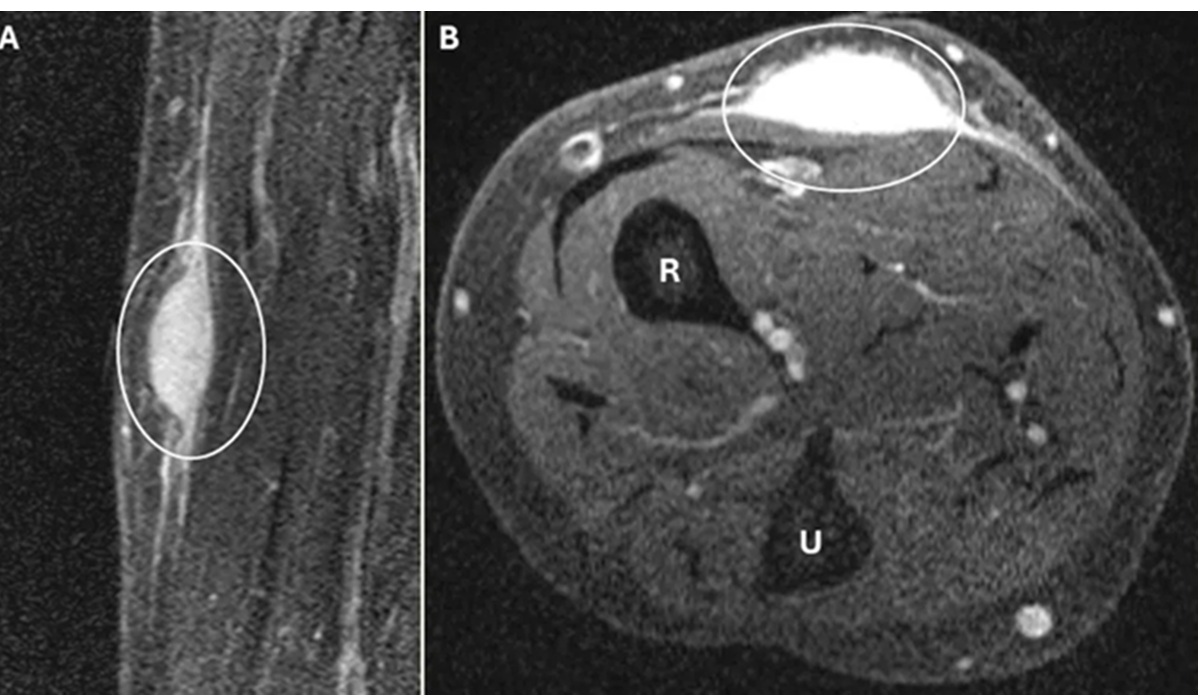
Initially the patient noticed a rapidly enlarging lump on her right arm. Physical examination and X-ray revealed a hard mass measuring 2 x 2 centimetres. MRI scans showed an oval, bright white lesion, consistent with sarcoma — a rare cancer that can affect bone or soft tissue such as muscle and fat.
To confirm the diagnosis, doctors performed a core needle biopsy and fine-needle aspiration to obtain tissue samples. Laboratory analysis revealed myxofibrosarcoma (MFS), a soft tissue sarcoma, grade 2 (intermediate aggressiveness).
However, following the biopsy, the lump began to shrink abruptly. Within two weeks, it was no longer palpable through the skin.
Despite the apparent disappearance, the team proceeded with a wide local excision to remove surrounding tissue to ensure control of the disease.
When the excised tissue was examined in the laboratory, no cancer cells were detected. The tissue showed only scar tissue and inflammation typically associated with the immune response to cancer. One year after the procedure, the patient remained cancer-free.
In the case report published in April, clinicians noted that spontaneous regression in sarcoma is exceedingly rare. Of 32 previously documented cases, eight (25%) began to shrink after diagnostic biopsy or physical trauma to the tumour.
The authors hypothesised that physical damage to the tumour during needle biopsy caused tumour-associated proteins to enter the bloodstream, flagging the presence of cancer to the immune system. Simultaneously, the healing process after biopsy attracted immune cells to the area, triggering a local immune assault that destroyed the tumour.
Although remarkable, clinicians warn that such abrupt tumour shrinkage can be a clinical trap. “Observing sarcomas that shrink presents a clinical pitfall. It might tempt clinicians to cancel surgery,” the authors wrote. “Yet our systematic review shows that while some regressions are complete, many are partial or temporary. Furthermore, in the biopsy group, nearly 40% of excised specimens still contained residual tumour cells despite clinically apparent shrinkage.”
Therefore, the medical team continued to recommend surgical removal to preempt any hidden cancer cells. The researchers hope to uncover the exact mechanism of this rare regression so it could be replicated as a future therapy. (Live Science)
Biopsy remains crucial in breast cancer patients, as it allows doctors to assess tumour markers and determine cancer types. Biopsy remains a primary method for detecting cancer, but the procedure is invasive and can cause discomfort.