
Can we still hear the writer's voice in their writing?
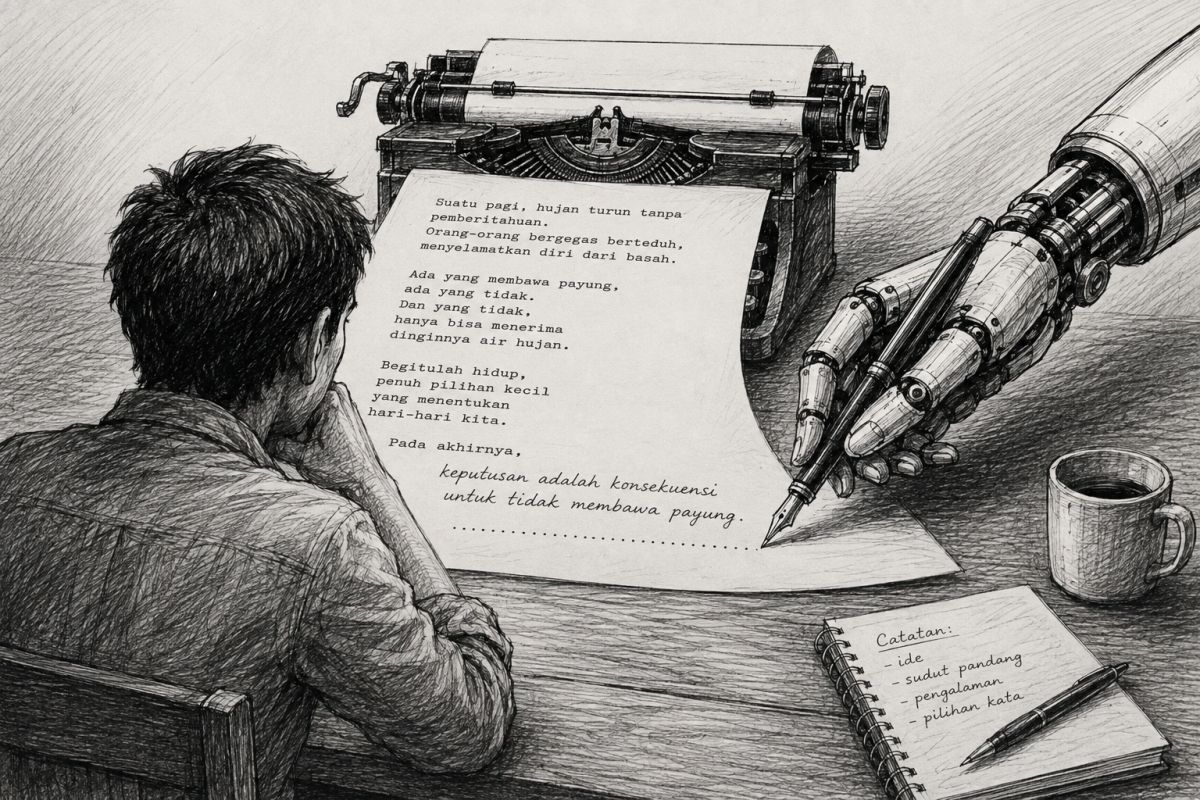
This is where the problem lies. If control must remain in human hands, may editorial decisions in the writing process—such as choosing diction, expressions, and sentence structure—be handed over to AI?
A friend sent me a link to an article. He asked whether a media outlet may publish a piece that is ‘reasonably suspected’ of not having been written by its author. I refrained from replying with a laughing icon, because after reading it again, he appeared to be asking in a serious tone.
I did not answer the question immediately. Besides being unsure what to reply, I also needed to read the article to the end. Sentence by sentence, paragraph by paragraph—so that I would not be accused of jumping to conclusions too quickly.
Actually, I would like to quote a sentence or two here, but it would be unseemly to comment on someone else’s writing. So I shall use examples whose structure is similar to the sentences in that piece.
‘When someone forgets to bring an umbrella, he is not merely committing a small oversight, but is confronting the consequences of a decision that was not carefully prepared.’
That sentence actually only wants to say one thing: forgetting to bring an umbrella. Yet something so simple apparently needs to be made convoluted with cause-and-effect relationships and ‘not merely this, but that’. The incident of forgetting an umbrella ends up sounding like an important plan that failed to be executed due to human negligence.
I shall give another example of a sentence used as a closing. ‘In the end, getting caught in the rain teaches us that every oversight, no matter how small, always carries consequences.’
Is this the problem? I do not think so.
There is nothing wrong with a writer using complex sentences, especially if what they wish to convey genuinely requires such sentences.
From the two example sentences above, readers may wonder why a trivial matter is made to look difficult—similar to the popular jibe at convoluted bureaucracy.
Complex sentences are commonly used in journalism, for example to explain something that, if simplified, could cause misunderstanding.
A trivial matter such as forgetting to bring an umbrella does not require a lengthy explanation. However, when a journalist must explain why fuel prices do not fall immediately after world crude oil prices drop, a more complex sentence can help readers quickly understand the cause.
‘Fuel prices do not fall immediately because the petrol sold today is made from old crude oil stocks purchased when prices were higher and using the dollar exchange rate at that time.’
Source: jawawa.id (https://jawawa.id/newsitem/can-we-still-hear-the-writers-voice-in-their-writing-1787820933)
Originally published by Antara (Indonesian) (https://www.antaranews.com/berita/5713519/masihkah-kita-mendengar-suara-penulis-dalam-tulisannya), translated from Indonesian