
Can the Human Rights Bill Break the Cycle of Violence in Papua?
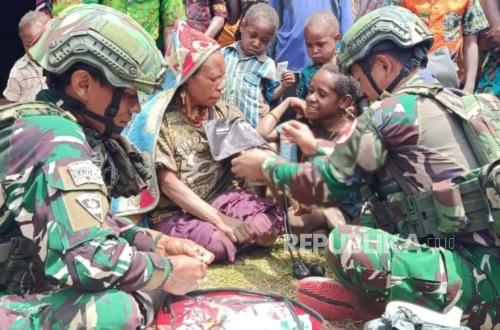
The cycle of escalating conflict in the land of Papua, which has yet to find its endpoint, increasingly weighs on the joints of people’s lives. Fulfilment of the most basic rights seems to remain an enormously costly thing to realise.
It must be acknowledged that the escalation of conflict between security forces (Polri/TNI) and armed criminal groups (OPM/TPNPB) has claimed many lives. This precarious situation has also become one of the obstacles preventing the government from fulfilling economic, social and cultural rights in Papua.
Recently, Yahukimo and Intan Jaya have become the epicentre of tension in Papua. Following the shooting of a pioneer aircraft pilot, a series of armed clashes occurred around Dekai District (the capital of Yahukimo).
The escalation grew more alarming after an armed criminal group executed three civilians accused of being intelligence operatives, even spreading the video recording on social media. Meanwhile, in Intan Jaya, armed groups once again disrupted civilian aviation logistics routes to Sugapa.
The disruption to aviation access has a direct impact on the supply of people’s basic needs, particularly in inland areas. This chain of events ultimately triggered a domino effect in the form of massive waves of internal displacement (internally displaced persons).
Residents have been forced to leave their birthplace and live in uncertainty about their fate. As the government’s human rights focal point, the Ministry of Human Rights has certainly not remained idle.
On 7 July 2026, the Ministry of Human Rights convened a coordination meeting with the leadership of the National Police and the Indonesian National Armed Forces specifically to discuss the situation in Papua. The meeting affirmed the importance of inter-agency synergy in handling the conflict while continuing to prioritise human rights principles.
Reorienting the Security Approach
To date, the conventional security approach has remained dominant in Papua. It cannot be denied that the complexity of conditions and threats of violence on the ground tend to demand a security presence in order to protect the populace.
However, the cycle of conflict, which has yet to find a clear path to resolution, must serve as a loud alarm. The conventional security approach clearly can no longer stand on its own. It is high time that the resolution of the Papua problem shifted to a human security approach that places people at the centre of attention.
This step is crucial given that the portrait of development in Papua still lags far behind the national average. Data from Statistics Indonesia for 2025 recorded the Human Development Index in Central Papua at 60.64, while the national average has already reached 75.90.
Disparity is also visible in the national poverty rate as of March 2025, which stood at around 8.47 per cent, whereas in Highland Papua it soared to 30.03 per cent. These figures reflect the real inequality that still separates Papua from the national average.
Integrating Human Rights into Peace Efforts in Papua
When human rights principles are made the foundation from the planning stage through to budget allocation, development will automatically become far more responsive to these disparities.
Public policy will also become more oriented towards restoring dignity while improving the welfare of the Papuan people. It is here that the Human Rights Bill takes on a role as a progressive instrument that institutionalises this approach into concrete policy.
After all, this regulation will oblige central and regional governments to mainstream human rights principles in every government function. Moreover, in the context of handling the conflict in Papua, the Human Rights Bill can touch on at least five other crucial aspects.
The Human Rights Bill will require the existence of meaningful public participation space. What is often forgotten in efforts to resolve the Papua problem so far is the inclusive involvement of all parties. Through the Bill’s mandate, a participatory approach will no longer be a mere formality, but an obligation.
On that basis, a genuine red carpet of mandatory involvement must be given to religious leaders, customary figures, academics, women’s groups, youth, and civil society organisations so that the solutions born are truly grounded in aspirations from the field. In addition, there is one breakthrough that is often overlooked yet highly relevant to Papua.
The Human Rights Bill embraces vulnerable groups based on their conditions of vulnerability and is not limited to specific subjects. This approach becomes progressive because it recognises that vulnerability can arise from many causes, including geographical factors, conflict, and threats of danger.
This formulation opens up protection space for internally displaced persons in Papua. Residents forced to flee due to conflict now fall into the vulnerable group category. On that basis, the state is obliged to take affirmative steps so that they receive special protection, not merely uniform treatment.
Furthermore, the Human Rights Bill shields human rights defenders in Papua with stronger protection guarantees. Their existence as the frontline in monitoring the human rights situation, accompanying victims, and advocating for policy now receives clear legitimacy.
Through this new regulation, the state affirms that those acting in good faith cannot be prosecuted criminally nor sued civilly. This step provides an important guarantee so that advocacy space in conflict areas can proceed without the shadow of fear.
Moving to the institutional level, the Human Rights Bill strengthens the Ministry of Human Rights through protective functions that are both preventive and restorative of victims’ rights. This strengthening is designed to ensure the state is fully present, both in anticipating potential conflict and in guaranteeing recovery for those affected.
In carrying out its protective function preventively, the Ministry of Human Rights will no longer act only after incidents occur, but will be equipped with the authority to conduct analysis, early detection, and supervision of potential human rights violations.
This institutional strengthening is crucial so that the Ministry of Human Rights can take more measured steps in Papua through inter-agency orchestration. The urgency of this new authority was proven real when the ministry moved quickly to consolidate joint steps with the leadership of the National Police and the Armed Forces on 7 July 2026.
In line with these protective efforts, guarantees for victims’ rights are also strengthened through an integrated, cross-agency recovery mechanism. To date, victims of human rights violations have often faced partial and convoluted recovery processes, when in fact they need real recovery in order to resume their lives safely and with dignity.
Going forward, the Bill mandates the Ministry of Human Rights to coordinate monitoring through to the implementation of victims’ rights recovery together with relevant institutions. Through this synchronisation, government assistance programmes for victims are expected no longer to run separately, but to become faster, better targeted, and more sustainable.
No less important, the Human Rights Bill also boosts the standing of the National Human Rights Commission (Komnas HAM) in carrying out its investigation and monitoring functions. The draft affirms the institution’s authority to summon relevant parties, access documents and digital data, conduct on-site examinations, and establish ad hoc investigation teams for suspected human rights violations.
Furthermore, recommendations addressed to ministries, agencies, or regional governments are designed to be binding after passing a plenary session. The urgency of affirming this authority is clearly reflected in Komnas HAM’s current steps to monitor seven incidents of violence in Intan Jaya Regency throughout mid-2026.
The juridical strengthening provided by the Human Rights Bill becomes a crucial answer so that monitoring and recommendations concerning casualties on the ground can proceed effectively without institutional obstacles.
Sustainable Peace
Through the Human Rights Bill, the state demonstrates its intention to always be present, positioning the human dignity of its citizens above all else.
This paradigm shift becomes a crucial foundation in resolving the problems in Papua. It would be naive to assume that security operations, or the birth of a new law, would automatically resolve the complex problems in Papua.
However, the Human Rights Bill can be a turning point because it changes the way the state works: from merely responding to violations towards prevention, from listening to the sound of weapons to listening to the voice of the people.
Thus, the Human Rights Bill will serve as a compass for the state in ensuring that every policy in Papua is always grounded in the respect, protection, fulfilment, enforcement, and advancement of human rights. Through this commitment, the space for building trust will open wide.
This is certainly a primary prerequisite for the realisation of sustainable peace in the land of Papua.
Source: jawawa.id (https://jawawa.id/newsitem/can-the-human-rights-bill-break-the-cycle-of-violence-in-papua-1785750923)
Originally published by Republika (https://analisis.republika.co.id/berita/tj6sfx472/mampukah-ruu-ham-memutus-siklus-kekerasan-di-papua), translated from Indonesian