
Can Non-Muslims Receive Qurbani Meat?
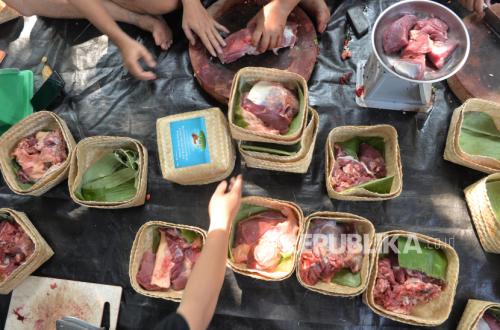
REPUBLIKA.CO.ID, JAKARTA – In a few days, Muslims will celebrate Eid al-Adha 1447 AH/2026 CE. Qurbani is a distinctive ritual of this holiday. Islam teaches that performing qurbani brings the sacrificer closer to Allah, as it represents sincere submission. ‘Neither their meat nor their blood reaches Allah, but rather your piety reaches Him’ (Quran 22:37).
Zaid bin Arqam reported that the companions of the Prophet (PBUH) asked, ‘O Messenger of Allah, what is this qurbani?’ He replied, ‘It is the tradition of your father Ibrahim.’ They asked, ‘What is the reward for us in this, O Messenger of Allah?’ He said, ‘For every hair, there is a good deed.’ They asked, ‘And for the wool?’ He said, ‘For every hair and wool, there is a good deed’ (Sunan Ibn Majah and Hakim).
Distribution of qurbani meat
According to Muhammadiyah’s official website, Islam has rules on distributing qurbani meat. In Surah al-Hajj verse 36, Allah states: ‘… then eat thereof and feed the contented and the beggar.’ This indicates that recipients include both those who ask and those in need who do not. Another Hadith from Buraidah states: ’The Prophet (PBUH) said, “I had forbidden you from eating the sacrificial meat beyond three days so that the affluent could share with those in need. Eat what you have, give to others, and store some” (Ahmad, Muslim, and Tirmidzi). There is no explicit ruling on the exact portions for the poor and the sacrificer. However, scholars, as noted by Sayyid Sabiq in Fiqh as-Sunnah, state that the sacrificer is entitled to one-third of the total meat.