
Can LIMS Tap WhatsApp? Understand Its Limitations
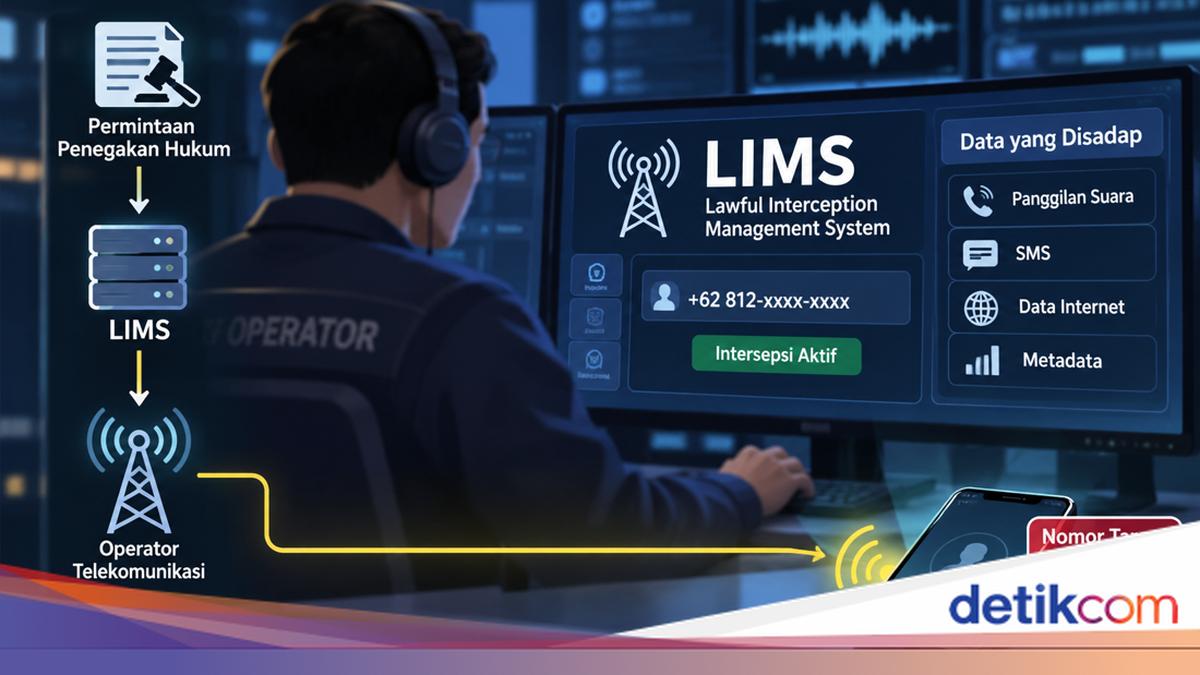
Communications interception technology cannot always read every conversation on a person’s phone. One example is the Lawful Interception Management System (LIMS), which has recently drawn attention following allegations of illegal surveillance targeting President Prabowo Subianto.
LIMS can be used to intercept communications through telecommunications networks. But can it also read WhatsApp messages and listen to users’ calls?
The answer is not straightforward. WhatsApp uses end-to-end encryption, which means messages and calls cannot simply be read by third parties, including through monitoring an operator’s network.
Cybersecurity expert Alfons Tanujaya of Vaksincom said LIMS cannot automatically break through that protection.
“No. It can [intercept] messages that are not protected by encryption,” Alfons told detikINET by phone on Wednesday (4 November 2026).
The ability to intercept communications through an operator’s network is different from the ability to break the encryption used by messaging apps. Although WhatsApp message content is protected, other information may still be visible through network activity, including communications metadata.
What can LIMS intercept?
Before considering WhatsApp, it is important to understand how LIMS works. The Lawful Interception Management System manages the interception of communications through telecommunications network infrastructure.
Alfons said LIMS is not spyware that must be installed on a victim’s phone, such as Pegasus. Instead, it connects interception mechanisms to telecommunications operators’ network infrastructure.
“LIMS is not spyware like Pegasus, but an official interface system that connects law enforcement directly to telecommunications operators’ network infrastructure,” Alfons explained.
Through this mechanism, an interception system can obtain certain communications information, depending on the network technology, system configuration and type of access available.
One category that may be accessible is conventional mobile telephone communications and SMS messages.
Unlike modern messaging apps that use end-to-end encryption, ordinary SMS does not have end-to-end encryption by default. Its content may therefore be readable through interception mechanisms with access to that content.
Information such as the sender’s and recipient’s numbers, the time a message was sent and its delivery status may also be available.
Network data can also be used to estimate a phone’s location based on the Base Transceiver Station (BTS) towers to which the device is connected.
That does not mean LIMS can read all communications carried over an operator’s network. Applications that use end-to-end encryption have their own layer of protection.
Why can’t LIMS read WhatsApp messages?
WhatsApp’s protection relies on end-to-end encryption (E2EE).
Messages are encrypted on the sender’s device and can only be read again once they reach the recipient’s device. Voice and video calls are also protected by end-to-end encryption.
During transmission, telecommunications operators only carry encrypted data. As a result, parties monitoring network traffic cannot automatically discover the contents of conversations.
In simple terms, an interceptor may be able to see that data is being exchanged, but cannot necessarily read the messages being sent.
Accessing the contents of a conversation would require access at another point beyond network monitoring alone, such as taking control of the sender’s or recipient’s device.
This distinction between network interception and direct attacks on devices is important.
Encrypted chats can still leave a trace
Although WhatsApp message content is protected by encryption, users still leave digital traces when they communicate.
These traces are known as metadata: information about communication activity, rather than the content of the messages themselves.
Alfons said metadata is no less valuable than the content of a conversation.
“Metadata is no less valuable than the actual message content and, over the long term, can provide a very accurate picture of a surveillance target,” he said.
In a telecommunications context, metadata may include connection times, IP addresses, the duration and frequency of network activity, and an estimate of a device’s location.
Such information can be analysed to map a person’s activity patterns, including when a device is active, how often it connects to a network and how its location changes according to available connection data.
Gathered over a long period, this seemingly simple information can reveal a person’s digital habits.
There are limits, however. Network metadata does not automatically reveal the contents of chats, members of WhatsApp groups or the identities of all message recipients. What can be obtained depends on the data source and the access available to those monitoring communications.
In other words, conversation content may be protected, but communications activity can still leave a trace.
Can spyware defeat WhatsApp encryption?
There is one situation in which WhatsApp’s encryption may not be enough: when a user’s device has been compromised by spyware.
Spyware is malicious software designed to monitor users’ activity and extract information from infected devices.
Alfons said that if spyware is installed on a victim’s phone, WhatsApp information may be captured before a message is encrypted or after it has been decrypted.
“If spyware is installed on the victim’s device, it may be possible to obtain messages sent through WhatsApp before they are encrypted—for example, through keystrokes,” he explained.
When someone types a WhatsApp message, the text is readable on the device before encryption takes place. If spyware can record keyboard activity, that information may be stolen without breaking WhatsApp’s encryption.
The same applies to received messages. Once decrypted and displayed on the screen, a message may be accessed by malware that has control of the device.
One well-known example of spyware in cybersecurity is Pegasus. The software has been linked to the exploitation of security vulnerabilities in applications and operating systems to gain access to target devices.
End-to-end encryption therefore does not guarantee that a device is completely safe from surveillance. It protects the communications channel; it does not automatically protect a device already controlled by an attacker.
WhatsApp or Signal: which is safer?
Using applications with end-to-end encryption is one way to protect message content from interception through a network.
WhatsApp and Signal use end-to-end encryption by default for private communications. Under this system, message and call contents cannot be read by third parties simply by monitoring network traffic.
Telegram works differently. End-to-end encryption is available only through its Secret Chat feature. Ordinary Telegram conversations are not end-to-end encrypted by default.
Even so, choosing an application with strong encryption is not enough on its own to guarantee secure digital communications.
Users should also protect their devices by regularly updating their operating systems and apps, avoiding suspicious links or files, and enabling additional security features such as two-step verification.
Digital communications security has several layers: encryption protects message content while it is being transmitted, while device security protects information stored on and accessed directly through a phone.
In the case of alleged illegal surveillance targeting President Prabowo Subianto, there has been no official explanation of what type of communications were accessed through LIMS, including whether encrypted messaging apps were targeted.
The use of LIMS in the case therefore cannot, by itself, be taken as evidence that the contents of WhatsApp conversations were successfully intercepted. Accessing communications through an operator’s network and breaking an application’s encryption are two different things.
Source: jawawa.id (https://jawawa.id/newsitem/can-lims-tap-whatsapp-understand-its-limitations-1793757036)
Originally published by detikBali (https://www.detik.com/bali/berita/d-8737371/lims-bisa-sadap-whatsapp-jangan-keliru-ini-batas-kemampuannya), translated from Indonesian