
Can cassava flour really extinguish fires? Here are the facts
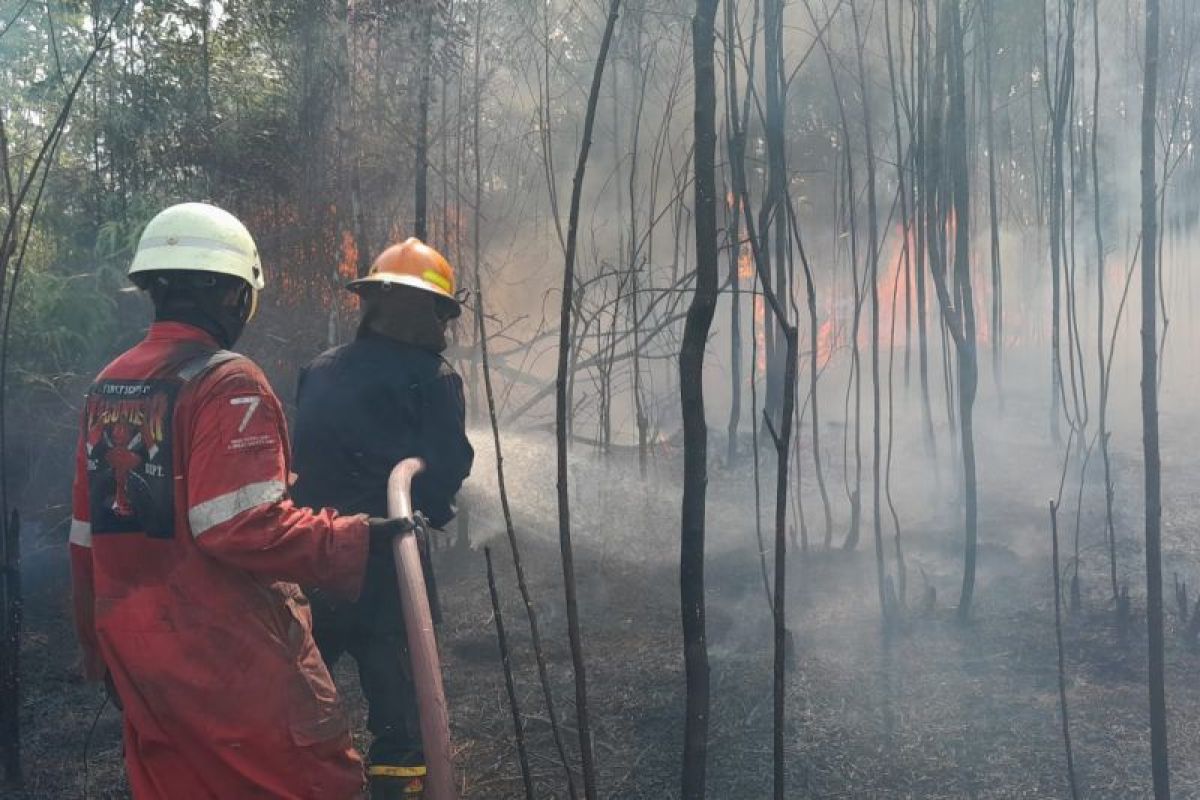
Cassava flour has been described as a potential alternative material to help extinguish forest and land fires. But is it true that cassava-based flour can put out fires?
The discussion emerged after National Police Chief General Listyo Sigit Prabowo mentioned an innovation using cassava or tapioca flour during a meeting on forest and land fire handling in South Sumatra on 24 August 2026. President Prabowo Subianto subsequently asked for the innovation to be developed and tested on a larger scale.
During the meeting, the cassava flour-based material was said to have the potential to help prevent the spread of fire by separating the elements that support the combustion process. The material was also said to be usable for early-stage fire suppression. Nevertheless, the government has requested further research and testing to determine its effectiveness.
Cassava flour does not mean ordinary kitchen flour. The term cassava flour in the discussion of fire-extinguishing innovation needs to be understood carefully. Cassava flour or starch in powder form is not a fire-extinguishing agent that can simply be used to replace water or light fire extinguishers.
Research on the characteristics of cassava starch actually shows that starch dust can undergo combustion and carries an explosion risk under certain conditions. A study published in the journal Processes used a 20-litre spherical explosion test device to study the combustion and explosion characteristics of cassava starch dust.
The study found that dust concentration and ignition conditions affect explosion pressure and dust dispersion characteristics. Therefore, ordinary cassava flour cannot be regarded as a fire-extinguishing material that is safe for indiscriminate use.
The potential of cassava-based materials in fire suppression technology has indeed been studied. One example is 2024 research at IPB University on the use of cassava peel waste as a complementary material for dry chemical powder in light fire extinguishers.
In that study, cassava peel powder was tested with several compositions. One of them was a mixture of two parts cassava peel powder and one part dry chemical powder. The mixture was able to extinguish a fire within 15 seconds in testing.
However, the research results do not mean that cassava peel or pure cassava flour can replace standard fire-extinguishing agents. In the same test, the use of 3 kilograms of cassava peel powder without any mixture failed to extinguish the fire after 95 seconds and the entire contents of the extinguisher were exhausted. By comparison, 3 kilograms of dry chemical powder extinguished the fire in 18 seconds.
These results show that the effectiveness found in the research relates to specific material mixtures, not the simple use of cassava flour.
Why could cassava flour be linked to fire suppression? In general, fire suppression is carried out by removing one or more of the elements required to sustain combustion, such as heat, oxygen, or fuel.
In the innovation being developed by the government, the cassava flour-based material is said to have the potential to help separate the elements that support the combustion process. However, that mechanism still needs to be proven through broader scientific testing before it can be applied as a method for extinguishing forest and land fires.
Therefore, the claim that cassava flour can extinguish fires should not be understood as meaning that cassava flour available in the kitchen can be directly used to pour onto or cover flames.
President Prabowo has asked for large-scale development. The President paid attention to the innovation after receiving a report on a fire-extinguishing material made from cassava or tapioca.
The President asked for the material to be produced on a large scale and tested further. In fact, during the meeting the term ubi bombing emerged as an analogy to the waterbombing method that has been used in aerial firefighting.
The government also asked the National Disaster Management Agency and the National Research and Innovation Agency to examine the possible use of certain materials that are more effective in helping to extinguish fires and prevent the spread of flames.
This means that the cassava flour innovation is currently still in the development and testing stage, not a technology that has been established as a replacement for the extinguishing methods used by officers.
Another point to note is the character of cassava starch as an organic material. Research on cassava starch dust explosions shows that starch powder can burn under certain conditions.
In that study, a dust concentration of 750 grams per cubic metre produced the maximum explosion pressure in testing, while the calculated maximum explosion index reached 22.3 MPa·m/s.
Other research in 2024 tested the use of ammonium phosphate to suppress cassava starch dust explosions. The results showed that the material can reduce explosion pressure, the maximum explosion index, and flame propagation characteristics of cassava starch dust.
These findings show that the ability to suppress fire does not simply come from cassava flour itself, but can be related to formulation, additives, concentration, and the method of use.
Do not use cassava flour to extinguish house fires. The emergence of research on cassava-based materials does not mean the public is advised to use cassava flour to extinguish fires at home.
For fires, especially those that have already grown large, the public should use appropriate extinguishing equipment and contact the fire brigade. The use of untested materials could actually create additional risks.
In the context of forest and land fires, cassava-based innovation still requires further testing to determine its effectiveness.