
Campus-Industry Collaboration Driven to Accelerate Human Resource Strengthening and National Innovation
Strengthening the synergy between universities and the industrial world is becoming increasingly vital to ensure that education, research, and human resource development align with national economic needs. Such collaboration also creates opportunities for more applicable innovations that provide direct benefits to society.
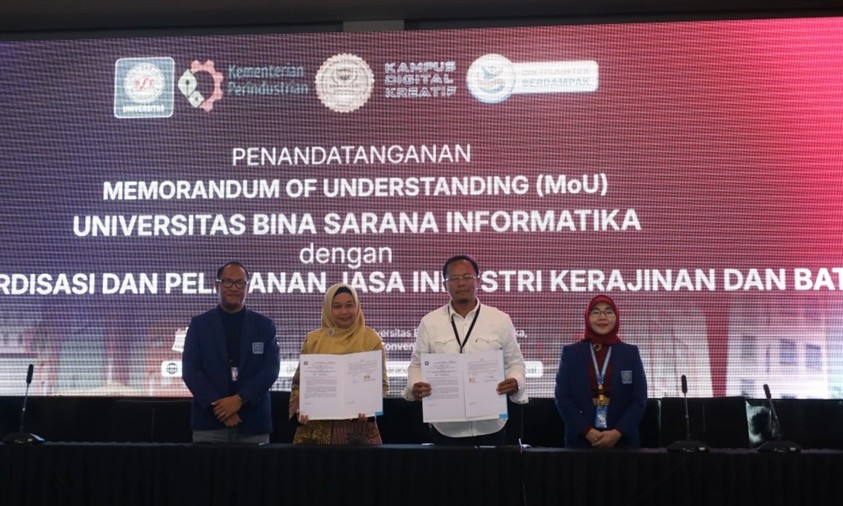
This spirit was realised through a partnership between Universitas Bina Sarana Informatika (UBSI) and the Large Centre for Standardization and Services of the Crafts and Batik Industry (BBSPJIKB), marked by the signing of a Memorandum of Understanding (MoU) at the BSI Convention Centre Kaliabang, Bekasi.
The MoU was signed by the Rector of UBSI, Prof. Mochamad Wahyudi, and the Head of BBSPJIKB, Zya Labiba. The cooperation covers education, student research, community service, and human resource development.
The collaboration is also directed towards the development of science, technology, and art by utilising the resources available to both parties. This step is expected to strengthen the link between academic knowledge and the real-world needs of the industry.
UBSI Rector Prof. Mochamad Wahyudi stated that in the field of education, cooperation can be implemented through industrial practices, student internships, lecturer internships, knowledge exchange, and the involvement of practitioner lecturers. This scheme provides opportunities for students and teaching staff to understand industrial developments more closely while strengthening competencies relevant to the workforce.
“In the field of research, collaboration can be directed towards supervising final projects or theses, particularly research related to the craft and batik industry. Finally, in community service, both parties have the opportunity to develop training, empowerment, and social responsibility activities tailored to community needs,” he said on Tuesday (15/09/2026).
Prof. Wahyudi expressed hope that the cooperation would not merely end with the signing of documents but would be translated into concrete programmes beneficial to students, lecturers, the community, and industrial development.
He noted that partnerships with institutions possessing industrial competence can help universities contribute more relevantly to the needs of the business world. This also strengthens the implementation of the ‘tridharma’ (three pillars) of higher education so that its impact is not limited to the campus environment.
Head of BBSPJIKB, Zya Labiba, stated that this collaboration serves as a space to strengthen synergy between universities and government agencies in developing human resources, knowledge, and technology to support the Indonesian craft and batik industry.
“The collaboration between BBSPJIKB and UBSI is expected to strengthen synergy in the development of human resources, knowledge, and technology, thereby benefiting the development of the craft and batik industry in Indonesia,” said Zya.
The cooperation has also begun to move towards concrete activities through the organisation of a National Seminar on Collaboration for the Development of the Craft and Batik Industry in Indonesia. This activity is formalised in a Cooperation Agreement (PKS) regarding the organisation of a national seminar for UBSI lecturers.
Under this agreement, BBSPJIKB provides speakers, while UBSI manages the organisation and supporting facilities. This pattern demonstrates that partnerships between universities and industry can be translated into academic activities that bring together knowledge, experience, and the needs of the industrial sector.
She emphasised that such collaboration is a vital part of strengthening the connection between the world of education and the world of work. By bringing together academic spaces, research, technology, and industrial needs, universities and the government can work together to drive human resource development and innovation that is more adaptive to national economic challenges.
Ultimately, strengthening the relationship between campuses and industry is not only about institutional interests but also relates to efforts to build competent human resources, increase innovation, and strengthen the competitiveness of national industries, including the craft and batik sector, which holds significant economic potential and cultural value for Indonesia.