
Call of Duty Imagines a North Korean Invasion of the South: Could It Really Happen?
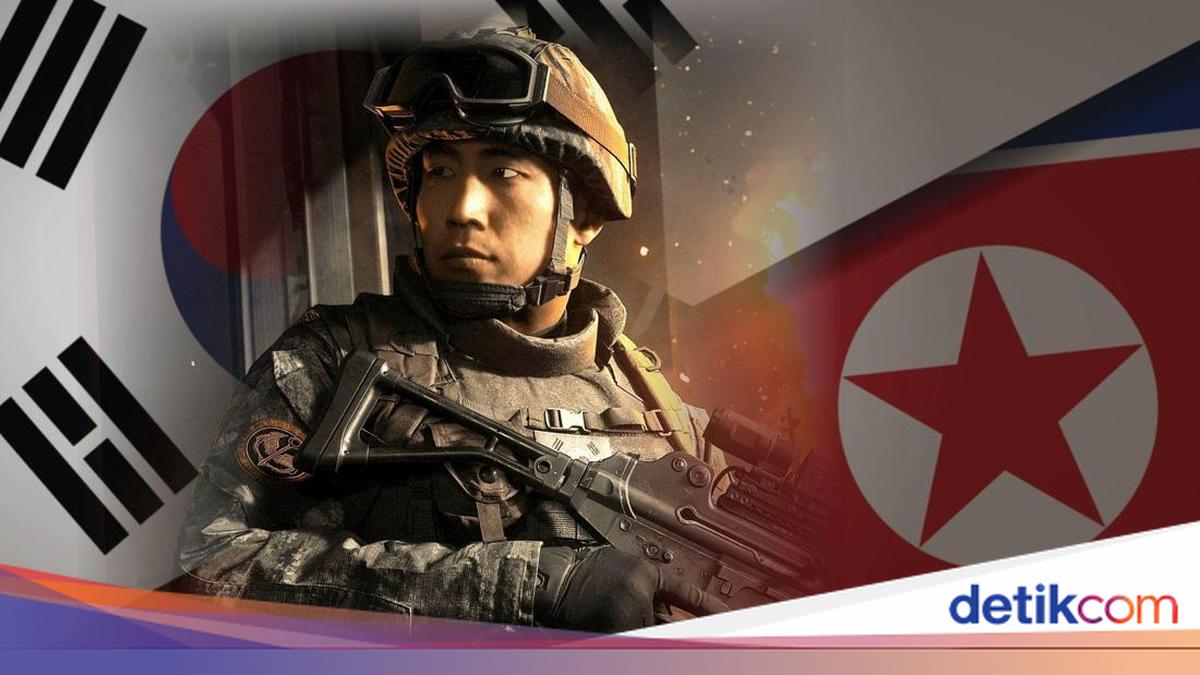
The latest Call of Duty trailer opens with young South Korean conscripts on a routine patrol. Moments later, North Korean missiles strike South Korean territory, setting off a war on the Korean Peninsula.
The trailer for Modern Warfare 4 had been viewed 22 million times when it was released in May. By 22 October 2026, it had amassed 61 million views.
Some have accused the game, released on 23 October, of turning an unresolved conflict into entertainment. Others have welcomed its portrayal of the conflict from the perspective of South Korean soldiers.
But could North Korea really invade South Korea as depicted in the game?
The Korean War began in 1950 and ended with an armistice in 1953. At least three million people died in the conflict. (RV Spencer/Interim Archives/Getty Images)
It has happened before.
Five years after the end of the Second World War, which left Korea divided, North Korea invaded South Korea on 25 June 1950, triggering the Korean War.
The conflict was more than a regional war: it was a struggle between the great powers of the Cold War. North Korea belonged to the Soviet-led Eastern Bloc, while South Korea was allied with the United States and the Western Bloc.
North Korean forces advanced rapidly, capturing Seoul in just three days. Within weeks, they had pushed South Korean and US-led United Nations forces back to a defensive line around the port city of Busan.
The conflict turned in South Korea’s favour in September 1950, when US General Douglas MacArthur led a surprise landing at Incheon. China entered the war a month later.
The armistice halted the fighting, but it was not a peace treaty. Although it was signed by North Korea, China and the US-led United Nations Command, South Korea refused to sign it.
The armistice established a ceasefire line close to the front line at the time, creating a four-kilometre-wide demilitarised zone (DMZ). The area remains one of the most heavily guarded borders in the world.
More than 70 years later, the two Koreas are technically still at war. Although there have been numerous clashes on land and at sea, both countries have avoided open warfare.
At least three million people died in the Korean War, making it one of the deadliest conflicts of the modern era.
Has North Korea threatened to invade South Korea?
In 2024, Kim Jong-un told members of his country’s parliament that North Korea no longer wanted reunification with South Korea. (Getty Images)
For decades after the Korean War, North Korea periodically said it wanted to reunify the Korean Peninsula peacefully, albeit on its own terms.
Pyongyang’s position changed in January 2024. North Korean leader Kim Jong-un told the country’s parliament that North Korea no longer wanted reunification with South Korea.
The constitution was amended to describe South Korea as North Korea’s “main enemy and principal unchanging foe”, and to state that the two countries should be treated as separate and hostile entities.
The United States has about 28,500 troops stationed in South Korea as part of its alliance with Seoul.
How likely is a North Korean invasion of the South?
North Korea declared that it possessed nuclear weapons in 2022 and vowed never to give them up. (KCNA via KNS/AFP/Getty Images)
For decades, Western and South Korean officials and military experts have used war games, military exercises and intelligence assessments to examine the possibility of an invasion and how one might unfold.
In 2023, the US Intelligence Community, a group of federal intelligence agencies and organisations, published a report saying North Korea was very likely to use its nuclear weapons and ballistic missiles to gain regional influence and as a deterrent, rather than launch a full-scale attack.
Markus Garlauskas, a former US National Intelligence Officer for North Korea who now works at the Washington-based Atlantic Council think tank, said that if Pyongyang attacked Seoul, it would most likely be a “limited” strike using missiles, backed by the threat of nuclear escalation.
North Korea is the only country in East Asia apart from China to possess nuclear weapons. Nine countries worldwide are widely believed to have nuclear weapons.
Why would an invasion be difficult?
Even if North Korea attempted an invasion, experts say it would face a number of challenges.
In addition to its nuclear weapons, North Korea has a much larger military than South Korea. It is estimated to have 1.2 million troops, compared with South Korea’s 450,000. North Korea also has more tanks and artillery, as well as a larger stockpile of missiles.
Nevertheless, “I would be careful not to underestimate South Korea’s advantage in air power,” said Fyodor Tertitskiy, a lecturer in the Division of International Studies at Korea University in Seoul.
South Korea is widely considered to have the world’s fifth most advanced military, with a defence budget of about US$43 billion. This is far larger than North Korea’s economy, let alone its defence budget, estimated at around US$1.6 billion.
Tertitskiy said North Korea also had a rigid, highly centralised military structure, designed to prevent a coup against the country’s leader rather than to ensure efficiency.
Many decisions within Korean People’s Army units require approval from political or security officials, he said. This reduces commanders’ ability to act independently and quickly on the battlefield, he added.
North Korea also has ageing military equipment.
In 2018, South Korea estimated that North Korea had about 810 fighter aircraft, many of them Soviet-era models. South Korea said the country’s most modern fighter, the MiG-29, had been acquired decades ago.
However, analysts say North Korea may have gained from sending troops to fight alongside Russian forces in the war in Ukraine.
Many of the approximately 16,000 North Korean troops who joined the war are believed to have been wounded or killed. Analysts say those who survive may return with valuable experience, including in the use of drones, now an important feature of modern warfare.
Why would it be difficult to defend against a North Korean attack?
South Korea has superior air power and military technology, experts say. But North Korea has nuclear weapons and a larger number of missiles. (SeongJoon Cho/Bloomberg/Getty Images)
Despite its military advantages, South Korea has vulnerabilities. Experts say the country’s geography leaves it exposed to an attack from North Korea.
Seoul lies only 38–50 kilometres south of the DMZ. The wider Seoul metropolitan area, which includes Incheon Metropolitan City and Gyeonggi Province, is home to more than half the country’s population.
This proximity to the border, combined with North Korea’s artillery, rockets, missiles and drones, makes the South Korean capital “vulnerable and extremely difficult to evacuate”, Tertitskiy said.
He also noted that South Korea faced long-term demographic pressures. It has one of the world’s lowest birth rates, leaving a limited pool of potential military recruits.
According to South Korea’s Ministry of National Defence, the number of active-duty military personnel fell from about 563,000 in 2019 to around 450,000 in 2025.
What is at stake?
Call of Duty is one of the world’s most successful video game franchises. Hundreds of millions of copies have been sold over the past 20 years. (Infinity Ward/Activision)
Experts say that although the likelihood of a major conflict between North and South Korea is low, the consequences would be extremely serious if one occurred.
Bruce Klingner, a former analyst at the CIA and the Defence Intelligence Agency who now works at the Washington-based Maureen and Mike Mansfield Foundation, said a North Korean attack would probably trigger a “multinational military response” involving US forces.
This could draw in China and Russia, which have their own military agreements with Pyongyang.
Tertitskiy said a conflict between North and South Korea would carry “a real possibility of not only nuclear war, but thermonuclear war”.
Thermonuclear weapons, often called hydrogen bombs, use both nuclear fusion and fission, potentially making them far more powerful than the atomic bombs dropped on Japan in 1945.
Even without nuclear weapons, a North Korean invasion could cause immense destruction, Klingner said.
“North Korea has large numbers of artillery pieces stationed near the DMZ and can fire on Seoul without advancing,” he said.
“Pyongyang also has hundreds or thousands of missiles, some of which could evade allied missile defences.”
Some have criticised the premise of Modern Warfare 4, but Tertitskiy is not among them. He lives in Seoul and, as a naturalised citizen, would be called up to fight if war broke out.
“Whatever form it takes, this will make many people think about our peninsula,” he said.