
Cak Imin and Amran Hold Early-Morning Meeting on Indonesia’s Conditions: The Outcome
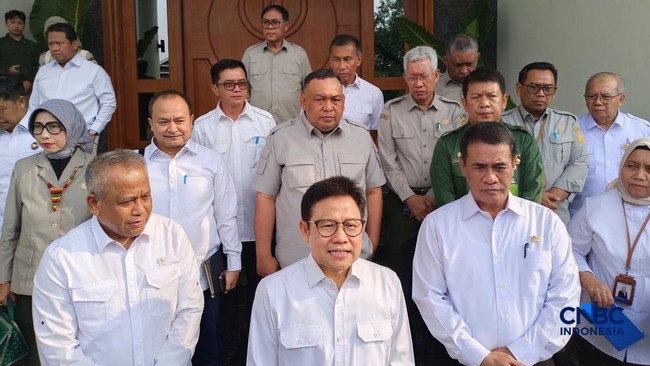
Jakarta, CNBC Indonesia — Coordinating Minister for Community Empowerment Muhaimin Iskandar, popularly known as Cak Imin, is working with Agriculture Minister Amran Sulaiman to accelerate poverty alleviation through economic empowerment in the agricultural sector. The government will map priority areas and identify leading commodities that can be developed to raise the incomes of people living in poverty.
The two ministers’ coordination meeting began at 6 am and ran until about 7.30 am at Amran Sulaiman’s private residence.
Muhaimin said the government wanted to strengthen its poverty-reduction strategy through empowerment, enabling people to improve their living standards and become less reliant on social assistance.
“Based on what we have done over the past two years, there is a new way of working, a new paradigm under President Prabowo Subianto’s leadership: the most effective and appropriate way to tackle poverty is through empowerment,” Muhaimin said after the meeting on Monday (19 October 2026).
He said economic empowerment was expected to help people living in poverty move up the economic ladder, including micro, small and medium-sized enterprises (MSMEs). As their economic independence grows, the number of people needing social assistance should fall.
“What does an empowerment-based approach do? It reduces poverty and the number of people receiving subsidies by helping them move up. Whether people move from poverty into the middle class or MSMEs move up a level, the number of social-assistance recipients will automatically decrease. As the number of recipients falls through empowerment, budget savings will automatically be available for further empowerment,” he said.
The government plans to integrate empowerment programmes from upstream to downstream. The scheme will cover land preparation, planting and commodity management, as well as product processing, packaging and marketing, to ensure production can be absorbed by the market.
Muhaimin said the Ministry of Agriculture had already implemented various area- and commodity-based empowerment ecosystems. However, the government wanted to make programme targets and stages more focused so that communities could benefit sooner.
“Following the progress made over these past two years, the next step is to make implementation more effective and faster, with more concrete targets and stages. We will soon invite the relevant ministers to work together on, first, identifying minimum locations as targets for poverty reduction, and second, selecting commodities and types of programmes,” he said.
He added that the government would not only encourage higher production, but also ensure that products had a market and generated added value for communities.
“From the upstream stages—planting and basic management—through to the outcome, the product must be exported or enter the market. That means packaging and target consumers. This upstream-to-downstream approach demonstrates the success of an empowerment system,” Muhaimin said.
Targeting 88 districts and cities
Muhaimin said the government had identified 88 districts and cities as priority locations for poverty alleviation. They are spread across Indonesia and have been targeted by cross-ministerial interventions.
The government will nevertheless identify the areas most in need of urgent action to serve as pilot projects. Locations will be selected according to poverty levels and the available budget.
“There are actually 88 priority poverty locations—88 districts and cities. But from those 88, we will select the most urgent priorities, in line with the budget we have,” he said.
He said empowerment programmes would continue to cover all 88 districts and cities, while the poorest areas would be prioritised for faster implementation.
“We have continued to work in these 88 locations with all the cross-sectoral ministries. But we want to identify some for rapid piloting among the 88, looking for the areas with the highest poverty,” Muhaimin said.
In the short term, the government will develop economic activities considered capable of growing relatively quickly in the target areas. Examples discussed at the meeting included growing chillies and cassava, as well as developing poultry farming.
Strengthening agricultural downstreaming
Alongside short-term programmes, the government is preparing a long-term strategy centred on downstream processing. Muhaimin cited coconut development, which has produced goods for export markets, as a model that could be replicated elsewhere.
“In the long term, the downstreaming being developed is substantial. Take coconut, for example. The Minister has succeeded in creating a concrete downstream coconut product, from upstream production through to the finished product. It has even been exported,” Muhaimin said.
Amran confirmed that the downstream coconut product had reached export markets.
“Yes, it has been exported,” Amran added.
Muhaimin said this success would serve as an empowerment model that could be expanded to more areas. He said both agricultural downstreaming and industries based on natural resources had significant potential to improve people’s welfare.
“In the long term, this can be replicated and expanded into an empowerment model. There are two kinds of downstreaming: agricultural downstreaming and industrial downstreaming based on natural resources. Both have enormous potential for empowerment,” he said.
On funding, Muhaimin explained that his role as coordinating minister was to coordinate programmes, while budget allocations were managed by individual ministries. The government would therefore strengthen coordination and focus available funding on the most appropriate targets.
“The coordinating minister’s role is only to coordinate. All allocations sit with the ministries. We will arrange, strengthen and focus the budget allocations among them—focus, in effect, on the main targets,” he said.
Source: jawawa.id (https://jawawa.id/newsitem/cak-imin-and-amran-hold-early-morning-meeting-on-indonesias-conditions-the-outcome-1792385448)
Originally published by CNBC Indonesia (https://www.cnbcindonesia.com/news/20261019104917-4-777399/cak-imin-amran-rapat-pagi-pagi-bahas-kondisi-indonesia-ini-hasilnya), translated from Indonesian