
Cable Knots, Governance Knots
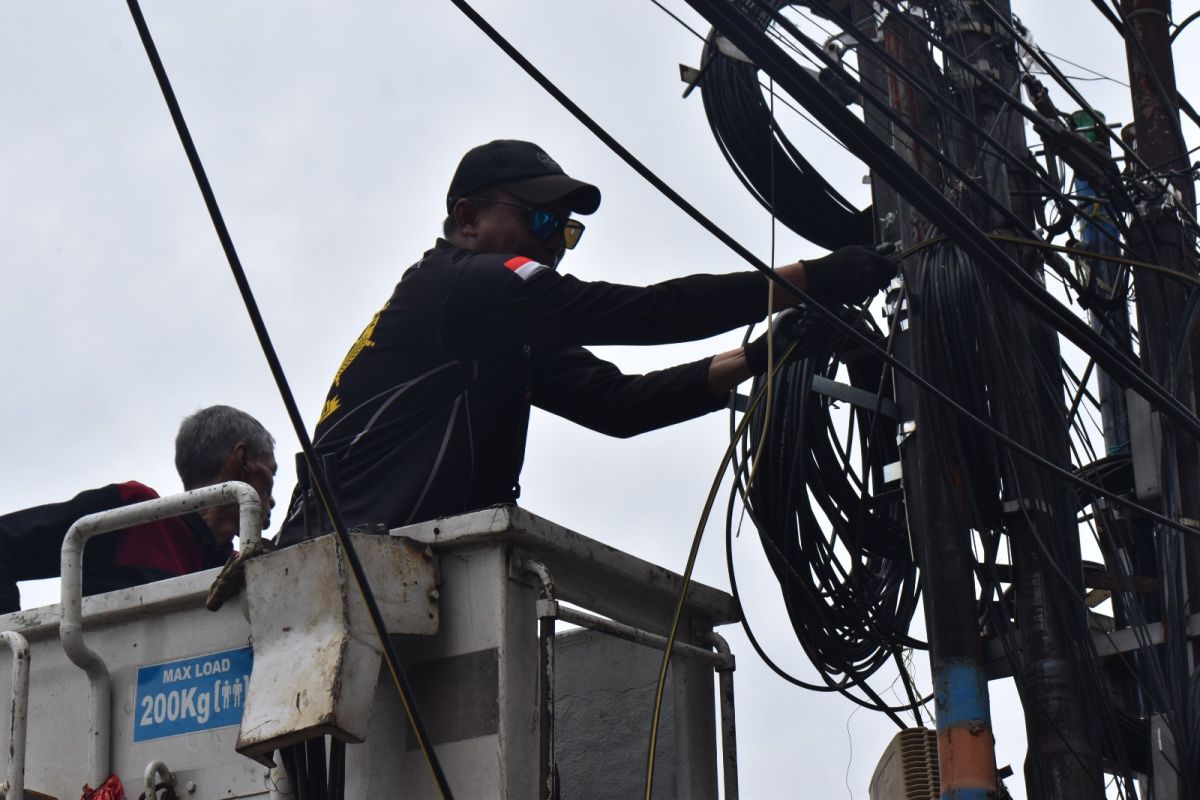
Surabaya (ANTARA) – The skies above Surabaya, East Java, tell a story of progress that is not always orderly. Among buildings, residential areas and roads, communications cables stretch, cross and pile up on poles.
The network connects residents to the internet, supports economic activity and is an important part of urban life. But when installation rules and aesthetics are disregarded, digital progress creates problems in public spaces.
The Surabaya City Government is continuing to bring unauthorised fibre-optic cables into compliance. Installing cables or poles on government-owned land and roads requires the relevant permits.
Enforcement is being carried out by the Surabaya City Communication and Informatics Office alongside other local government agencies, including the Water Resources and Highways Office and the Civil Service Police Unit.
This is no trivial matter. Behind the tangle of cables lie questions of business compliance, use of regional assets, road-user safety and the responsibilities of network providers.
The operation should therefore be understood not merely as an effort to improve the city’s appearance, but also as part of enforcing the governance of urban infrastructure.
The problem of illegal cables in Surabaya is not new. On 8 February 2026, the city government began clearing unauthorised fibre-optic networks while also tidying cables belonging to service providers that had met the requirements.
The initial operation targeted the area from Jalan Dharmawangsa to Jalan Kertajaya, with further enforcement on 10, 11 and 14 February 2026, before being expanded to other roads.
During the operation, the city government continued to find cable networks without permits or which had not met their obligation to pay rental fees for using regional assets.
On 20 February 2026, enforcement targeted 45 fibre-optic poles on Jalan Ngaglik and along the northern and southern sides of Jalan Kapas Krampung.
These findings show that illegal cables are not merely an aesthetic issue. They also concern compliance with rules governing the use of regional assets and the need for ongoing oversight.
Surabaya needs a strong digital network, but that need does not mean public spaces can be used without limits. Roads, pavements and government-owned land are shared spaces that must be used in an orderly manner.
Companies’ right to build networks must go hand in hand with an obligation to respect the public interest.
Fair enforcement
Surabaya City Regulation No. 5 of 2017 on the Provision of Utility Networks provides a framework for controlling the construction and maintenance of utility infrastructure.
The regulation covers telecommunications networks, underground and overhead cables, cable ducts, poles and other supporting facilities. Among its aims is to prevent damage to city infrastructure and threats to safety, comfort, security, public order and aesthetics.
The city government therefore has a legal basis for taking action against installations that breach the rules. But enforcement must be accompanied by clear procedures, accurate records and consistent treatment of all network providers.
Verifying who owns each pole or cable, and issuing warnings in stages before removal, are important parts of the process.
This approach shows that firm action need not come at the expense of legal certainty. Enforcement backed by administrative procedures is more robust than action that produces only a short-term visual change.
Here the government faces a more fundamental challenge. Cable networks may belong to many service providers, while a particular pole or route may be shared.
When ownership is unclear, it becomes harder to determine who is responsible. Disused cables may also be left behind because no party openly claims them.