
C40 Collaboration: Government Buildings Must Achieve Greater Energy Efficiency
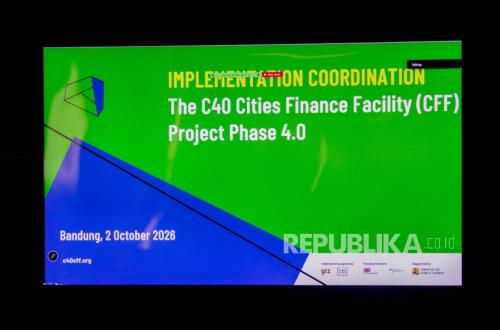
The Bandung City Government is pushing for increased energy efficiency in government buildings as part of an effort to realise more sustainable urban development. This step is being strengthened through a collaboration with the C40 Cities Finance Facility (CFF) Phase 4.0.
This was stated by the Bandung City Regional Secretary, Iskandar Zulkarnain, representing the Mayor of Bandung, Muhammad Farhan, during the Coordination Meeting for the Implementation of C40 CFF Phase 4.0 at the Bandung City Hall Multipurpose Building on Friday, 2 October 2026.
Iskandar noted that the collaboration is part of a joint effort to transform how cities are built and managed, particularly regarding energy efficiency, the implementation of green buildings, and the utilisation of renewable energy.
“Today’s meeting is not merely a coordination meeting, but part of a collective effort to encourage changes in how we build and manage cities, specifically in terms of energy efficiency, green buildings, and the use of renewable energy,” said Iskandar.
He added that buildings play a vital role in urban life. Therefore, energy efficiency is not only about cost savings but is also part of the local government’s responsibility to build cities that are sustainable, efficient, and comfortable for the community.
Iskandar continued that the Bandung City Government welcomes the support of the C40 Cities Finance Facility in its fourth phase. This support is seen as a way to help strengthen planning, increase capacity, and identify measurable steps to promote energy efficiency and renewable energy use.
“We are also prepared to discuss which government buildings can be part of this project, including considering service aspects, technical requirements, and development potential,” he said.
Under this programme, Bandung will also collaborate with Palembang. Iskandar noted that while both cities have different urban characters and challenges, they share the same goal of fostering more efficient, resilient, and sustainable cities.
He also mentioned that the experience of the DKI Jakarta Provincial Government, particularly in implementing energy efficiency and the use of rooftop Solar Photovoltaic (PV) systems, could serve as a learning model for Bandung and Palembang.
Iskandar expressed hope that the coordination meeting would go beyond merely selecting buildings for development, but would instead result in clarity regarding implementation teams, capacity-building needs, timelines, and the commitment of each party.
“We want to utilise technology while still attending to the needs of the community. We want to carry out development today without compromising the environmental quality and the lives of future generations,” he remarked.
Meanwhile, the Director of Building Technical Development and Environmental Sanitation (BTBGPL) of the Directorate General of Cipta Karya at the Ministry of Public Works, Kuswara, stated that the building sector is a major contributor to emissions through energy consumption.
He noted that energy consumption in the building sector accounts for almost one-third of national energy consumption, necessitating systematic attention and management.
“The amount is very large and certainly requires special attention regarding how this can be handled and carefully monitored,” said Kuswara.
Kuswara explained that the government is encouraging the implementation of Green Building (BGH) through passive design, changes in user behaviour, and the use of new and renewable energy as part of efforts to increase energy efficiency and low-carbon development.
The Ministry of Public Works, along with various stakeholders, has also drafted a roadmap for the implementation and supervision of Green Buildings. These efforts are directed towards strengthening the building sector’s contribution to national greenhouse gas emission reduction targets.
Kuswara stated that the projected contribution to greenhouse gas emission reductions from the building sub-sector by 2030 reaches approximately 3 million tonnes of CO2 from government buildings, 14 million tonnes of CO2 from commercial buildings, and 19 million tonnes of CO2 from residential buildings.
He noted that the C40 CFF Phase 4.0 programme serves as an instrument to strengthen the targets and implementation plans for Green Building supervision in Indonesia, at the central government, local government, and private sector levels.
“CFF support includes building energy audits, rooftop solar PV assessments, financial modelling, and other technical support in the aspect of green buildings,” he explained.
He added that the experiences and lessons from DKI Jakarta could serve as a reference for Bandung and Palembang in developing energy efficiency and renewable energy utilisation in government buildings.
Source: jawawa.id (https://jawawa.id/newsitem/c40-collaboration-government-buildings-must-achieve-greater-energy-efficiency-1791013990)
Originally published by Republika (https://rejabar.republika.co.id/berita/tmbm3l430/kolaborasi-c40-gedung-pemerintah-harus-lebih-efisien-energi), translated from Indonesian