
BYD Prepares Battery Investment in Indonesia, Targeting 60 Per Cent Local Content by 2027
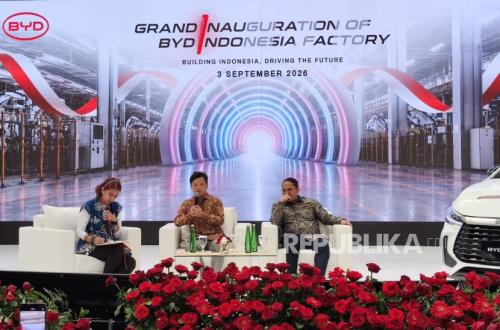
The inauguration of the BYD electric vehicle plant in Subang, West Java, on Thursday (3/9/2026), does not mark the end of the Chinese automaker’s investment in Indonesia. Instead, BYD is preparing further steps to strengthen the national electric vehicle ecosystem, including the development of battery-related manufacturing.
Eagle Zhao, President Director of PT BYD Motor Indonesia, stated that BYD’s investment in Indonesia will not stop at the newly inaugurated vehicle manufacturing facility at the Subang Smartpolitan Industrial Park. According to him, BYD is planning several assembly activities related to battery manufacturing. This move is part of the company’s effort to increase the local content, or Domestic Component Level (TKDN), of vehicles produced in Indonesia.
“Without a comprehensive production process, we cannot say that a product is entirely made in Indonesia. We are also planning to undertake several assembly tasks related to battery manufacturing,” Eagle said during the factory inauguration.
BYD is targeting an increase in TKDN to 60 per cent starting in 2027. Eagle emphasised that the company is optimistic this target can be met alongside ongoing preparations.
“In 2027, we will certainly be the first to stand in support of a TKDN that reaches 60 per cent. With current preparations, we are very optimistic that TKDN fulfilment can be achieved starting from January 2027, reaching 60 per cent,” said Eagle.
In addition to expanding manufacturing investment, BYD is also focusing on the development of local human resources. Eagle noted that the company continues to prepare training and technology transfer programmes for the Indonesian workforce.
Last year, hundreds of Indonesian technicians and engineers were sent to BYD’s research and development (R&D) centre in China to study the company’s latest technologies. “We will continue to do this,” he added.
Currently, more than 5,000 domestic workers have joined BYD. This number is targeted to increase to approximately 20,000 as the company’s activities in Indonesia expand. The development of local talent is also being conducted through cooperation with a school in West Java, where graduates will have the opportunity to undergo training from BYD. Meanwhile, recruitment processes for university graduates are also ongoing.
These steps demonstrate that the presence of the BYD factory in Subang is not solely intended as a vehicle production facility. The factory is also projected to serve as a gateway for developing local workforce competence, technology transfer, and the strengthening of the national electric vehicle ecosystem.
The BYD factory in Subang currently has a production capacity of up to 150,000 vehicles per year. The facility will produce several models, including the BYD Atto 1, M6 EV, and M6 DM. In the future, the plant will also produce vehicles from BYD’s premium brand, Denza.
Through the expansion of vehicle manufacturing, the increase in local content, and plans for battery-related activities, BYD is demonstrating its seriousness in making Indonesia one of the important bases in the company’s growth strategy in Southeast Asia.
Source: jawawa.id (https://jawawa.id/newsitem/byd-prepares-battery-investment-in-indonesia-targeting-60-per-cent-local-content-by-2027-1788440473)
Originally published by Republika (https://ekonomi.republika.co.id/berita/tksfw3348/byd-siapkan-investasi-baterai-di-indonesia-targetkan-tkdn-60-persen-pada-2027), translated from Indonesian