
BYD Pledges to Use Up to 60 Per Cent Local Components Starting January 2027
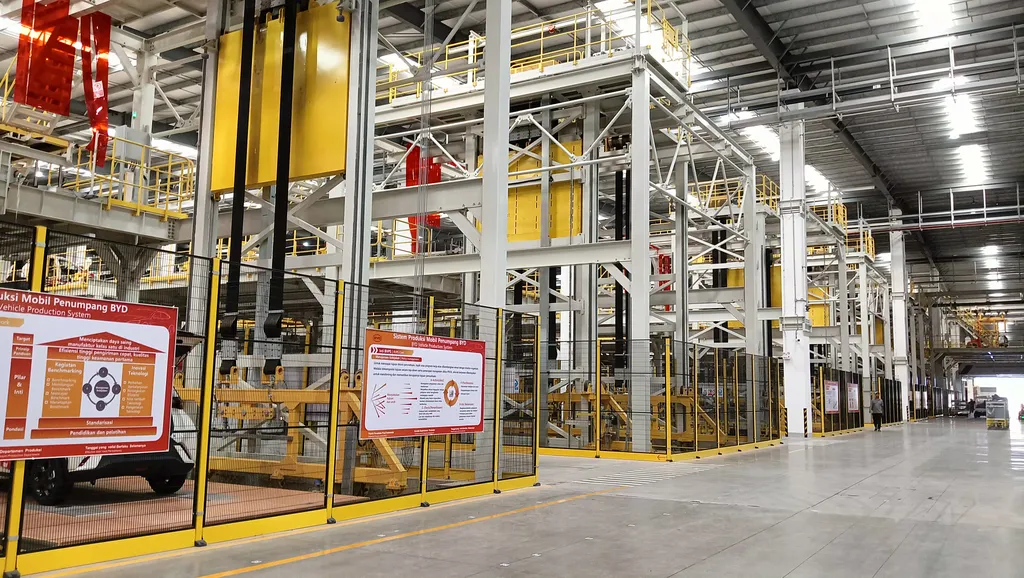
BYD has pledged to use up to 60 per cent local components in its electric vehicle production in Indonesia starting from January 2027. The Chinese electric vehicle manufacturer also promised to engage domestic enterprises as part of its supply chain.
“2027 is approaching rapidly. With our current preparations, we are very optimistic that the 60 per cent local content requirement (TKDN) can be realised starting January 2027,” said Eagle Zhao, President Director of PT BYD Motor Indonesia, during a speech at the inauguration of the BYD assembly plant in Subang Regency, West Java, on Thursday (3/9/2026).
Currently, more than 5,000 technicians are working with BYD, a figure that is targeted to increase to approximately 20,000 technicians.
Present at the event were the Chairman of the National Economic Council, Luhut Binsar Pandjaitan, the Minister of Industry, Agus Gumiwang Kartasasmita, and the Governor of West Java, Dedi Mulyadi.
Zhao explained that BYD continues to explore collaborations to expand the use of components and production activities within the country. In addition to increasing local content, the company plans to continue expanding its investment in Indonesia.
He promised that BYD would expand the electric vehicle ecosystem through cooperation with various local partners. The deepening of the electric vehicle industry will be accompanied by human resource development.
According to Zhao, BYD has sent local technicians and engineers to its headquarters to receive training on BYD’s electric vehicle technology. The company pledged to continue increasing the capacity of the local workforce to ensure they can master and develop the technologies used in the manufacturing process.
BYD is also collaborating with a school in West Java to prepare graduates for training at BYD. Recruitment from universities is also ongoing.
Luhut Binsar Pandjaitan stated that BYD’s presence in Indonesia is a significant momentum because the company can connect with the battery industry ecosystem established through the mineral downstreaming programme.
“This is indeed an important momentum for BYD because they are building an ecosystem. It began with our nickel downstreaming to build the ecosystem. So, the battery has precursors, cathodes, and everything,” said Luhut during the inauguration of the BYD factory in Subang.
According to him, the development of the electric vehicle industry must be carried out in an integrated manner, ranging from raw material processing and the production of components and batteries to vehicle assembly. Consequently, Indonesia will not only serve as a marketing location for electric vehicles but also as a production base with greater added value.
Luhut assessed that BYD possesses advanced electric vehicle technology and has developed into one of the strong electric vehicle brands in the Indonesian market. BYD is also opening opportunities for cooperation with Indonesian companies through joint venture schemes. Such cooperation is expected to expand the involvement of the national industry in the electric vehicle supply chain.
Luhut cited the development of commercial vehicles, including buses and trucks, as an area that could expand the electric vehicle production base in Indonesia. This development, according to him, must be directed so that more components and production processes originate from within the country.
Luhut continued that Indonesia does not wish to return to the position of being merely a market for foreign industrial products. Large investments in the automotive sector must create new surrounding industries to provide a broader economic impact.
“We are not just a market. We do not want that; we must be part of that ecosystem,” he said.
The government is also encouraging an increase in local content while considering investor interests. According to Luhut, industrial policy should not merely impose obligations on companies but must create benefits for both parties.
BYD’s investment in Subang, covering an area of 126 hectares, has created more than 5,000 jobs. Therefore, Luhut requested that both local and central governments maintain a business-friendly climate so that companies can continue to grow and expand.
Luhut also encouraged the development of the electric vehicle battery recycling industry. He noted that battery recycling capability will be a vital part of the electric vehicle ecosystem, as it allows valuable materials, including nickel and lithium, to be reused.
BYD’s technology currently allows for the recovery of materials from used batteries at a very high level. “Battery recycling is important so that the nickel we have can be extracted again from the cars or batteries from the cars here,” he said.
Thus, according to Luhut, the construction of the BYD factory in Subang should not merely be viewed as an automotive investment. The facility is expected to become one of the nodes in the development of a new industrial ecosystem based on electric vehicles.
“I see the BYD factory not just as an automotive investment. This is part of the development of a new industrial ecosystem,” he said.
Meanwhile, Minister of Industry Agus Gumiwang Kartasasmita stated that electric vehicles in Indonesia are currently experiencing positive development, as seen in the data for the first half of 2026.