
BYAN Drags IHSG Down 1% in Morning Trade
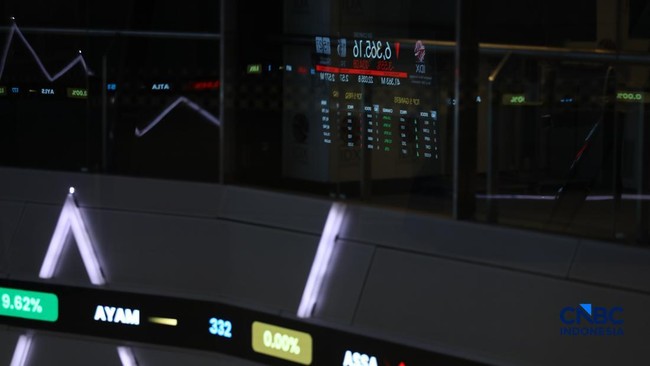
The Jakarta Composite Index (IHSG) came under immediate pressure at the start of trading on Wednesday (19/8/2026), falling more than 1%. The decline came after shares of PT Bayan Resources Tbk (BYAN) slumped as much as 14%.
According to data from the Indonesia Stock Exchange (IDX), the IHSG was down 65.61 points, or 1.02%, at 6,384.22 as of 09:03 WIB. The index opened at 6,408.18 and touched an intraday high of 6,414.89 and a low of 6,380.17.
One of the main drags on the index was BYAN, which tumbled 14.04% to Rp14,850. This came after the coal producer’s shares had soared 19.97% to Rp17,275 on Tuesday (18/8/2026), making it one of the main drivers of the IHSG’s gains.
The correction in BYAN followed the company’s clarification regarding rumours of a plan to acquire approximately 62.2% of its shares by businessman Andi Syamsuddin Arsyad, also known as Haji Isam. BYAN’s management stated that it was not aware of any takeover or acquisition transaction plan.
Pressure was also visible across the broader market. As of 09:03 WIB, 293 stocks were declining, while 154 stocks were advancing and 516 others were unchanged.
Transaction value reached Rp683.1 billion, with trading volume of 1.82 billion shares and a frequency of 129,500 transactions.
The IHSG is expected to move in a volatile manner on Wednesday (19/8/2026). Investors tend to be in a wait-and-see mode ahead of Bank Indonesia’s interest rate decision, while also monitoring geopolitical developments and the policy direction of the US central bank.
Domestically, the main focus is on the outcome of Bank Indonesia’s Board of Governors Meeting held on Tuesday-Wednesday (18-19 August 2026). BI is scheduled to announce its monetary policy decision today.
A CNBC Indonesia poll of 14 institutions showed that all respondents expect BI to hold its benchmark interest rate, the BI Rate, at 5.75%.
If realised, BI will have kept interest rates unchanged for two consecutive meetings after previously holding the BI Rate at 5.75% in July 2026.
Investors will also be watching BI’s views on domestic economic conditions, banking liquidity, and credit growth prospects through the end of the year.
The rupiah’s movement is one of the main factors behind market expectations that BI will not raise interest rates again. The rupiah has moved away from the psychological level of Rp18,000 per US dollar and is trading around Rp17,800/US$ ahead of the August meeting.
Domestically, investors are also monitoring Indonesia’s external debt data. Bank Indonesia recorded external debt at US$453.4 billion, or approximately Rp8,095.5 trillion, in the second quarter of 2026, growing 4.4% year-on-year.
Of that amount, approximately US$105.9 billion, or Rp1,891.7 trillion, will mature within a maximum of one year.
Nevertheless, BI considers Indonesia’s external debt structure to remain healthy. The external debt-to-GDP ratio stands at 30.6%, while approximately 82.1% of total external debt is long-term.
Meanwhile, external sentiment remains overshadowed by tensions in the Middle East. US President Donald Trump’s statement that the Strait of Hormuz is open for shipping contradicts Iran’s assertion that the strategic waterway remains closed.
Uncertainty surrounding US-Iran negotiations has pushed oil prices higher again. West Texas Intermediate (WTI) crude futures rose 0.4% on Tuesday to US$85.26 per barrel, while Brent gained 0.17% to US$91.02 per barrel.
Brent has risen 4.53% over the past three trading days, while WTI is up 3.5% over the past four days.
Shipping disruptions in the Strait of Hormuz are also continuing. The United Kingdom Maritime Trade Operations (UKMTO) reported that a vessel was struck by an unknown projectile while exiting the Strait of Hormuz. The incident damaged the engine room and resulted in one crew member becoming a casualty.