
Butet Kartaredjasa Presents Punakawan Glass Painting to Pope Leo XIV at Vatican
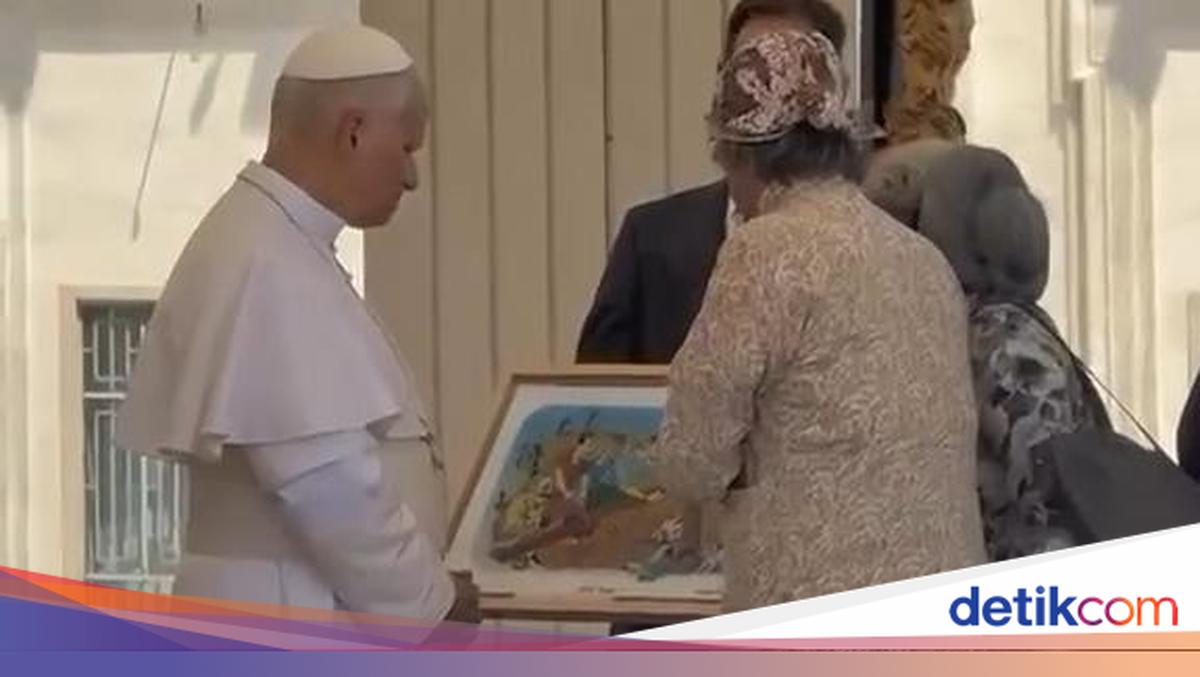
Cultural figure Butet Kartaredjasa met with and presented a glass painting titled ‘Jalan Salib Punakawan’ (Punakawan Stations of the Cross) to Pope Leo XIV at the Vatican. Butet revealed that the Pope was very pleased that someone had interpreted the Stations of the Cross using local Javanese characters.
Butet recounted that he was able to meet the Pope on Wednesday (17/6), a meeting he attributed to the role of the Indonesian Embassy to the Holy See. ‘Because the protocol was complicated, it was truly the result of lobbying and struggle so that we could get through and be received to shake hands with the Pope. Without that struggle, it would not have been possible,’ he said when contacted by journalists on Friday (19/6/2026).
Butet attended the meeting with his wife, Rulyani Isfihana, often called Bu Ageng. Both wore traditional Javanese attire during the meeting with the Pope. ‘The essence of the meeting was to embody pluralism, cross-faith, and cross-cultural dialogue. I am a nominal Christian, Bu Ageng is a Hajah. And the Stations of the Cross is a Catholic tradition,’ he stated.
Butet brought a glass painting that narrates the Stations of the Cross using the visual idiom of the Punakawan. The artwork consists of 14 frames, but during the handover, Butet only brought one, as the rest were already inside the Vatican. ‘It is interpreted in a Javanese way using the glass painting method. That is a cultural interpretation, so it is cross-cultural, and the Pope was happy that a Javanese person had such an initiative,’ he said.
Butet explained that he created the painting at the end of 2024 as an expression of gratitude after recovering from an illness. ‘It took a few weeks at the end of 2024. It was after I was sick. I felt I had been given a miracle by recovering,’ he said. ‘I, whose religion is unclear, wanted to manifest something. It turned out I received a spiritual task. This is more about a spiritual process for myself,’ Butet continued.
Regarding the idea of using the Punakawan wayang characters in the painting, Butet believes that Punakawan are an integral part of Javanese tradition. Javanese people often display Punakawan paintings with Javanese philosophies on their walls, such as ‘ojo dumeh’ (do not be arrogant) and ‘melik nggendong lali’ (greed makes one forget). ‘So, the characters used are the Punakawan. These characters are very close to the community. I see the Stations of the Cross as a socialisation of values,’ he said.
Consequently, as a socialisation of values, Butet interpreted the Stations of the Cross through the lens of the Punakawan. ‘I imagined, why not use the Punakawan idiom that exists in Javanese tradition to socialise these values? So I interpreted and created it, so that the socialisation of religiosity, the spiritualism about the humanitarian struggle of Jesus, could be recorded in the painting,’ he explained.
Regarding Pope Leo’s response to the gifted painting, Butet revealed that the Pope was very happy. ‘Oh, he was very happy. He was very happy that someone from far away, from the East, interpreted it using local characters, a very local Javanese version,’ he said. Butet added that the Pope was also pleased when he introduced himself as being from Java, Indonesia. ‘I said from Java, Indonesia, and he was happy,’ he stated. Butet also expressed hope that his glass painting could be displayed in St. Peter’s Basilica. ‘Yes, hopefully it can be hung on the wall of the Basilica,’ he said.