
Businesses Urge Government to Reopen Nickel, Tin Exports Amid Rare Earth Regulatory Uncertainty
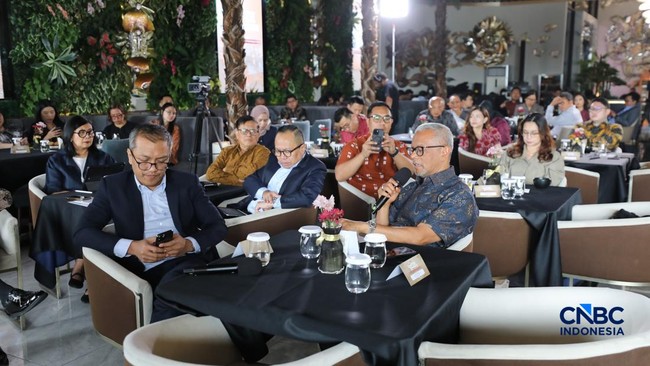
Jakarta, CNBC Indonesia - Mining industry players are urging the government to immediately reopen exports of mineral products that have been held up due to inspections for rare earth element (REE) content. They argue that the absence of regulatory certainty regarding REEs as associated minerals has hampered exports and caused losses for the industry.
Chairman of the Indonesian Bauxite Association (ABI) Ronald Sulistyanto stated that the issue of REE presence has long been known, but clear governance on handling these elements is still lacking. ‘This is a problem we have known about for quite some time, that REEs exist. But how to manifest that existence into something requires regulation. Let us return to the fundamentals. If it is mining, it falls under the Ministry of Energy and Mineral Resources. Do not go elsewhere,’ he said during a CNBC Indonesia event on Thursday.
He emphasised that for commodities like bauxite, REEs are generally associated minerals, not the primary product. Therefore, their regulation should be distinct from that of the main commodity. Ronald explained that the REE content in processed bauxite products is very small after washing, grading, sizing, and refining into alumina.
Meanwhile, Chairman of the Indonesian Nickel Industry Forum (FINI) Arif Perdanakusumah said the REE issue has become a major concern for businesses due to a regulatory vacuum governing limits and management. ‘We see the REE issue being discussed very intensively by business actors recently. This is part of governance, but there is still little regulated, causing confusion,’ he said.
He revealed that the nickel industry is currently facing layered pressures, from geopolitical impacts in the Middle East triggering spikes in energy and logistics costs, to domestic issues such as rising royalty tariffs, limited ore supply due to work plans and budgets (RKAB), and REE-related policies. Arif noted that around 80% of Indonesia’s sulphur needs in 2025 will come from the Middle East. As sulphur prices soared from around US$220 per ton to US$1,200 per ton, nickel production costs surged sharply.
‘In 2025, approximately 6 million tons of sulphur will be imported, mostly needed by the nickel industry. So besides scarcity, the price has risen tremendously. The price was US$220 per ton in 2025, recently it was US$1,200 per ton and has already consumed 50%,’ he said. The REE policy has also disrupted export activities, with recent data showing around 120 ships unable to sail as they could not leave port. ‘This certainly causes losses, not only for business actors but also for the government,’ he added.
Executive Director of the Indonesia Mining Association (IMA) Sari Esayanti assessed that the problem is not merely an export issue, but reflects challenges in the identification, testing, and regulation systems for associated minerals naturally occurring in various mining commodities. She said mining activities have historically focused on the primary commodity according to business licenses and each company’s processing facility design. For commodities like tin, bauxite, nickel, and copper, REEs are generally just associated minerals with very small grades. With such low grades, most companies do not yet have adequate facilities or technology to identify, separate, or utilise these REEs economically. ‘This condition, along with new interpretations regarding reporting or export obligations, creates uncertainty for businesses. What businesses actually need is a return to certainty regarding technical parameters, testing methodologies, and reporting mechanisms, so that all business actors have the same standard,’ she said.
Source: jawawa.id (https://jawawa.id/newsitem/businesses-urge-government-to-reopen-nickel-tin-exports-amid-rare-earth-regulatory-uncertainty-1785397906)
Originally published by CNBC Indonesia (https://www.cnbcindonesia.com/news/20260730125534-4-755077/ramai-ramai-pengusaha-minta-pemerintah-buka-ekspor-nikel-timah-cs), translated from Indonesian