
Business Sector Urged to Accelerate Adoption of Sustainable Business Practices
The adoption of sustainable business practices requires collaboration between government, the business sector, academia, and society to have a broader impact on economic development, a forum in Jakarta heard. Cross-sector synergy is also considered essential to accelerate the achievement of the Sustainable Development Goals (SDGs).
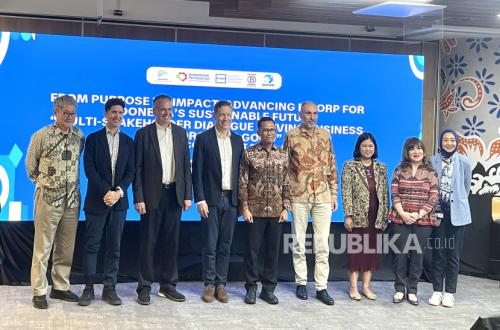
This issue was the focus of the Asia B Corp Summit 2026 site visit, themed ‘From Purpose to Impact: Advancing B Corp for Indonesia’s Sustainable Future’, organised by Danone Indonesia together with B Lab and B Market Builder (BMB) South East Asia. The forum, held on Thursday (25/6/2026), brought together government representatives, business players, academics, and organisations to discuss strengthening business practices that consider economic, social, environmental, and governance aspects.
The event was attended by representatives from the Ministry of National Development Planning/Bappenas, the Ministry of Industry, the Indonesian Employers’ Association (APINDO), academics, and B Lab executives.
Pungkas Bahjuri Ali, Head of the National SDGs Secretariat and Deputy for Sustainable Development at the Ministry of PPN/Bappenas, stated that the SDGs have become the direction for national development through the Long-Term Development Plan (RPJPN), the Medium-Term Development Plan (RPJMN), the Asta Cita missions, and the Golden Indonesia 2045 vision. He noted that achieving these goals requires collaboration between government, businesses, philanthropy, academia, civil society, and the media to create economic value while improving quality of life, the environment, and governance. “The success of the SDGs is not only determined by how many initiatives we run, but by how strongly we change the way development works,” Pungkas said.
Professor Christopher Marquis from the University of Cambridge assessed that B Corp offers a different approach to driving economic system change. According to him, this approach not only provides standards for measuring company impact but also builds a collaborative network among members. “B Corp offers a truly different perspective on our entire economic system. B Corp also builds a community where companies connect, learn, and grow together,” he said.
B Lab Board Member and Co-Founder Bart Houlahan said that B Corp certification is not an end goal, but a starting point for companies to continuously improve responsible business practices. He noted that various global challenges, such as climate change and social inequality, require cross-company collaboration. “The challenges we face cannot be solved by one company alone. Therefore, the B Corp movement encourages companies to learn from each other, collaborate, and continuously raise the standards of responsible business practices,” Bart said.
APINDO Chairperson Shinta W. Kamdani stated that sustainability has become a factor influencing corporate competitiveness. She said cross-stakeholder collaboration is needed to accelerate the implementation of responsible business practices while driving economic growth. “Sustainability is no longer just a commitment, but has become a business strategy that determines a company’s competitiveness,” Shinta said.
During the forum, Danone Indonesia explained the implementation of its sustainability strategy through the Danone Impact Journey, which focuses on health, environmental conservation, and community empowerment. The programme is implemented through the provision of nutritious products, water resource conservation, catchment area rehabilitation, circular economy development through the #BijakBerplastik movement, and the empowerment of farmers, MSMEs, waste banks, and communities around the company’s operational areas. The company also noted that it has obtained B Corp certification for all its business lines since 2018, with a B Impact Score of 98.6, exceeding the minimum certification threshold of 80 points.
Danone Indonesia CEO Laurent Boissier said that B Corp certification serves as a reminder for the company to continuously improve sustainability standards through every business decision. “We believe sustainability challenges cannot be solved alone. Therefore, we hope cross-sector collaboration can encourage more companies to make business a force for positive change in Indonesia,” Laurent said.
Through the forum, the organisers hope that collaboration between government, the business sector, academia, and society can strengthen the transformation towards a more inclusive, resilient, and sustainable economic system to support the achievement of Indonesia’s SDG targets.
Source: jawawa.id (https://jawawa.id/newsitem/business-sector-urged-to-accelerate-adoption-of-sustainable-business-practices-1782737548)
Originally published by Republika (https://esgnow.republika.co.id/berita/the7ls416/dunia-usaha-didorong-percepat-adopsi-praktik-bisnis-berkelanjutan), translated from Indonesian