
Business Legality and Halal Certification Become Capital for MSMEs to Expand Markets
Business legality and halal certification are increasingly becoming necessities for micro, small, and medium enterprises (MSMEs) to expand market access, boost consumer trust, and open up partnership and financing opportunities. However, many MSMEs at the village level still lack these documents due to limited information and assistance.
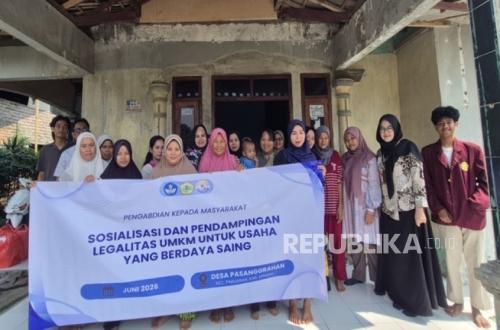
Responding to this situation, a Community Service team from Universitas Sultan Ageng Tirtayasa (Untirta) held a workshop on business legality and halal certification for MSMEs and Women Farmers’ Groups (KWT) in Pasanggrahan Village, Pabuaran District, Serang Regency, Banten.
Vega Yoesepa Pamela, the head of the Untirta team, stated that many MSMEs have produced innovative products but are not supported by adequate business legality. “Increasing knowledge about legality is a strategic first step to enhance consumer trust, expand access to financing and partnerships, and prepare MSMEs to compete and grow sustainably,” she said.
During the activity, participants received guidance on obtaining a Business Identification Number (NIB), Halal Certificate, and Home Industry Food Production Permit (PIRT). Vega explained that these documents serve as a crucial foundation for MSMEs to strengthen their competitiveness and meet the requirements to enter wider markets.
She noted that a lack of knowledge regarding licensing procedures is one reason business owners delay obtaining legal documentation. Therefore, universities have a role to play in providing assistance to the community.
Participants showed high enthusiasm during the discussion sessions, particularly regarding technical obstacles in document processing. Evaluations indicated a significant improvement in participants’ understanding, with average scores rising from 45.3 percent before the training to 93 percent afterwards.
One participant, Sunaiah, said the training provided insight into the benefits of legality for business development. “This activity was very beneficial for us. Now I understand better why business legality is important and what the benefits are for the growth of the business we run. The material was also delivered very clearly,” she said.
The programme is part of a Community Service grant from the Directorate of Research and Community Service (DPPM) of the Ministry of Higher Education, Science, and Technology for the 2026 funding year. Through this assistance, Untirta hopes that more MSMEs will obtain business legality and halal certification, thereby enhancing their competitiveness and expanding access to formal markets.