
Business Community Partners with Academics to Strengthen Scientific Foundation for Forest Management
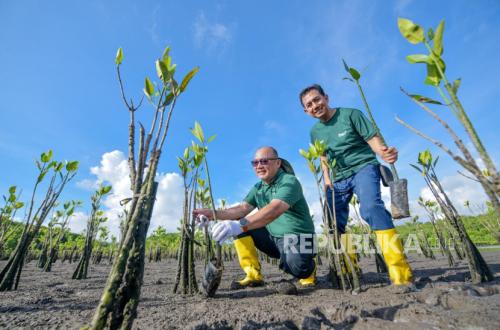
REPUBLIKA.CO.ID, JAMBI — The Indonesian Forest Business Association (APHI) is partnering with Jambi University to strengthen the scientific foundation for sustainable forest management. This collaboration is aimed at promoting applied research, enhancing human resource capacity, and accelerating the implementation of priority forestry programmes.
The partnership was highlighted during APHI’s visit to Jambi University campus on Friday (16/4/2026). The synergy between the business world and higher education is focused on developing landscape-based Multi-Forest Business (MUK) and strengthening the prevention and control of forest and land fires (karhutla).
APHI General Chairman Soewarso stated that the involvement of academics is key to strengthening the scientific basis of forestry planning. “We encourage active involvement of universities in developing landscape-based MUK, both through research, technological innovation, and the formulation of sustainable business models,” he said, as quoted on Saturday (18/4/2026).
He explained that a scientific approach is needed to address increasingly complex ecological and economic challenges. The integration of scientific knowledge with industrial practices is seen as capable of accelerating the transformation of more adaptive and measurable forest management.
Soewarso also highlighted the importance of long-term improvement strategies in handling the presence of palm oil in forest areas. This approach opens up space for gradual restructuring of governance to ensure that legality, productivity, and environmental sustainability run in harmony.
He assessed that this strategy does not stop at regulatory compliance but also aims at increasing long-term business value addition. This effort is part of strengthening sustainable-oriented forestry governance.
In the context of karhutla, APHI is strengthening its commitment to cross-sectoral collaborative mitigation. Synergy between government, business, community, and higher education is seen as crucial to reducing fire risks, especially in peat areas.
“Karhutla prevention must be a shared priority by prioritising early efforts, human resource capacity building, and the use of technology for detection and rapid response,” said Soewarso.
Dean of the Faculty of Agriculture at Jambi University, Bambang Irawan, assessed that MUK development needs to be integrated with a long-term improvement approach. This integration allows for gradual area restructuring while maintaining a balance between production, conservation, and legal certainty.
“Integrating MUK with long-term improvement is a strategic step to ensure productive yet sustainable forest management,” he said.
He explained that a landscape-based approach is also important in addressing food land limitation challenges. Integrating forestry and agriculture opens opportunities for space optimisation without sacrificing ecological functions.
Bambang added that this approach enables the creation of a balance between food production, environmental protection, and improving the welfare of communities around forest areas. This model is seen as relevant for strengthening forest-based food security.
From an educational perspective, the Forestry Department at Jambi University is strengthening capacity through the development of a Silviculture Study Programme connected to industry needs. Collaboration with business actors is aimed at strengthening the linkage between education and the working world.
“Strengthening practice-based and industry-needs curriculum is key to producing competent forestry human resources ready to enter the field,” said Bambang.
He also highlighted the strategic role of Jambi University as part of forestry development stakeholders in the region. The existence of the Joint Secretariat for Forest Resource Management serves as an initial asset to strengthen the implementation of landscape-based MUK.
Multi-stakeholder collaboration through that forum is seen as able to strengthen forest management coordination and karhutla control. The established synergy is expected to strengthen the scientific foundation while accelerating sustainable forestry transformation at the regional level.