
Burdened by Numerous Regulations, Tobacco Farmers Hold Mass Prayer
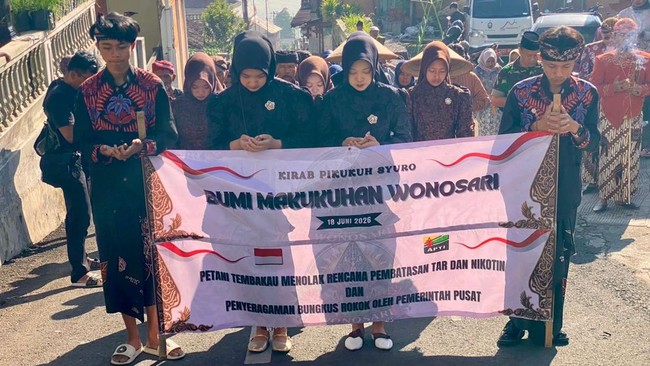
Rejection of the planned regulation on maximum tar and nicotine limits, as well as the standardised cigarette packaging policy in the derivative rules of Government Regulation (PP) Number 28 of 2024 on Health, continues to be voiced by tobacco farmers. This time, their aspirations were conveyed through a spiritual endeavour by holding a mass prayer as part of the Khoul Ki Ageng Makukuhan and Kirab Pikukuh Syuro tradition in Wonosari Village, Bulu District, Temanggung Regency, on Thursday (18/6). Hundreds of residents participating in the procession unfurled banners expressing their rejection of the policy before proceeding with the mass prayer at the Ki Ageng Makukuhan Cemetery area. The annual tradition was used as a momentum to plead for the government to reconsider regulations deemed to threaten the economic sustainability of the tobacco community. Wonosari Village Head, who is also the General Chairman of the Indonesian Tobacco Farmers Association (APTI), Agus Parmuji, stated that the mass prayer was a form of last resort after various channels of conveying aspirations had been undertaken by farmers, ranging from hearings with ministries to dialogues with various stakeholders. “We hope the government cancels the derivative rules of PP 28/2024 on Health because it will have a negative impact on the tobacco sector and its derivatives,” he said, as quoted on Tuesday (23/6/2026). According to Agus, farmers hope policymakers will prioritise the interests of the people whose livelihoods depend on the tobacco sector. He assessed that the regulations being drafted have the potential to ignore the characteristics of local Indonesian tobacco, especially Temanggung tobacco, which is known to have relatively high natural tar and nicotine content. As an organisation that accommodates tobacco farmers across various regions, APTI views that these restrictions could hit the tobacco economic chain from upstream to downstream. The impact would not only be felt by farmers but also by farm labourers, processing businesses, and the tobacco industry, which is the main absorber of harvests. Agus added that the plan to standardise cigarette packaging would also worsen the condition of the tobacco industry. According to him, this policy could eliminate product identity, weaken the competitiveness of the legal industry, and simultaneously open up space for the increasingly rampant circulation of illegal cigarettes. “The tobacco products will certainly have a social impact on farmers and workers. When plain packaging is enforced, it will effectively kill the right to production creativity and will also make it easier for illegal cigarettes to run rampant. It will certainly further slow down the absorption of harvests,” he said. He emphasised that for farmers in Temanggung and other tobacco-producing regions, the commodity remains the main source of livelihood, especially during the dry season when alternative crop choices are very limited. Therefore, any policy that has the potential to reduce demand for tobacco is considered to have a direct impact on farmers’ welfare. Agus hopes the government will open a wider space for dialogue with all stakeholders before finalising the derivative regulations of PP 28/2024. According to him, policies affecting millions of people in the tobacco sector should be formulated more comprehensively by considering health, economic, social, and sustainability aspects of farmers’ livelihoods. “If the aspirations of the community, especially farmers, have not yet received a response, perhaps prayer can be our bridge to God, so as to make the government aware in formulating tobacco regulations,” he said. Khoul Ki Ageng and Kirab Pikukuh Syuro is an annual tradition of the Wonosari Village community to welcome the Islamic New Year. The procession begins with a parade carrying lurup or cloth to cover the tomb, a mountain of agricultural produce, and a tumpeng robyong towards the Ki Ageng Makukuhan Tomb complex. Ki Ageng Makukuhan is known as a figure who spread Islam in the Kedu region and also taught the values of economic independence based on agriculture to the community. After the procession, residents carry out the cleansing of village heirlooms, replacement of the tomb cover cloth, mass prayer, and conclude with kembul bujono or communal eating as a symbol of gratitude. “Entering this Islamic New Year, we hope that all residents will always receive an abundance of blessings and prosperity,” Agus concluded. Previously, Temanggung Regent Agus Setyawan conveyed aspirations to Central Java Governor Ahmad Luthfi regarding the derivative rules of PP 28/2024. According to him, the policy has the potential to affect the economic sustainability of tobacco farming in the region. The regulations under scrutiny include the plan to limit maximum tar content to 10 mg and nicotine to 1.0 mg, which is currently being discussed by the Coordinating Ministry for Human Development and Cultural Affairs (Kemenko PMK). In addition, the government is also drafting a Minister of Health Regulation (RPMK) that regulates the standardisation of plain cigarette packaging without branding, with the final discussion scheduled for mid-June. Agus assessed that both policies have the potential to put pressure on the tobacco sector, both from the industry side and farmers’ welfare. He said similar concerns are not only felt by farmers in Temanggung Regency but also in 17 other tobacco-producing regions in Central Java. “If this continues, farmers will face the threat of problems with the absorption of tobacco products by the industry. Because local tobacco products in a number of Central Java’s producing regions have nicotine and tar levels higher than the maximum limits stipulated in the PP. Therefore, we ask for your direction, Governor,” he said during the Central Java Development Discussion Agenda for 2026 at the Pengayoman Pendopo of Temanggung Regency, Wednesday (3/6/2026). He further explained that tobacco remains a commodity.