
Bumitama and First Resources Deny Greenpeace Report on Forest and Land Fires
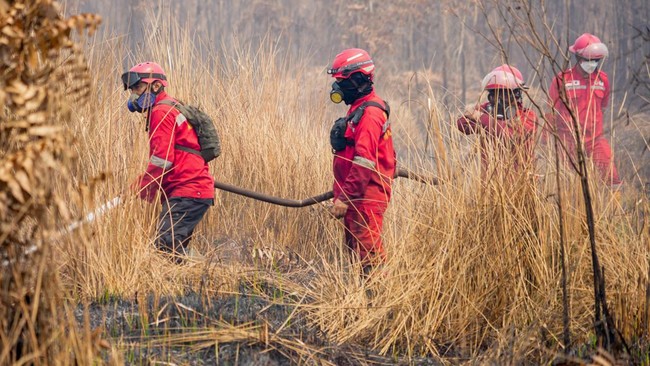
Two Singapore-listed palm oil companies, Bumitama Agri and First Resources, have been linked to plantation areas in Indonesia where fires were detected. The findings were included in an investigative report published by Greenpeace on 5 October 2026.
Greenpeace also highlighted First Borneo Plantations, a privately held company with ownership links to several Singapore-incorporated entities.
The Straits Times reported that Greenpeace’s report identified plantation concessions linked to the three companies as locations where hotspots and smoke were detected between August and September 2026.
First Resources and Bumitama Agri have denied that their operations were the source of the fires under scrutiny.
Speaking to The Straits Times on 15 October 2026, First Resources said that hotspot detections and satellite observations within or around plantation concessions did not prove the origin of a fire, who was responsible, or that fire had been deliberately used to clear land.
The company said such conclusions required detailed field investigations and an assessment of conditions around each fire. This included establishing when and where a hotspot was first detected and how the fire subsequently spread.
“The presence of hotspots within a concession should not, in itself, be interpreted as an indication that the concession holder caused, started or allowed a fire to occur,” the company said, according to a statement quoted on 18 October 2026.
First Resources said it had detected hotspots near its plantation concessions in West Kalimantan. However, after verification, many were found to be outside the company’s operating boundaries.
The company said its plantations faced varying levels of fire risk. Areas near concession boundaries, community-owned land and unmanaged areas were considered more vulnerable to fires.
First Resources added that its firefighting teams had been on standby along concession boundaries since hotspots were first detected nearby. The teams provided support for firefighting efforts where possible and co-ordinated with neighbouring companies when necessary.
Greenpeace’s report identified the concession operated by Kayung Agro Lestari, a palm oil plantation manager in West Kalimantan, as one of the areas where fires and smoke were detected.
The company is a subsidiary of Indonesian palm oil producer Austindo Nusantara Jaya (ANJ), which First Resources acquired in May 2025.
First Resources initially acquired 91.17 per cent of ANJ for about US$330 million, equivalent to S$422 million. Its stake was increased to 95.92 per cent later that year.
ANJ owns 99.99 per cent of Kayung Agro Lestari, which manages a 13,878-hectare plantation in Ketapang, West Kalimantan.
First Resources, which had a market capitalisation of S$6.42 billion as at 15 October, is majority-owned by members of Indonesia’s Fangiono family. Ciliandra Fangiono is the company’s chief executive, while his brother, Fang Zhixiang, is deputy chief executive.
Bumitama Agri
Greenpeace’s report also identified Damai Agro Sejahtera, an Indonesian plantation company affiliated with Singapore-listed Bumitama Agri, as a concession holder in an area where fires and smoke were detected.
Bumitama Agri, which is listed on the Singapore Exchange’s Mainboard and had a market capitalisation of about S$3.25 billion as at 15 October, is affiliated with Indonesia’s Harita Group, a conglomerate with interests in mining and palm oil.
The company is controlled by the Lim family. Lim Gunawan Hariyanto is executive chairman and chief executive.
On 16 October, Bumitama Agri said fires spreading from surrounding land had damaged some areas within or bordering its licensed areas, particularly community-managed areas and land that had not yet been planted.
In a disclosure issued on the evening of 16 October and signed by Lim Gunawan Hariyanto, the company said that hotspot detections within concession boundaries could not, by themselves, establish where a fire had started or who was responsible for igniting it.
“Based on field observations and the information currently available, some incidents appear to have originated outside areas directly managed by the Group before spreading to the surrounding landscape,” the company said.
Bumitama Agri added that it had deployed substantial resources to control and extinguish the fires.
The company, which had earlier requested a temporary halt to trading in its shares on the Singapore Exchange on 16 October, also pointed to the current extreme dry-season conditions. These had left vegetation and peatland highly flammable, while water supplies could fall sharply.
Bumitama Agri said it strictly enforced a zero-burning policy. It monitored fire risks through a range of measures, including satellite hotspot tracking, drones equipped with thermal-imaging cameras and smart weather stations.
“Based on the Group’s internal observations and preliminary investigations currently available, no evidence has been found linking the Group’s operations to the start of the fires under investigation or to the haze in question,” the company said.
Bumitama Agri shares fell 4.81 per cent to S$1.78 at the midday trading break on 16 October, before the temporary trading halt took effect.
First Borneo Plantations
Greenpeace also identified Arjuna Utama Sawit as a plantation company where fires and smoke had been detected. It is linked to Indonesian palm oil group First Borneo Plantations, which is said to have Singaporean origins.
First Borneo has historical ownership links to Singapore. According to regulatory documents filed by Thai energy company PTT in 2019, Singapore-incorporated Chancellor Oil had conducted palm oil business through First Borneo Plantations.
PTT disclosed that it had sold its 77.56 per cent stake in Chancellor Oil to Premier Palmoil Energy in April 2019.
Company documents list Indonesian businessman Alexander Thaslim as a director of Chancellor Oil and Premier Palmoil Energy.
First Borneo has previously faced allegations relating to deforestation and damage to orangutan habitat.
In February 2026, environmental group Mighty Earth accused First Borneo’s PT Equator Sumber Rezeki concession of continuing to clear rainforest and orangutan habitat in West Kalimantan without authorisation. The allegation is a claim by an environmental group and should be distinguished from a finding by a competent authority.
The Greenpeace report and the companies’ responses have renewed attention on the oversight of plantation concessions in Indonesia, particularly amid widespread forest and land fires and cross-border haze.
However, a company’s connection to a concession where fires occurred does not, by itself, prove that it caused or deliberately started them. Responsibility can only be established through field verification and investigations by the relevant authorities.
Source: jawawa.id (https://jawawa.id/newsitem/bumitama-and-first-resources-deny-greenpeace-report-on-forest-and-land-fires-1792317025)
Originally published by CNBC Indonesia (https://www.cnbcindonesia.com/market/20261018125358-17-777202/bumitama-dan-first-resources-bantah-laporan-greenpeace-soal-karhutla), translated from Indonesian