
Bumi Resources' Coal-to-Methanol Project Enters FEED Stage
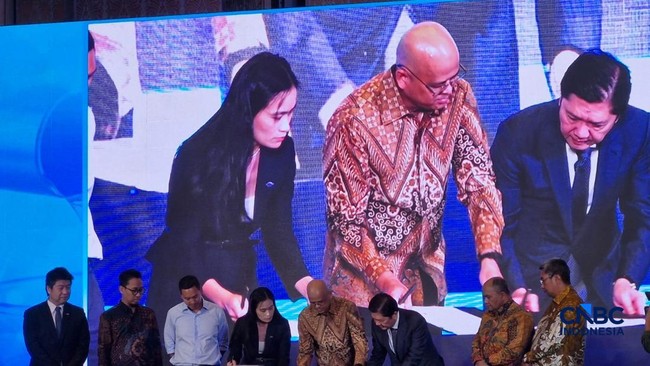
The coal-to-methanol downstreaming project developed by subsidiaries of PT Bumi Resources Tbk (BUMI), namely PT Kaltim Prima Coal (KPC) and PT Arutmin Indonesia, has entered a new chapter.
Through the joint venture PT Bumi Etam Chemical (BEC), the national strategic project (PSN) for coal gasification, or Coal to Methanol, has officially entered the Front-End Engineering Design (FEED) stage and the drafting of an Engineering, Procurement, Construction, and Commissioning (EPCC) Framework Agreement.
The FEED contract and EPCC Framework Agreement were signed by BEC together with PT Istana Karang Laut (IKL) and China National Chemical Engineering Co., Ltd. (CNCEC) at the Ballroom of The Ritz-Carlton Jakarta, Mega Kuningan, on Wednesday (29/7/2026).
The agreement marks an important milestone in the development of the national coal downstreaming project, as it signals the start of the basic engineering (FEED) stage as well as the drafting of the EPCC implementation framework as the foundation towards the construction phase of the coal-based methanol production facility in East Kutai, East Kalimantan.
BEC President Director Rio Supin said the signing of the FEED and EPCC Framework Agreement represents one of the most important milestones in the long journey of a downstreaming project that has been in development for more than two decades.
“Today, 29 July 2026, marks an important milestone in the project’s journey. The project began two decades earlier, starting in 2010 when KPC began searching for a location and a strategy to develop its downstreaming project,” he said at the event.
He explained that until 2023, KPC and Arutmin had in fact been developing their downstreaming plans separately. KPC was preparing a project in East Kalimantan, whilst Arutmin was developing a similar plan in South Kalimantan.
However, KPC and Arutmin subsequently decided to collaborate and form a synergy by establishing PT Bumi Etam Chemical as the business unit that would run the downstreaming project in Indonesia.
“Currently, 50% of PT Bumi Etam Chemical’s shares are held by Arutmin Indonesia and 50% by PT Kaltim Prima Coal,” he said.
Meanwhile, Chief Executive Officer of PT Arutmin Indonesia, Ido Hotna Hutabarat, said the BEC Coal to Methanol project is not merely an investment project, but part of the transformation of coal utilisation towards creating added value through technology and domestic industrialisation.
According to him, for many years coal has made a major contribution to Indonesia’s development, whether through state revenue, strengthening energy security, regional development, or job creation.
“However, we all understand that the challenges ahead demand bolder steps. The strategic value of natural resources is no longer determined solely by our ability to mine and supply, but also by our ability to process, integrate, and create value-added industrial products,” he said.
KPC President Director and Chief Executive Officer Muhammad Rudy said the project is not only part of the company’s commitment to supporting the extension of its IUPK permit, but also a tangible contribution to transforming the national mining industry towards one with greater added value.
“We believe that the future of the coal industry will be determined not only by the ability to produce resources efficiently, but also by the ability to create added value through innovation, technology, and collaboration. We also extend our highest appreciation to the Government of the Republic of Indonesia for its direction, support, and strong commitment to advancing the national downstreaming and industrialisation programme,” he said.
As is widely known, the development of the Coal to Methanol facility by BEC forms part of the fulfilment of coal value-added obligations by Arutmin and KPC, whilst also supporting the national downstreaming policy through the conversion of coal into methanol as a strategic raw material for the petrochemical, manufacturing, energy, and various downstream industries.
As part of the PT Bumi Resources Tbk business ecosystem, BEC was established by Arutmin and KPC as the corporate entity developing the coal-based downstreaming project. In its implementation, BEC has partnered with IKL and CNCEC as strategic partners who will support the project from the planning stage through to construction and commissioning.
This synergy is expected to accelerate the realisation of the Coal to Methanol project whilst strengthening the national chemical industry supply chain. Beyond supporting the development of coal-based downstream industries, the project is also expected to create jobs, boost regional economic activity, attract investment, and generate multiplier effects for communities and the national economy.