
Bumi Bekasi Baru Retaining Wall Expected to Control Flooding in Rawalumbu
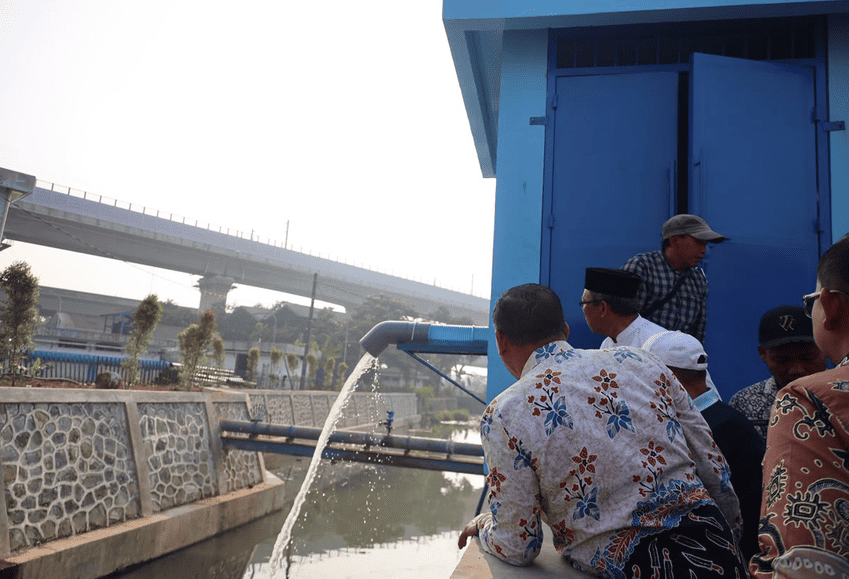
The Bekasi City Government continues to strengthen its flood control infrastructure using an integrated civil engineering approach. Mayor of Bekasi, Tri Adhianto Tjahyono, officially inaugurated the construction of a sheet pile wall in the Rawalumbu River Basin, specifically in the Bumi Bekasi Baru housing estate, Sepanjang Jaya Urban Village, Rawalumbu District. This measure forms part of the city government’s broader strategy to mitigate the risk of overflowing water in densely populated areas.
The construction of this sheet pile wall is not merely a physical project, but rather a technical response to the hydrological challenges of the Rawalumbu River. The river flows through critical points, including three community units in Pengasinan Urban Village and three community units in Sepanjang Jaya Urban Village, which have long been affected areas during periods of heavy rainfall.
At the inauguration, Tri Adhianto stressed that the effectiveness of flood control infrastructure depends heavily on the continuity of the water flow. He highlighted the importance of comprehensive handling from upstream to downstream to prevent water from accumulating at any single point.
“The bridges from the first point to Carita are already very good. But I ask that we do not stop here; we must continue to Carita Bridge. Because when Bridge 0 was built, we actually saw water overflowing. This means the handling must be viewed holistically from upstream to downstream,” Tri said in his statement on Friday (14/8/2026).
This instruction underscores that sheet pile construction must precisely follow the water flow pattern. Without reinforcement up to the Carita Bridge area, the risk of overflow at transition points remains high due to flow bottlenecks.
Amid the massive construction drive, the Bekasi City Government is also implementing a strict budget efficiency strategy. Tri revealed a significant fiscal adjustment to ensure public funds are returned to the community in the form of directly beneficial infrastructure.
The total efficiency achieved amounts to nearly Rp500 billion. The budget, which typically stood at around Rp7 trillion, has now been adjusted to approximately Rp6.5 trillion. These savings were achieved by cutting ceremonial and consumptive operational costs.
“The government must make concessions, because money that comes from the public must be returned to the public,” Tri asserted. He added that every regional budget allocation of Rp100 million must have a clear priority scale so that results are optimal and not wasted.
One of the classic challenges in infrastructure development is the maintenance aspect. The Mayor of Bekasi reminded his staff not to focus solely on inauguration ceremonies, but also on the long-term upkeep of the sheet pile walls, parks, and water channels that have been built.
To support this, the Bekasi City Government relies on the Lingkar Keren programme. The programme is designed as a platform for every sub-district and community unit to identify specific problems in their neighbourhoods and devise solutions based on local needs.
Man-made holes have rendered the sheet pile wall’s function as a barrier against river overflow less than optimal.
Vehicle congestion on one side of the road has disrupted traffic flow, causing long tailbacks along Jalan Daan Mogot.