
Bulog Rice 2 Kilogram Set to Launch, Here's the Estimated Price
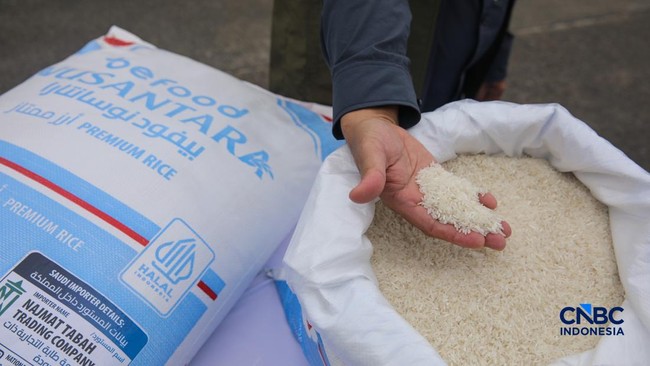
Jakarta, CNBC Indonesia - Perum Bulog has spoken out regarding plans to add a 2-kilogram (kg) packaging variant to its Stabilisation of Food Supply and Price (SPHP) rice, which was previously only available in 5 kg packs.
Bulog’s President Director, Ahmad Rizal Ramdhani, stated that it is not yet possible to confirm when the 2 kg SPHP variant will be sold to the public, as preparations are still underway for determining the packaging and production has not yet begun.
“Regarding the plan to sell SPHP in 2 kg packaging, we are preparing the packaging first, so it hasn’t been produced yet,” Rizal said when met by reporters at the DPR RI building on Thursday (2/4/2026).
When asked about the highest retail price (HET) for this SPHP packaging, the company stated it would align with the base SPHP HET of Rp12,500, multiplied by two for the 2 kg size.
“Well, the SPHP HET per kg is Rp12,500, so just multiply by 2, what does that make it? Rp25,000, that’s how it will be,” he continued.
Previously, during a hearing with Commission XI of the DPR today, Rizal revealed plans to launch SPHP in 2 kg packaging to reach low-income communities who need access to affordable rice in smaller amounts.
Rizal said the policy is a response to the purchasing power conditions of parts of society.
The distribution of SPHP (in 2025) is only in 5 kg sacks and now added with 2 kg sacks, because, apologies, there are also communities who are very limited in funds and have to buy in 2 kg sizes,” Rizal said during the Hearing with Commission XI of the DPR RI at the Parliamentary Complex, Jakarta, on Thursday (2/4/2026).
In addition to adding packaging sizes, Bulog is also relaxing the purchase limits for SPHP rice by the public. Previously, purchases were limited to a maximum of two packs, now expanded to five packs per transaction.
“Then the maximum purchase was 2 packs each time buying, now we add it to become 5 packs, previously only 2 packs,” he said.
Not only that, the ordering capacity by retailers has also been significantly increased. From a previous maximum of 2 tons per order, retailers can now order more than 4 tons.
“Each retailer could previously order 2 tons at a time, now they can order more than 4 tons,” he added.