
Bulog President Director urges public to recognise rice quality according to standards
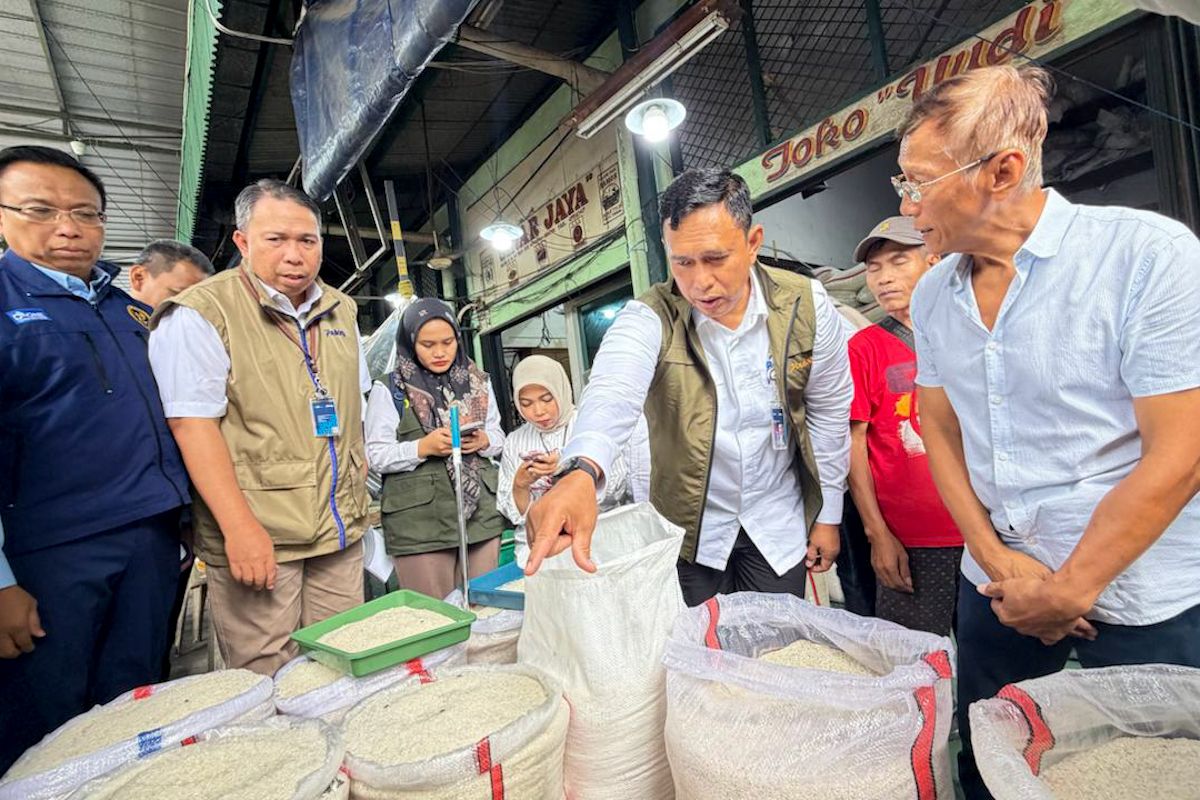
Jakarta (ANTARA) - The President Director of Perum Bulog, Ahmad Rizal Ramdhani, has invited the public to understand rice quality according to established standards, so they are not deceived by labels or appearance, ensuring they obtain products that match their quality and fair pricing.
Rizal stated that rice categories are not solely determined by whiteness, a shiny appearance, brands, or claims on packaging, but are based on quality parameters set by the government.
“Through this education, we want to help the public become more discerning consumers while gaining certainty that the rice purchased matches its class and price,” said Rizal in Jakarta on Friday.
Perum Bulog is strengthening public education regarding rice quality standards so that consumers can accurately distinguish between premium and medium-grade rice. Rizal noted that understanding rice quality is essential for consumers to receive products that correspond to the information on labels and the prices paid.
“Premium rice is not merely rice that looks white, clean, or shiny. The determination of quality class must refer to measurable and testable parameters,” he said.
He explained that based on the National Food Agency Regulation Number 2 of 2023 concerning Rice Quality Requirements and Labelling, distributed rice must meet specified criteria regarding milling degree, moisture content, broken grains, small grains, other rice grains, and paddy grains.
“This regulation groups rice according to its quality, namely premium and medium,” he clarified.
For the premium category, quality requirements include a minimum milling degree of 95 per cent, a maximum moisture content of 14 per cent, a maximum of 0.5 per cent small grains, a maximum of 15 per cent broken grains, a maximum of 1 per cent for other rice grains, and the absence of paddy grains and foreign matter.
For medium-grade rice, the milling degree and moisture content requirements are the same, but with higher tolerances: a maximum of 2 per cent for small grains, 25 per cent for broken grains, 4 per cent for other rice grains, and a maximum of one paddy grain per 100 grams.
“The difference between premium and medium is primarily visible in the grain composition. Therefore, consumers need to examine the overall condition of the rice, read the packaging information, ensure product labels are clear, and purchase from trusted traders or distribution channels,” he continued.
This educational effort is also part of consumer protection to ensure alignment between quality, labelling, and the Maximum Retail Price (HET) set by the government. Under current regulations, the HET for rice is determined based on distribution zones.
For Zone 1, which includes Java, Lampung, South Sumatra, Bali, West Nusa Tenggara, and Sulawesi, the HET for medium rice is Rp13,500 per kilogram and premium rice is Rp14,900 per kilogram. In Zone 2, covering Sumatra (excluding Lampung and South Sumatra), Kalimantan, and East Nusa Tenggara, the HET for medium rice is Rp14,000 per kilogram and premium rice is Rp15,400 per kilogram. Meanwhile, for Zone 3, which includes Maluku and Papua, the HET for medium rice is Rp15,500 per kilogram and premium rice is Rp15,800 per kilogram.
“Bulog believes that rice quality literacy needs to be continuously expanded through various communication channels so that the public does not rely solely on physical appearance to determine quality,” said Rizal.
He added that this aligns with public feedback for Bulog to play a role in providing simple understanding regarding national rice quality standards and the differences between rice classes. He hopes that with increased transparency, the public can compare products more objectively and receive quality commensurate with the price paid.
“At the same time, business actors who conduct trade honestly and in accordance with regulations will also receive protection,” Rizal emphasised.
Moving forward, Bulog will continue to synergise with the Ministry of Agriculture, the National Food Agency, relevant agencies, local governments, business actors, and other stakeholders to strengthen rice quality supervision and education. “This effort is expected to maintain public trust, create transparent rice trade, and ensure consumers obtain food that is safe, high-quality, and in accordance with government regulations,” he concluded.