
Building Trust, Strengthening Indonesian Investment
The strategy to strengthen Indonesian investment extends beyond merely attracting new capital; it also involves building trust to ensure that existing capital remains and is reinvested.
The Indonesian government is relying on investment as one of the main pillars of the nation’s economic growth for 2027. To achieve the target of 6 per cent economic growth next year, the government aims for investment to grow by up to 7 per cent. This target requires synergy between various parties, including the government, the private sector, banking, and investment institutions, to ensure a more conducive business climate and sustainable investment growth.
These efforts take place as the global economy faces increasingly complex dynamics. Geopolitical uncertainty, international trade fragmentation, inflationary pressures, shifts in global monetary policy, and rising competition between nations to attract investment have created new dynamics affecting global capital flows and investment decisions.
In these conditions, investors no longer consider only market potential, but are increasingly paying attention to economic stability, regulatory certainty, institutional quality, and a country’s ability to create a competitive and sustainable investment climate.
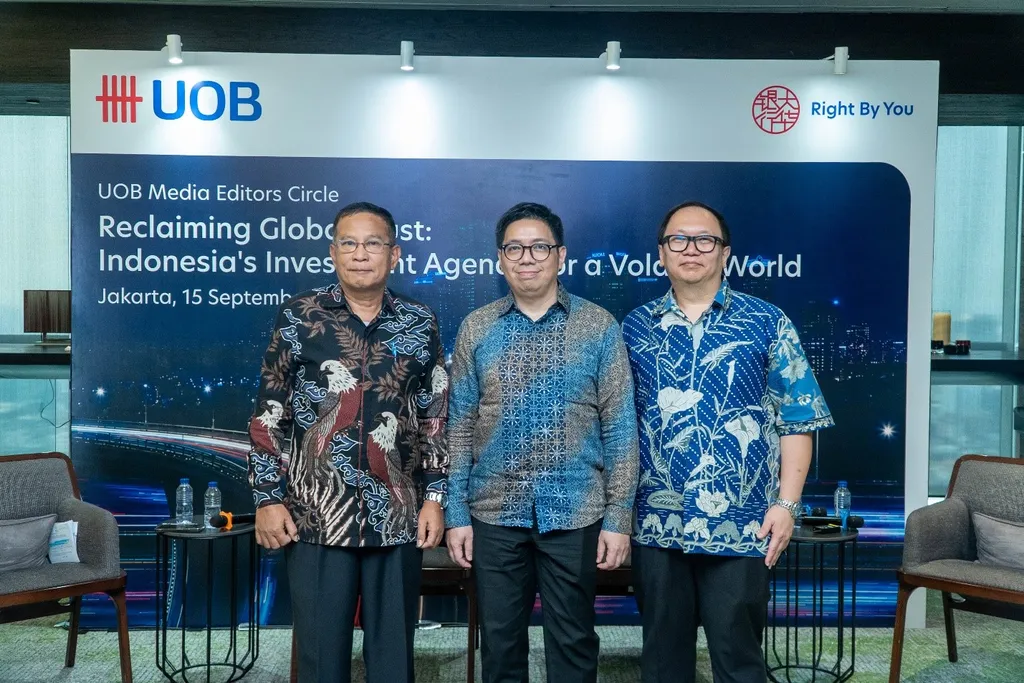
UOB ASEAN Economist Enrico Tanuwidjaja, speaking at the UOB Media Editors Circle 2026 in Jakarta on Tuesday (15/9/2026), emphasised the importance of building trust. “Because uncertainty is increasing, trust is declining. That is what must be built in Indonesia,” stated Enrico.
Cultivating Domestic Trust
Amidst these dynamics, Indonesia’s economic position in the Southeast Asian region still shows a relatively strong foundation. In the first half of 2026, the Indonesian economy grew by a cumulative 5.45 per cent, marking the highest first-half growth in the last five years. The trade balance for the January–June 2026 period also recorded a surplus of US$3.58 billion. Meanwhile, foreign exchange reserves as of late July 2026 reached US$145.3 billion, equivalent to 5.5 months of imports.
According to Enrico, the character of the Indonesian economy, supported by domestic consumption and government spending, provides room for optimism. Although it remains below Vietnam, which has a higher dependence on exports, Indonesia possesses a domestic demand base that serves as a buffer for growth.
“If we look at other ASEAN economies, Vietnam is very dependent on exports. Singapore and Malaysia are as well. The Philippines is doing okay because of its services sector,” explained Enrico. This characteristic is an important asset for building domestic trust before Indonesia strengthens its attractiveness to global investors.
Providing Ease to Investors
In addition to economic foundations, the ease of doing business is a vital part of building investor confidence. The Director of Investment Promotion for Southeast Asia, Australia, New Zealand, and the Pacific at the Indonesian Ministry of Investment and Downstreaming/BKPM, Saribua Siahaan, explained that there are two main indicators investors always consider before committing capital to Indonesia: certainty in licensing and certainty in land availability.
“There are two major indicators that always attract the attention of investors before investing in Indonesia. The first is the issue of licensing, and the second is the issue of land,” said Saribua.
To address these needs, the government provides various industrial estates that can be tailored to investor requirements while continuously improving the ease of licensing. The digitalisation of licensing processes is one step towards creating a simpler process and providing certainty for the business world.
“Regarding licensing, the government is continuously improving so that permits are processed online. This is indeed the key if we want economic growth. Therefore, the government is fully aware that these two things must be addressed,” said Saribua.
Reinvestment
Confidence in the investment climate must also be realised through Indonesia’s ability to retain investors who are already operating so they can continue to expand their businesses. Reinvestment is a key indicator of this sustainability.
Enrico explained that every quarter, approximately US$9 billion is returned to the investors’ home countries in the form of payments and dividends. This flow affects the primary income balance and the dynamics of the Rupiah exchange rate.
“Every quarter, US$9 billion is returned to the home country in the form of dividend payments. If we are successful, they will stay here, and automatically, they will reinvest,” said Enrico.
From the perspective of the business and banking sectors, legal and business certainty must ultimately be realised within a sustainable business framework involving the government, business players, and the banking sector as a unified entity.
Head of Corporate Banking at UOB Indonesia, Edwin Kadir, stated that UOB is ready to be a strategic partner for investors by providing comprehensive assistance, from the initial exploration stage to the point where investors operate their businesses in Indonesia, including coordination with BKPM, notaries, consultants, industrial estates, and tax consultants.
“We are not only focused on financing, but we also want to provide end-to-end service,” said Edwin.
Thus, the strategy to strengthen Indonesian investment does not stop at attracting new capital, but also at building trust so that the capital that has entered can remain and be reinvested. Economic stability, certainty in regulation and land, ease of licensing, support for industrial estates, and collaboration between the government, the business world, and the banking sector form a complementary ecosystem. With this foundation, Indonesia can maintain investment momentum while directing economic growth more sustainably.
Source: jawawa.id (https://jawawa.id/newsitem/building-trust-strengthening-indonesian-investment-1790164302)
Originally published by kompas.id (https://www.kompas.id/artikel/membangun-kepercayaan-menguatkan-investasi-indonesia?open_from=Taja_Page), translated from Indonesian