
Budget Increases to Nearly Rp 1 Trillion: The Ministry of Transmigration's Plan
The Ministry of Transmigration has received a substantial increase in its budget allocation for the 2027 fiscal year. The ministry’s budget ceiling has now reached nearly Rp 1 trillion following an increase from its initial allocation.
This increase allows the Ministry of Transmigration to create more space to implement technical programmes on the ground. A portion of the additional budget is also directed towards strengthening the ministry’s supporting systems.
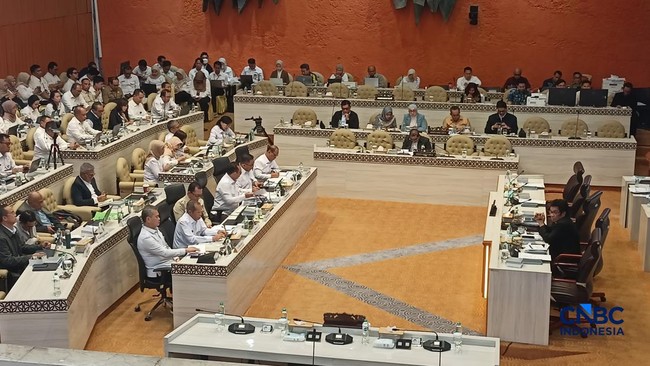
“The Ministry of Transmigration has currently been allocated Rp 972,227,000,000 from the original budget of Rp 400.27 billion. We express our gratitude to all the Leaders and Members of Commission V; thanks to their support, alhamdulillah, we have achieved a budget ceiling increase of 137%,” said the Secretary-General of the Ministry of Transmigration, Edy Gunawan, during a meeting with Commission V of the House of Representatives (DPR RI) on Wednesday (2/9/26).
The budget is subsequently divided among several of the ministry’s main units. The largest portion is allocated to the Directorate General of Development and Expansion of Transmigration Areas and the Directorate General of Economic Development and Community Empowerment of Transmigrants.
From the total budget, the Secretariat General received Rp 329.63 billion. The Directorate General of Development and Expansion of Transmigration Areas received Rp 384.13 billion, while the Directorate General of Economic Development and Community Empowerment of Transmigrants received Rp 223.93 billion.
“Alhamdulillah, with funds amounting to Rp 972.227 billion, we can distribute them across development and transmigration programmes. Therefore, all supporting activities are sufficiently covered, and for our technical programmes, we can allocate 40% which will be detailed by each Director General,” he stated.
The additional funds in the Secretariat General are not entirely directed towards routine expenditure. Several allocations are prepared to strengthen information systems, economic area development, information technology services, and support for resolving land issues in transmigration areas.
At the technical unit level, the budget is also directed towards implementing priority transmigration programmes. The government is preparing several activities related to area development, community empowerment, and the economic development of transmigrants.
“From the Rp 329.63 billion, the composition for the Secretary General’s budget is Rp 308.83 billion, where 93.7% is for supporting programmes, while Rp 20.8 billion or 6.3% is for transmigration support programmes,” said Edy.
2027 Transmigration Budget to be Disbursed to 78 Regencies/Cities
The Ministry of Transmigration is preparing to implement transmigration area development programmes in dozens of regions in 2027. A total of 78 regencies/cities are the targets for activities under the Directorate General of Development and Expansion of Transmigration Areas.
The programme covers areas spread across various regions of Indonesia. The government has divided the activity locations from Sumatra to Papua, each with different regional characteristics and development needs.
“For 2024, we plan to focus on 78 regencies or cities, involving 76 transmigration areas,” said the Director General of Development and Expansion of Transmigration Areas, Sigit Mustofa Nurudin, during the same session.
The distribution of locations includes several key regions in Indonesia. Sumatra is one of the target regions with a significant number of regencies/cities, followed by Sulawesi and Kalimantan.
“In the Sumatra region, there are 22 regencies/cities. In Kalimantan, there are 12 regencies. For the Nusa Tenggara region, there are 7 regencies. For Sulawesi, there are 24 regencies/cities, for Maluku there are 3 regencies, and for Papua there are 6 regencies,” he noted.
Area development will follow the ‘5T’ programme agenda, which is a priority for the Ministry of Transmigration. The activities involve not only settlement development but also encompass land legality, community empowerment, and economic development.
One agenda is directed towards resolving land issues in transmigration areas. The government is also preparing facilities for the issuance of ownership certificates (SHM) and land measurement for transmigrants.
“For ‘Trans Tuntas’, we are directed to conduct an inventory of HPL (Land Use Rights) in transmigration areas, as well as facilitate the acceleration of SHM issuance for transmigrants. This also includes land measurement for both T1 and T2 placement transmigrants,” said Sigit.
Meanwhile, the ‘Local Transmigration’ programme is directed towards supporting local communities through the development of basic infrastructure. The requirements include bridges, roads, clean water, transmigrant housing, drainage, public facilities, and land clearing.
Another programme connects area development with economic activities and cross-sector cooperation. ‘Trans Gotong Royong’, for example, is directed towards supporting economic activities through the provision of production facilities, socio-cultural institutions, and post-harvest equipment.
“As for the fifth programme, ‘Trans Gotong Royong’, it is directed towards fulfilling cross-sector cooperation to support mandatory economic activities, such as facilitating socio-cultural institutions, providing agricultural production facilities, and providing post-harvest tools related to the revitalisation of transmigration areas,” he concluded.
Source: jawawa.id (https://jawawa.id/newsitem/budget-increases-to-nearly-rp-1-trillion-the-ministry-of-transmigrations-plan-1788346863)
Originally published by CNBC Indonesia (https://www.cnbcindonesia.com/news/20260902141025-4-764367/anggaran-naik-jadi-nyaris-rp-1-t-ini-rencana-kementerian-transmigrasi), translated from Indonesian