
Budget for Prabowo's Key 2027 Programmes Approved, Here are the Details!
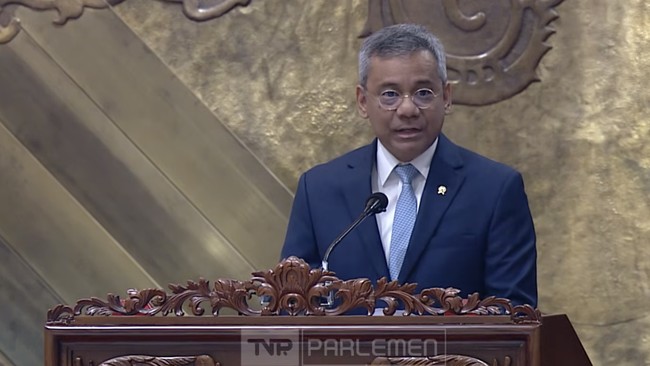
The Government and the House of Representatives (DPR) have officially approved the 2ability 2027 Draft State Budget (RAPBN) during a plenary session on Tuesday (29/09/2026). In next year’s State Budget, the government has allocated hundreds to thousands of trillion rupiah to support various priority programmes of President Prabowo Subianto.
Finance Minister Suahasil Nazara stated that the 2027 RAPBN is designed to maintain economic growth momentum while accelerating the achievement of the national development agenda amidst high global uncertainty.
“The 2027 fiscal policy is designed to remain expansively collaborative, targeted, and measurable, with a deficit of 2.4% of GDP,” Suahasil said during the DPR plenary session on Tuesday (29/09/2026).
In the 2027 RAPBN, state revenue is set at Rp3,445.1 trillion, while state expenditure reaches Rp4,106.3 trillion. The budget deficit is pegged at 2.4% of Gross Domestic Product (GDP), with financing requirements reaching Rp671.2 trillion.
Suahasil emphasised that this budget will serve as the government’s primary instrument to execute various national priority programmes.
One of the largest portions is allocated to the education sector, reaching Rp824 trillion. This budget will support various programmes, ranging from the Smart Indonesia Programme (PIP) and KIP Kulintiah (Scholarships for Higher Education), to the renovation of schools and madrasahs, as well as the development of the ‘Sekolah Rakyat’ and ‘Sekolah Unggul Garuda’.
Additionally, the government is preparing support for scholarships and talent development through the Indonesia Endowment Fund for Education (LPDP).
“This is not merely about fulfilling a constitutional mandate, but a direct investment in the future of the Indonesian generation,” Suahasil remarked.
For social protection, the government has allocated Rp539.7 trillion. These funds will be used for various social assistance programmes such as the Family Hope Programme (PKH), food assistance, basic food cards, subsidies for the National Health Insurance (JKN) contributions, and various programmes for the protection of the poor and vulnerable.
The government has also budgeted Rp195.3 trillion to strengthen national food security. These funds are intended to support food self-sufficiency targets while simultaneously improving the welfare of farmers and fishermen.
“The food security budget of Rp195.3 trillion aims to strengthen self-sufficiency while realising prosperous farmers and well-off fishermen,” said Suahasil.
Meanwhile, Transfers to Regions (TKD) have been agreed at Rp735 trillion. This budget represents an increase compared to the previous year and is aimed at strengthening regional development and improving the quality of public services.
According to Suahasil, the 2027 RAPBN will focus on supporting eight clusters of the National Priority Work Programme (PKPN) and one supporting (enabler) programme, covering a total of 60 work programmes.
The eight priority clusters include food sovereignty, energy and water independence, education, health, downstreaming and industrialisation, infrastructure, housing and disaster resilience, strengthening the grassroots economy and village development, and the acceleration of poverty reduction.
The supporting programmes include the strengthening of defence and security, law enforcement, governance, the acceleration of digitalisation, and economic diplomacy.
The government targets Indonesia’s economic growth to reach 6% in 2027, with inflation maintained at 2.5%. The rupiah exchange rate assumption is set at Rp17,500 per US dollar, while the Indonesian Crude Price (ICP) is pegged at US$75 per barrel.
Through these various programmes, the government hopes that the poverty rate can be suppressed to the 6%-6.5% range, the open unemployment rate can drop to 4.3%-4.87%, and the quality of human resources will continue to improve.
“The State will continue to be present in every pulse of the lives of the Indonesian people,” Suahasil concluded.