
BTN to be more selective in corporate lending as cost of funds rises
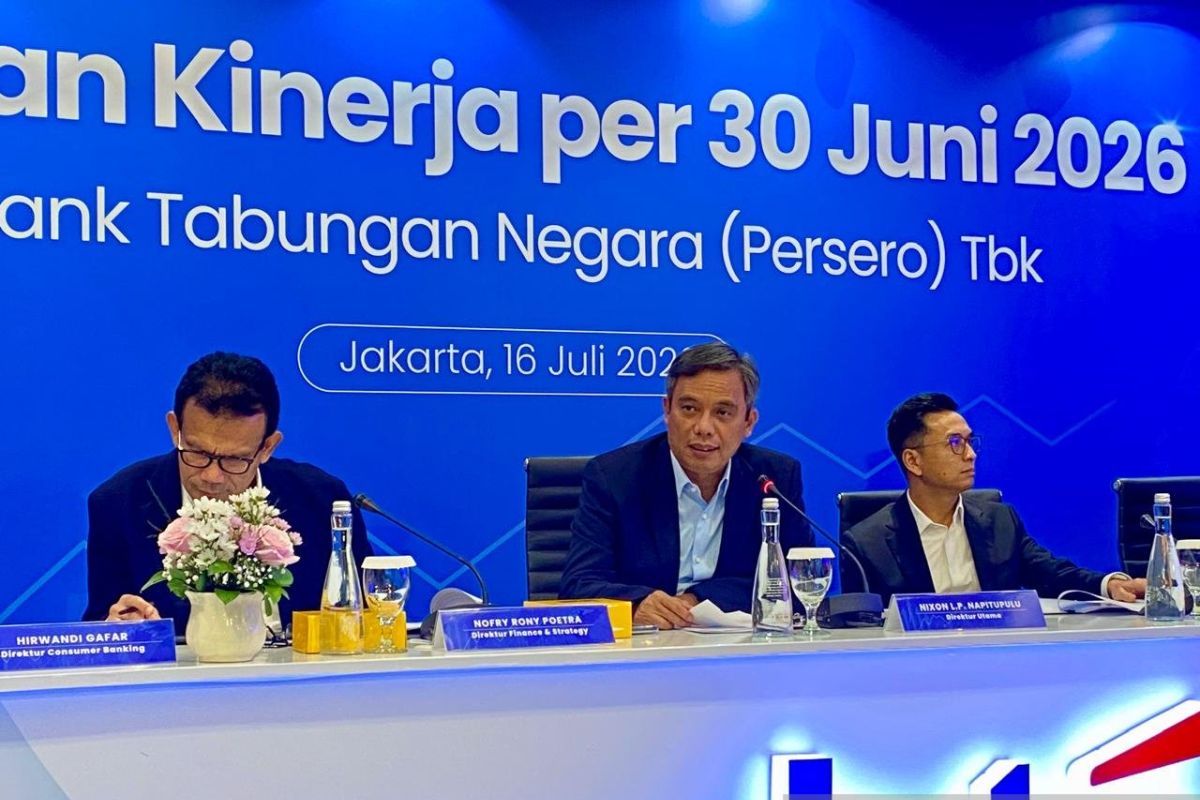
Jakarta (ANTARA) - PT Bank Tabungan Negara (Persero) Tbk (BTN) will be more selective in extending credit to large corporates offering low yields, in line with rising cost of funds amid tight liquidity.
However, the bank has assured that lending for government programmes, such as the People’s Business Credit (KUR) for Housing or the Housing Programme Credit (KKP) as well as the Housing Financing Liquidity Facility (FLPP), remains a priority.
“But for large corporates with low yields, we are being very selective, and we are even inclined to remove them from our pipeline for now,” said BTN President Director Nixon LP Napitupulu at a press conference in Jakarta on Thursday.
According to him, the measure was taken because the rising cost of funds means the bank can no longer offer low-interest credit to borrowers.
“Today we cannot sell loans too cheaply because the cost of funds has indeed risen. That is why we are choosing which segments to enter. Government programmes continue to run. But for corporates where the interest is too cheap, we are starting to reduce them,” Nixon said.
The rise in the benchmark interest rate (BI-Rate), followed by higher yields on Bank Indonesia Rupiah Securities (SRBI), has absorbed banking liquidity, driving up the cost of raising funds.
Nixon said the bank continues to monitor developments in the BI-Rate and SRBI interest rates, which are still showing an upward trend. As long as there is no signal of monetary policy easing, BTN will remain cautious in extending credit.
He added that the company also holds an asset liability committee (ALCO) meeting every week to monitor liquidity developments and macroeconomic conditions.
“The game changer today is liquidity. We cannot force credit to grow when there is no money. Liquidity is like blood in the body. If the blood is reduced, you should not force yourself to run fast,” Nixon said.
Meanwhile, BTN is maintaining its credit growth target this year in the range of 8-10 per cent and has not revised its Bank Business Plan (RBB). The bank has only adjusted its internal key performance indicators (KPI).
“We are not revising the RBB; that has been decided together with Danantara. So we are only changing internal KPIs. As for the figures that have been announced, nothing has changed,” Nixon said.
At the same time, BTN is maintaining its cost of funds target in the range of 3.1-3.3 per cent until the end of the year.
According to him, pressure on funding costs intensified when the withdrawal of the Budget Surplus (SAL) funds coincided with liquidity absorption through SRBI and the issuance of government instruments, triggering deposit rate competition at the end of June.
However, the situation began to ease after the government returned part of the SAL funds to the Himbara banks.
Nixon said the additional funds received by BTN reached nearly Rp13 trillion. Following the government’s reallocation of SAL, he noted that liquidity pressure and interest rate competition had started to subside.
The bank hopes that future SAL returns to the government will be carried out with proper timing.
“Except for September; in September it is already clear how much we must return. Perhaps after that, because the withdrawals will certainly be gradual, we are only asking that the timing be right when the SAL is withdrawn by the government,” Nixon said.
As of the end of June 2026, BTN recorded consolidated loans and financing growth of 11.2 per cent (yoy) to Rp418.11 trillion.
Subsidised mortgage loans (KPR) remain the driving engine of housing credit, rising 8.1 per cent (yoy) to Rp196.96 trillion. In addition, the Housing Programme Credit (KPP) disbursed by BTN reached Rp4.1 trillion as of June 2026, since its launch at the end of October 2025.
On the other hand, third-party funds (DPK) reached Rp433.00 trillion, growing 6.6 per cent (yoy).
The bank continues to strengthen its low-cost funding structure as the foundation for long-term growth. As of the end of June 2026, BTN’s cost of funds stood at 3.01 per cent.
The bank also succeeded in reducing its loan at risk (LAR) to 18.6 per cent and lowering its cost of credit (CoC) to 0.7 per cent in the first half of 2026. Its capital adequacy ratio (CAR) rose to 20 per cent over the same period.