
BTN holds mass credit agreement for subsidised home ownership in Jambi
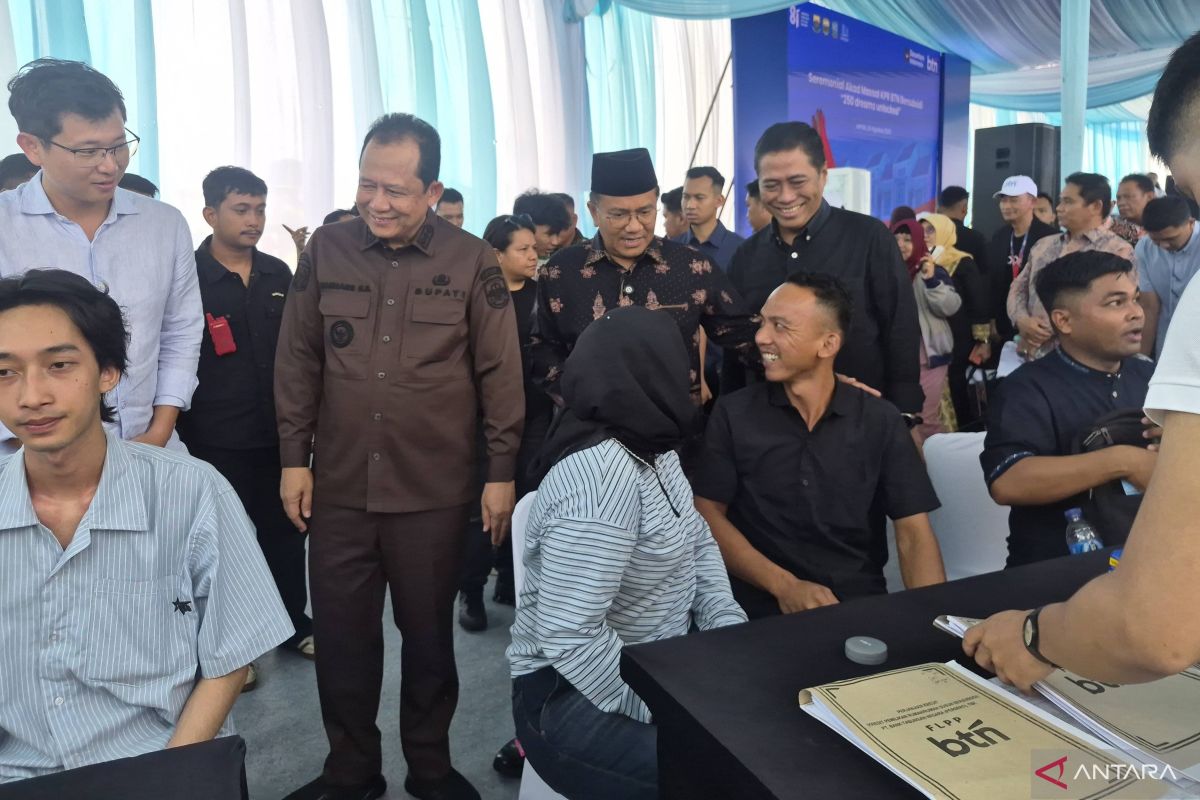
Muaro Jambi, Jambi (ANTARA) - PT Bank Tabungan Negara (BTN) held a mass credit agreement for 250 units of subsidised home ownership credit (KPR) centred at Perumahan Grand Citra Asri Pudak, Kasang Pudak Village, Kumpeh Ulu District, Muaro Jambi Regency.
“Thank you to the President for providing financing policy, with interest of five per cent throughout the tenor, making it easier for the public to pay instalments through subsidy assistance,” said BTN Director of Consumer Banking Hirwandi Gafar in Muaro Jambi on Saturday.
Hirwandi explained that the subsidised housing programme provides an opportunity for the people of Jambi to obtain quality housing with low interest rates and long instalment periods, ranging from 10 to 40 years.
The programme also addresses the gap between housing demand and supply (backlog), particularly in Muaro Jambi Regency and Jambi City. Based on data, the two areas currently have a backlog of around 130,000 units. This shortfall presents an opportunity for developers and banks to meet the public’s need for quality subsidised housing at affordable prices.
According to him, BTN, as part of the Association of State-Owned Banks (Himbara), has been committed to supporting housing credit distribution since 1976. During that period up to now, BTN has distributed 6 million mortgages to the public.
During 2026, up to August, BTN has distributed 100,000 units. Of that figure, 70 per cent are subsidised home ownership credit programmes.
“The challenge is that there are still many people who do not have a house. I hope that starting from Jambi City and Muaro Jambi Regency, data by name and by address can be prepared so that they can be assisted from our financing side,” Hirwandi said.
Jambi Mayor Maulana said that the city government is ready to collaborate with Muaro Jambi Regency on basic facilities to support subsidised housing development. According to him, the availability of subsidised housing, whether on the outskirts of the city or in border areas, greatly helps the community.
Moreover, the two regional heads have reached an agreement to collaborate on improving road infrastructure, clean water and waste management.
“Basic services do not recognise regional boundaries. We facilitate border area development, such as waste management and clean water. This is a form of agglomeration. The trend of increasing housing must be accompanied by the development of basic facilities,” Maulana said.
Muaro Jambi Regent Bambang Bayu Suseno said on the sidelines of the mass credit agreement programme that his area is currently a residential development zone. Residents who benefit from the subsidised housing programme are essentially residents of Jambi City and Muaro Jambi.
For this reason, he assured continued support for subsidised housing development in his area to realise the three million houses programme designed by President Prabowo Subianto.
“Muaro Jambi provides support in terms of land availability and infrastructure. We together (Jambi City and Muaro Jambi) work hand in hand to reduce the housing backlog in Jambi Province,” he said.
Founder of LIP House Jambi, Raymond Tanoto, said that in today’s programme his company together with BTN launched a simultaneous key handover programme packaged as “250 dreams unlocked”.
“We are helping 250 people receive houses today. We see that Jambi’s potential going forward is very good,” Raymond said.
He explained that his company has so far successfully built 800 subsidised housing units in five locations, the largest in the Kasang Pudak and Mendalo areas (Muaro Jambi) and Liposos, Kenali and Simpang Rimbo (Jambi City).
With concepts including four-season houses, gen-z concepts, in-law houses, and teletubbies, of the total built, only 150 units remain.
The high public demand for subsidised housing, according to him, is inseparable from the building construction and supporting facilities. For this reason, from the initial planning stage, his company always considers the right concept so that residents do not get bored within the housing environment.
“A house is not just a place to live, but a place to start life. Our programme is in line with the three million houses programme, helping the Indonesian people enjoy life and quality infrastructure,” he concluded.