
BTN Boss Reveals Strategy to Realise 3 Million Affordable Homes
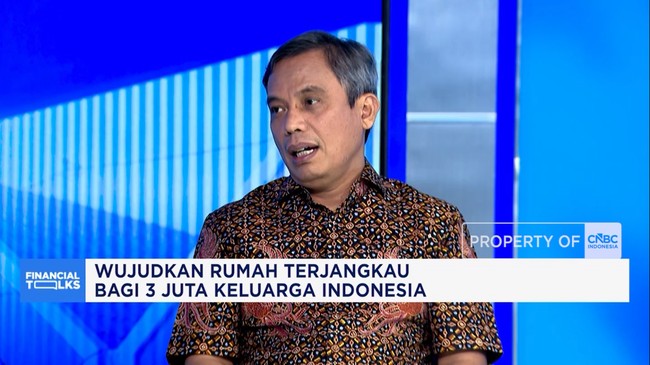
Jakarta, CNBC Indonesia – PT Bank Tabungan Negara (Persero) Tbk President Director Nixon Napitupulu has revealed a number of strategies to realise the programme to build 3 million homes for the Indonesian people. Through this programme, BTN is committed to broadening access to home ownership whilst maintaining financing quality through innovation and digital transformation.
He said the bank had been assigned the task of national housing finance since 1976. That long experience has made BTN a key player in housing finance, particularly for low-income communities.
Thanks to this long journey, BTN gave birth to the term Kredit Pemilikan Rumah (KPR), or home ownership mortgage. To date, BTN has disbursed housing finance for around 6.1 million homes across the country, with the majority of that financing directed at lower-middle-income households.
“The KPR was actually created at BTN in 1976,” Nixon said during Financial Talks on CNBC Indonesia on Thursday (30/07/2026).
He said BTN still commands a 70-80% share of the subsidised housing finance market under the government programme. Overall, BTN’s KPR market share stands at around 39-40%. BTN itself has financing capacity of around 250,000 to 350,000 units each year.
According to Nixon, BTN recorded positive KPR disbursement growth throughout the first half of 2026. In detail, growth in subsidised KPR from BTN reached 8.1%, whilst disbursement of the Housing Programme Credit (KPP) for informal business operators reached around Rp 4.1 trillion of the Rp 10 trillion full-year target. The KPP is aimed at entrepreneurs such as traders, salon owners, barbers and creative industry players who wish to own a home that also serves as their place of business.
Nixon then explained that the government is running two main schemes to meet the target of building and renovating 3 million homes: KPR financing and the Self-Help Housing Stimulant Assistance (BSPS) programme.
For the subsidised housing programme under the Housing Financing Liquidity Facility (FLPP) scheme, the government has provided a quota of around 350,000 units this year. The BSPS programme will target hundreds of thousands of households in need of renovation assistance.
“By June we had already grown 4.8%. The biggest was subsidised KPR at 8.1%. So it is still growing quite well at 8.1% in subsidies. Then, besides FLPP or the subsidised KPR programme, the government has one more programme called KPP, formerly the housing people’s business credit. Under KPP we have disbursed roughly Rp 4.1 trillion in these six months. Our target is Rp 10 trillion,” he explained.
The KPP programme is intended for entrepreneurs, meaning those who do not receive a fixed monthly income – for example vegetable vendors, meatball sellers, barbers and salon owners. These entrepreneurs typically buy homes to live in whilst also using them as their place of business.
He said the KPP can serve as an alternative for people to access housing finance more easily when they do not have a payslip. In other words, the KPP addresses the housing finance problem for the entrepreneurial segment.
On the other hand, Nixon sees clear demand for housing among low-income (MBR) communities. However, the challenge in meeting that demand comes from the supply side. In this context, there has been a slowdown in house construction by developers, as well as in certification and permitting processes, which has affected subsidised KPR transactions.
Nevertheless, Nixon said BTN remains optimistic it can still pursue the disbursement of financing for 350,000 homes by the end of 2026. One effort BTN is undertaking to meet that target is accelerating business transformation through digitalisation.
Here, BTN is working to speed up the KPR application process from a maximum of 5 days to a maximum of 3 days. This is being done by digitalising the KPR application and assessment process. BTN has also begun relying on Artificial Intelligence (AI) to run the operational side of the KPR programme.
“Yes, we are indeed making many innovations, especially in business processes. How can the Indonesian people get their KPR disbursed within a maximum of 5 days? Once we achieve 5 days, we actually want to push it to 3 days,” he explained.
In addition, BTN is strengthening collaboration with Danantara to drive growth in the housing sector, including making a success of the 3 million homes programme. This synergy is realised through national housing exhibitions, the provision of short- and medium-term funding, and a home ownership programme for state-owned enterprise (BUMN) employees.
“So these are efforts at creating new demand, to ensure housing can keep growing. Because the impact of housing on economic growth is quite good, given the multiplier effect. There are 182 subsectors that come alive when housing thrives,” he concluded.