
BSKDN synchronises central-regional policies to support President's programmes
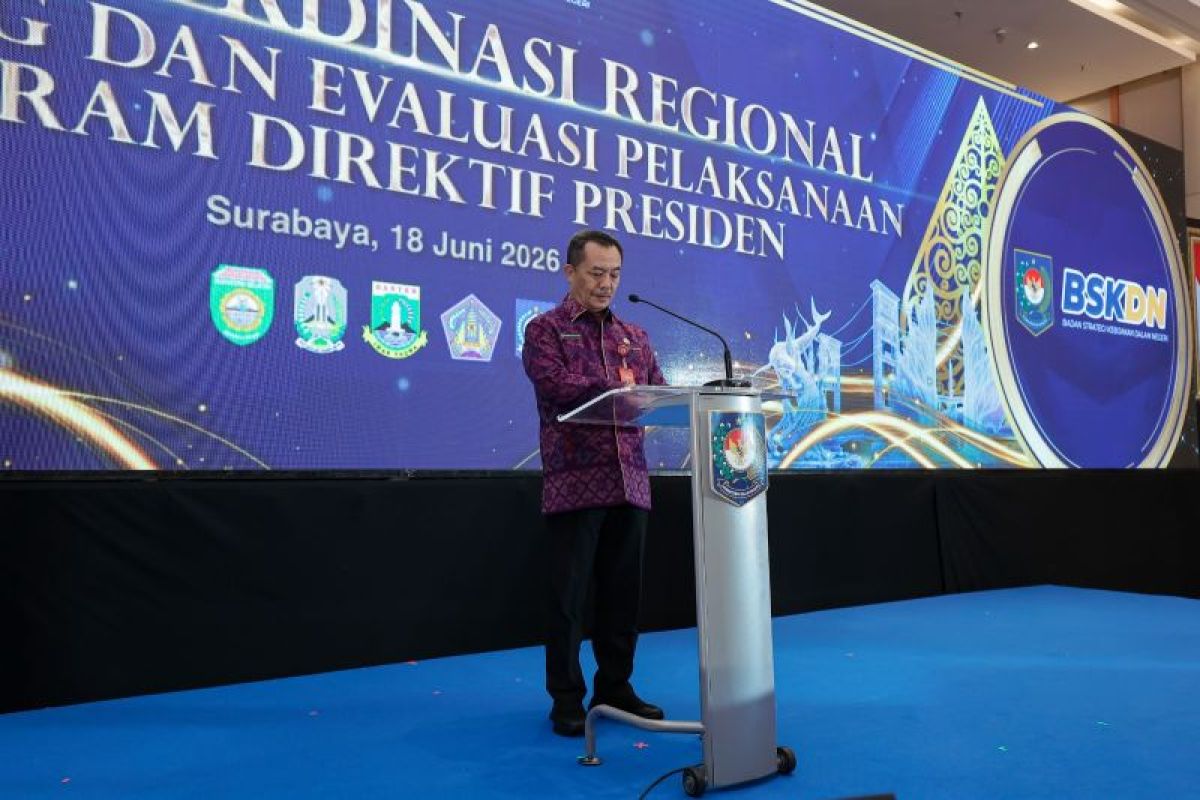
East Java is currently experiencing a period of prosperity with an economic growth rate of 5.96 per cent. However, we must not become complacent, as we aim to reach the national target of growing beyond 6 per cent, stated Adhy Karyono, Regional Secretary of East Java.
Jakarta (ANTARA) - The National Policy Strategy Agency (BSKDN) of the Ministry of Home Affairs (Kemendagri) has held a strategic forum to strengthen governance, synchronise central and regional policies, and evaluate the implementation of various priority programmes of President Prabowo Subianto at the regional level.
“National priority programmes must not run separately from regional planning and budgeting. Therefore, policy synchronisation is vital so that national programmes connect with the real needs of the community and regional capacity,” said the Head of BSKDN, Yushante Huntoyungo, in a statement in Jakarta on Friday.
This was conveyed during the Regional Coordination Meeting for Monitoring and Evaluation of the Implementation of Presidential Directive Programmes (Batch IV) in Surabaya, East Java, on Thursday (18/6).
These programmes encompass various strategic issues that directly impact community needs, ranging from economic growth, inflation control, Free Nutritious Meals (MBG), the construction of three million houses, the formation of Red and White Village/Sub-district Cooperatives, People’s Schools, food self-sufficiency, free health checks, Garuda Schools, to the eradication of extreme poverty.
According to Yusharto, the success of these programmes requires the strengthening of three main pillars: the synchronisation of central and regional policies, good governance, and integrated, data-driven monitoring and evaluation.
He explained that monitoring and evaluation should not merely be interpreted as an administrative process or a search for errors. Instead, monitoring and evaluation must serve as an instrument for learning and policy improvement, capable of identifying obstacles, risks, support needs, best practices, and the impact of policies on the ground.
To support this, BSKDN continues to strengthen its Policy Hub function as a strategic policy node within the Ministry of Home Affairs. Through this mechanism, data, analysis, field issues, and policy recommendations are integrated to produce sharper, evidence-based, and operationally actionable recommendations.
Meanwhile, the Regional Secretary of East Java Province, Adhy Karyono, stated that East Java is currently showing encouraging development performance. East Java’s economic growth was recorded at 5.96 per cent, higher than the national average.
“East Java is currently happy with an economic growth of 5.96 per cent. However, we must not be satisfied too quickly because we want to chase the national target, which is expected to grow by more than 6 per cent,” said Adhy.
Adhy also emphasised the commitment of the East Java Provincial Government to support various priority programmes of the President, including the Free Nutritious Meals Programme, which is currently being expanded in scope.
Based on data presented in the forum, East Java is one of the provinces with the largest number of Free Nutritious Meal beneficiaries in Indonesia, with over 9 million recipients and more than 4,000 Nutrition Fulfilment Service Units (SPPG) already operational.
“We are certainly monitoring this very closely. This excellent Presidential programme must run according to standards so that the benefits can truly be felt by the community,” he stated firmly.
“I believe that if these achievements continue to increase, it is possible for East Java to become an example for other regions in implementing national priority programmes,” he added.
Jusuf also emphasised that the success of public policy is not only determined by the scale of the programmes implemented but also by the quality of the data used in the decision-making process. Therefore, an evidence-based policy approach must be the foundation for both the formulation and evaluation of policies.
“Our decisions are data-driven decisions. If the data is incorrect, it is dangerous. Therefore, data-based policy is very important so that the programmes implemented are truly on target and able to address existing problems,” he remarked.
Furthermore, Jusuf assessed that the success of implementing national priority programmes is heavily influenced by bureaucratic capacity, resource availability, data-based supervision, inter-agency collaboration, and community involvement. Consequently, synergy between the central government, regional governments, academics, and all stakeholders must continue to be strengthened.