
BSKDN Oversees Implementation of President's Priority Programmes in the Regions
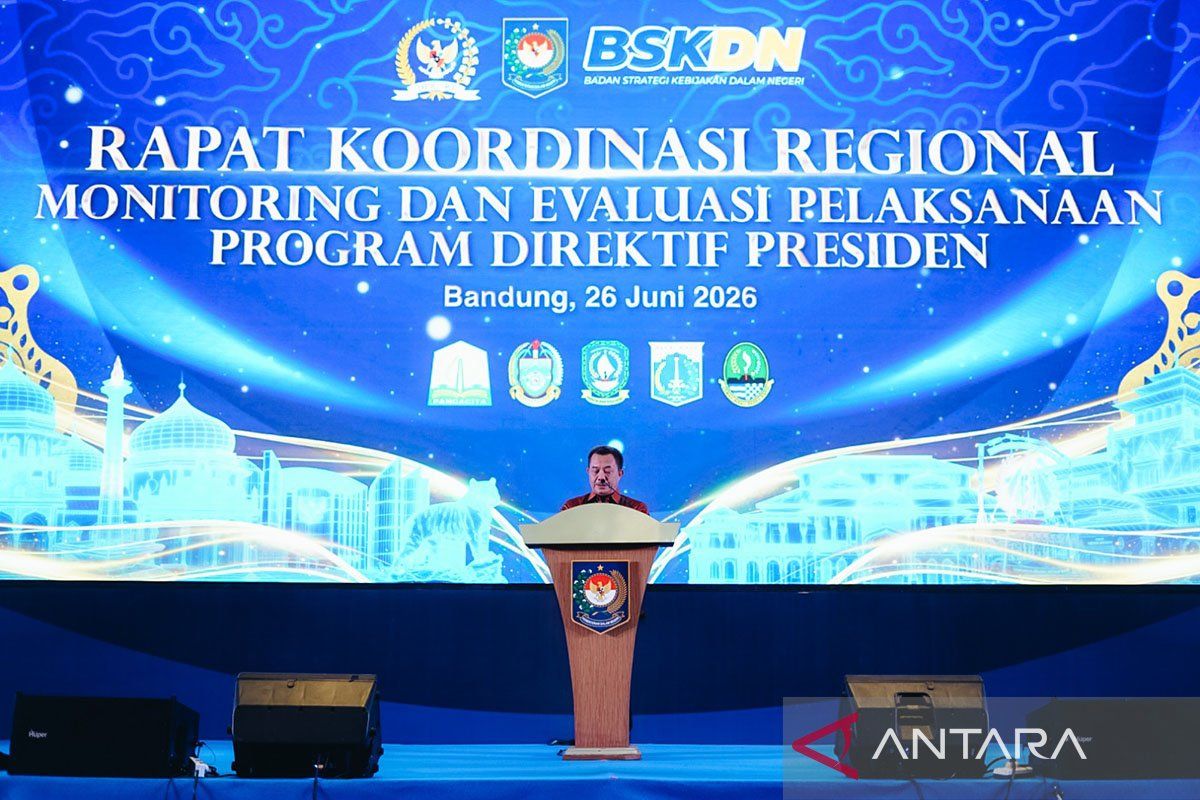
Jakarta (ANTARA) - The Agency for Domestic Policy Strategy (BSLTDN) of the Ministry of Home Affairs is continuing to strengthen the synergy between central and regional governments in overseeing the implementation of the President’s priority programmes across various regions.
The Head of BSKDN, Yusharto Huntoyungo, emphasised that monitoring and evaluation are instruments that regions must utilise to ensure that national policies do not stop at the planning stage, but are truly able to provide real benefits to the community through effective implementation in the regions.
“The hope is that this activity can produce a comprehensive picture of achievements, obstacles, and the need for policy strengthening as a basis for formulating more operational and responsive strategic policy recommendations for regional conditions,” Yusharto stated in his remarks in Jakarta on Friday.
This was conveyed by Yusharto during the Regional Coordination Meeting for Monitoring and Evaluation of the Implementation of Presidential Directive Programmes (Batch V) held in Bandung, West Java, on Friday.
In addition to capturing the achievements of programme implementation, the forum also identified various obstacles, risks, best practices, and the need for policy strengthening as a basis for formulating more operational and responsive strategic recommendations for regional conditions.
Yusharto explained that the Batch V Regional Coordination Meeting aims to bridge the gap between national policy design and the realisation of its implementation on the ground.
Furthermore, this activity is expected to strengthen the coordination, synchronisation, and consolidation of the implementation of the President’s directive programmes, producing a comprehensive evaluation and serving as a foundation for formulating policy recommendations that are adaptive to the needs of each region.
According to him, both aspects must go hand in hand so that every policy can provide optimal benefits to the community. “If it is effective but not efficient, it is a waste, and vice versa,” he said.
Yusharto explained that several development indicators in West Java show positive progress. One of these is reflected in the level of public consumption, which remains stable alongside the success of the regional government in controlling the rate of inflation.
“The level of public consumption is relatively good so far because inflation is controlled. We are maintaining it within the 2.5 per cent range,” said Yusharto.
In line with this, the Deputy Chairman of Commission II of the Indonesian House of Representatives (DPR RI), Dede Yusuf Macan Effendi, emphasised that the successful implementation of the President’s ten directive programmes requires collaboration from all stakeholders, including regional governments and legislative institutions.
According to him, this synergy is a crucial factor in achieving the national economic growth target of eight per cent set by the President.
“The President wants economic growth to reach eight per cent. Many people say that target is very optimistic. The question is, is it achievable or not? This is where all elements of government must work together so that the target can be realised,” said Dede.
Dede explained that one of the determining factors in achieving this target is the ability of regional governments to maintain price stability through inflation control.
He assessed that concrete steps, such as conducting market operations, are effective instruments for maintaining public purchasing power when the prices of basic necessities rise.
“Inflation is simple. When the price of LPG or chilli rises, what needs to be done? One way is to conduct market operations. If a region does not conduct market operations, it means they do not want to maintain inflation,” he asserted.
In addition to inflation control, Dede also highlighted the importance of accelerating the Three Million Houses Programme as part of the government’s strategic agenda.
According to him, the success of this programme is not only measured by the number of houses built or renovated but must also be accompanied by legal certainty through the ownership of certificates for the beneficiaries.
“We also support the effort so that the houses built do not just stand physically, but also have certificates. We have prepared 500,000 free certificates for low-income communities,” he added.