
Bromo Fire Leaps Across Sea of Sand, Expert Reveals Root Causes
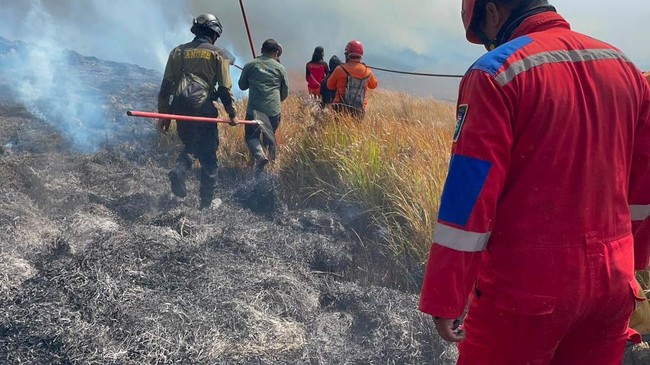
The forest and land fire at Mount Bromo has shown no signs of abating after more than a week, instead advancing towards the iconic savanna favoured by tourists. Daryono, a member of the Indonesian Association of Disaster Experts (IABI), identified three main factors behind the difficulty in controlling the blaze. Firstly, a combination of hot weather has made the vegetation increasingly dry. Secondly, strong winds have enabled the fire to ‘leap’ across the Sea of Sand, a natural barrier that should have contained its spread. Thirdly, the abundance of dry grass and shrubs in the Bukit Teletubbies area has provided ideal fuel for the flames.
Daryono explained that despite massive firefighting efforts involving water bombing, drone spray, and ground operations, high-speed wind gusts continue to disperse the water dropped from the air. As a result of these conditions, a total closure of all tourist access points, including the Cemoro Lawang and Wonokitri routes, is strongly being considered to prioritise the safety of the public and visitors. The current firefighting strategy focuses on two key aspects: cutting off the fire’s propagation path and optimising evacuation routes for personnel and the community. In addition to the planned tourist access closure, the joint task force is prioritising the construction of firebreaks in affected areas, including the Tengger Caldera Ring Road, to localise the flames that continue to expand due to strong winds.
To prevent similar incidents from recurring, IABI emphasised the importance of four mitigation pillars for forest and land fires in the Bromo area. These include tightening visitor prevention measures by strictly inspecting tourists’ belongings and banning fire-inducing items like flares or fireworks, as well as prohibiting the careless disposal of cigarette butts. The management of high-risk areas involves building firebreak lanes and periodically monitoring vegetation dryness levels. Patrols and community engagement will be strengthened by deploying Community Fire Care Teams (MPA) and intensifying routine patrols in vulnerable zones. Finally, detection and rapid response will be enhanced by utilising hotspot monitoring and preparing emergency response teams for early intervention. With the combination of extreme weather factors and difficult terrain, experts assess that future handling of the Bromo fires requires a long-term approach, rather than merely reactive firefighting once the flames have grown large.