
BRMP Proposes In situ and Ex situ Models for Agricultural Waste Utilisation
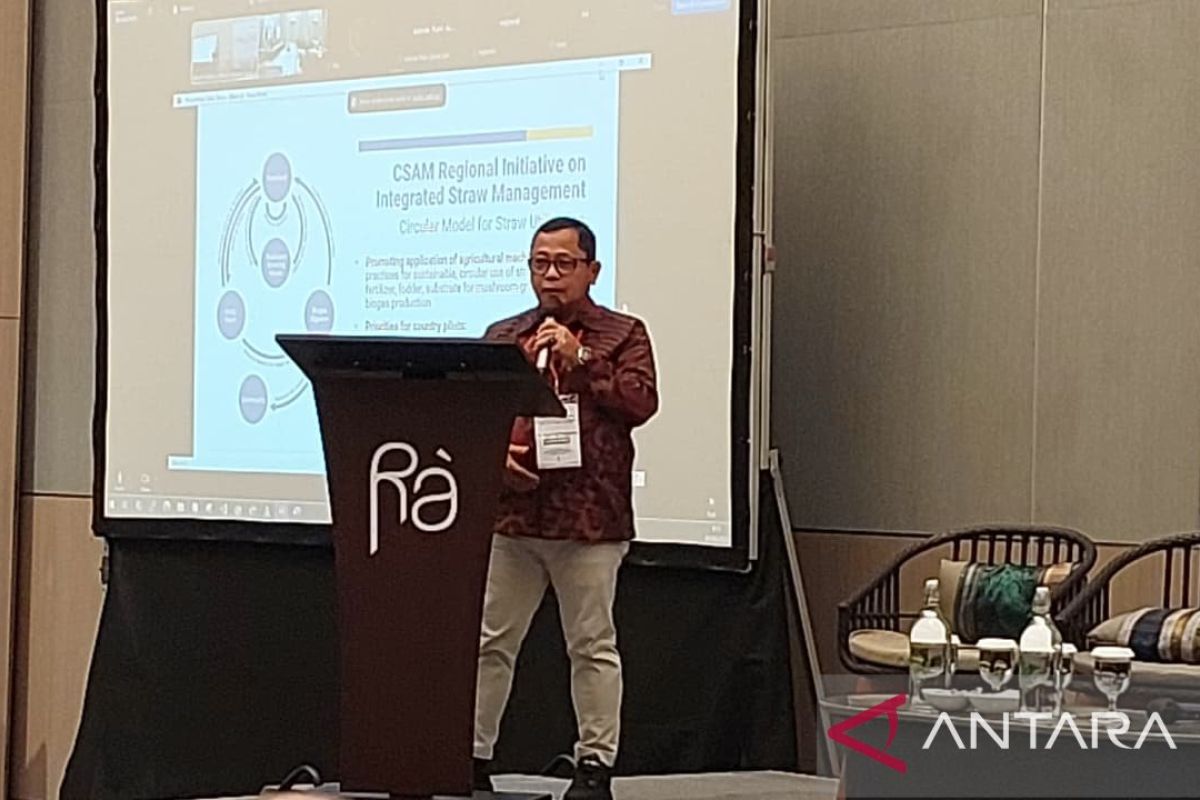
Jakarta (ANTARA) - An engineer from the Agency for Agricultural Assembly and Modernisation (BRMP), Mektan Agung Prabowo, stated that mechanisation models through two approaches, namely In situ and Ex situ, can be utilised to optimise the use of agricultural residues, which can serve as a source of added economic value.
“We must integrate productivity, efficiency, resource conservation, emission reduction, and the circular economy,” said Agung during the National Multistakeholder Dialogue titled “Scaling Up Crop Residue Management through Mechanisation and Custom Hiring in Indonesia” in Jakarta on Tuesday.
He assessed that the potential for crop residue is immense given high agricultural productivity, with a product-to-biomass ratio of approximately one-to-one. Consequently, there needs to be a paradigm shift that views crop residue not as waste to be immediately discarded, but through changes in agricultural mechanisation and the ability to manage such residues in an integrated manner.
In the proposed model, agricultural residues are divided into two utilisation pathways. First, the In situ approach, where residues remain on the land through processes such as chopping, spreading, incorporation, merging, and soil management.
Second, the Ex situ approach, where residues are collected to be subsequently rolled, transported, further processed, or stored in storage facilities.
This model can transform agricultural remains into planting media for specific commodities such as paddy straw mushrooms, fertiliser, or livestock feed from rice straw and maize residues.
BRMP maintains that these two approaches cannot be applied uniformly. The choice between returning residues to the land or removing them for further use must consider site-specific conditions.
“We need to remember, how much can be removed and utilised through In situ and Ex situ? Usually, only about 40 per cent can be utilised ex situ. Therefore, decisions must be made using a site-specific approach,” he said.
Agung noted that residues from agricultural remains can be utilised to support the agronomy, livestock, energy, and industrial sectors. This also forms part of the support for the government’s national programmes regarding food and energy self-sufficiency.
The development of this mechanisation model is expected to encourage a more integrated agricultural system, while simultaneously supporting the implementation of a circular economy through biomass utilisation and the reduction of agricultural residue burning.
Source: jawawa.id (https://jawawa.id/newsitem/brmp-proposes-in-situ-and-ex-situ-models-for-agricultural-waste-utilisation-1788250018)
Originally published by Antara (Indonesian) (https://www.antaranews.com/berita/5720259/brmp-usulkan-pemanfaatan-limbah-pertanian-model-in-situ-dan-ex-situ), translated from Indonesian