
British Aircraft Carrier Sets Sail as NATO Heightens Alert Against Russia
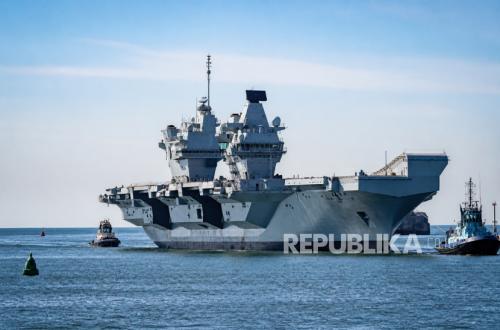
One of the United Kingdom’s largest warships, HMS Queen Elizabeth (R08), has returned to sea after undergoing a lengthy series of maintenance and repair works. The return of the 65,000-tonne aircraft carrier comes as the UK and NATO increase military readiness in the North Atlantic, Northern Europe, and the Arctic regions.
HMS Queen Elizabeth departed from its base in Portsmouth on Saturday (5/9/202/6) to undergo a programme of training and operations lasting approximately three months. This deployment represents a vital stage before the ship regains its status as a high-readiness aircraft carrier for the Royal Navy in 2027.
However, the return of the Queen Elizabeth is not merely about the conclusion of maintenance. The vessel is now an integral part of the UK’s evolving defence strategy, which increasingly integrates manned warships, fighter jets, drones, and autonomous systems to face modern warfare.
The Royal Navy stated that more than 800 personnel will participate in an intensive training and operational programme over the next three months. The Queen Elizabeth will operate in British and Northern European waters, training alongside allied nations to enhance collective defence, deterrence, and NATO readiness.
The aircraft carrier will undergo advanced training under the Flag Officer Sea Training (FOST). The crew will be tested in various modern naval warfare scenarios, ranging from flight operations and ship defence to the ability to coordinate multinational fleets during a crisis.
The position of the Queen Elizabeth has become increasingly strategic, as since July 2026, the ship has been designated as the Afloat Command Platform for NATO’s Allied Reaction Force Maritime (ARF(M)). For the first time, a Queen Elizabeth-class carrier is being utilised as a floating command platform for NATO’s maritime rapid reaction force.
In crisis scenarios, this maritime command can be used to coordinate warships, naval air power, and support vessels from various member states. The Allied Reaction Force itself is designed by NATO as a high-readiness force capable of being deployed against various threats, including conventional conflict, hybrid warfare, terrorism, and cyber-attacks.
The Commander of HMS Queen Elizabeth, Captain Claire Thompson, stated that this deployment is a significant milestone for the UK’s commitment to NATO and the carrier’s journey back to high-readiness status.
“This autumn deployment is a significant milestone for our NATO commitment as an Afloat Command Platform, as well as in our journey towards returning to being a ‘very high readiness’ Royal Navy aircraft carrier, a task we will take back from our sister ship HMS Prince of Wales in 2027,” said Thompson, as reported by USNI News on Wednesday, 9 September 2026.
Thompson also emphasised the importance of joint training for the combat staff onboard. According to her, integration and training are essential as the Queen Elizabeth refines its flight operation capabilities to perform operational duties at the heart of NATO’s strength if required.
The training programme will continue until 2027 and includes the Queen Elizabeth’s involvement in several major NATO exercises. Once all stages are completed, the ship is projected to replace HMS Prince of Wales (R09) as the UK’s high-readiness aircraft carrier by the end of 2027.
Returning After Long Repairs
The Queen Elizabeth previously underwent a series of phased maintenance works since late 2024. One of the largest undertakings took place at the Rosyth Royal Dockyard in Scotland, from August 2025 to March 2026.
This docking period included significant engineering works that could only be performed while the ship was in dry dock. The Queen Elizabeth subsequently returned to its base in Portsmouth in May 2026 before proceeding with a series of trials and operational preparations.
The return of the aircraft carrier is part of the UK’s efforts to maintain continuous Carrier Strike capabilities. While the Queen Elizabeth was undergoing maintenance, most of the operational duties of the UK’s aircraft carriers were handled by HMS Prince of Wales.
HMS Prince of Wales is itself scheduled for redeployment in the second half of 2026 to carry out the second phase of Operation Firecrest in the Atlantic, the High North, and Northern Europe. Consequently, the UK is gradually preparing both aircraft carriers to rotate operational duties and maintain high readiness.
Source: jawawa.id (https://jawawa.id/newsitem/british-aircraft-carrier-sets-sail-as-nato-heightens-alert-against-russia-1789001891)
Originally published by Republika (https://news.republika.co.id/berita/tl4f36451/kapal-induk-inggris-kembali-berlayar-nato-kian-siaga-hadapi-rusia), translated from Indonesian