
BRIN Urges Muhammadiyah to Become Strategic Partner in Accelerating Indonesia’s Energy Transition
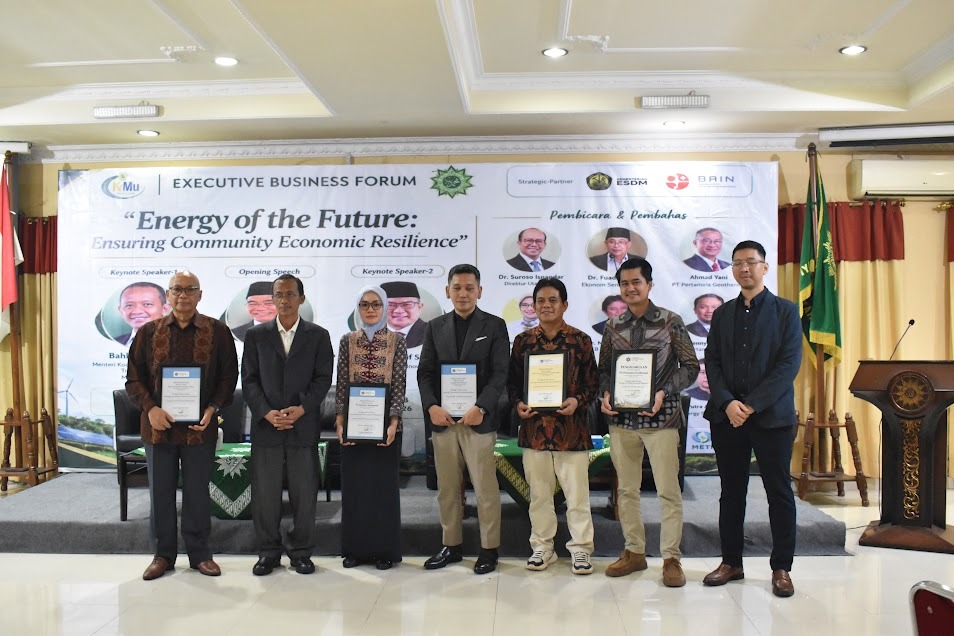
Accelerating Indonesia’s energy transition will require more than government policy and industrial investment. Research, technology, business, universities and civil society must work together so that the energy transformation can strengthen economic resilience and improve public welfare.
That message emerged at the National Executive Business Forum hosted by TV Muhammadiyah, under the theme “The Challenges of a Just Energy Transition in Building the Economic Strength of Communities”. The event was held at the Muhammadiyah Central Board building in Jakarta on Wednesday, 28 October.
National Research and Innovation Agency (BRIN) head Professor Arif Satria said Indonesia had abundant renewable energy potential, including solar, geothermal, hydro, wind and bioenergy. The challenge, he said, was to accelerate its use through technological innovation, investment and cross-sector collaboration.
Energy and Mineral Resources Ministry data show that renewables accounted for 15.75% of Indonesia’s energy mix in 2025, with installed capacity of 15,630 MW. India, meanwhile, had renewable energy capacity of 250.52 GW in December 2025, according to International Renewable Energy Agency statistics. The comparison highlights how much room Indonesia still has to accelerate its progress.
Arif also outlined opportunities to develop energy technologies using domestic resources. Palm oil mill effluent (POME), for example, could potentially generate about 1.73 GW of energy. Combined with the use of empty palm fruit bunches, the estimated potential rises to 3.9 GW. BRIN is also developing renewable natural gas, gas storage technology, battery energy storage systems (BESS), biofuels and waste-to-energy conversion.
Arif said the energy transition was an important part of Indonesia’s development agenda as it seeks to become a developed country. The government needs partners capable of connecting research, innovation and technology with practical implementation.
He told Muhammadiyah that the energy transition was not solely the government’s responsibility. With its network of universities, hospitals, schools, Islamic boarding schools and other charitable enterprises, Muhammadiyah had considerable potential to become a strategic partner in renewable energy development, applied research and workforce preparation.
From an economic and policy perspective, Dr Mukhaer Pakkana stressed that the success of the energy transition should be measured by its benefits to the public. Investment and growth in the energy industry must not generate gains only for particular sectors while leaving public welfare and environmental protection behind.
Putra Adhiguna, managing director of the Energy Shift Institute (ESI), warned of a gap between policy and implementation. Energy, he said, had not yet been fully treated as an integral part of the national macroeconomic structure, despite its influence on industrial competitiveness, productivity, investment and economic growth.
Putra also called on participants to scrutinise the electricity-sector management structure, including PLN’s dominant position, to improve governance, value creation and the sector’s contribution to the national economy.
The issue is relevant to PLN’s 2025–2034 Electricity Supply Business Plan (RUPTL), which envisages about 69.5 GW of additional power-generation capacity. Around 42.6 GW is to come from renewables and 10.3 GW from energy storage systems. The challenge is to ensure the plans are delivered and their economic benefits distributed fairly.
Representatives from industry, Jelita Irmawati of Pertamina and Romy Ramadhani of Pertamina Geothermal Energy (PGE), outlined efforts and challenges in developing new and renewable energy, particularly geothermal power.
Jelita said Pertamina was continuing to promote clean energy as part of its business transformation and support for national energy-transition targets. Its efforts include developing low-carbon energy, optimising domestic energy resources and pursuing innovation to strengthen Indonesia’s energy security.
Romy outlined PGE’s geothermal development. The company currently operates 727 MW of geothermal generation capacity across six operating areas, with a total managed portfolio of 1,932 MW. A key project is the 55 MW Lumut Balai Unit 2 geothermal power plant.
Geothermal energy has the advantage of being a clean source capable of providing relatively stable electricity around the clock. Its development, however, still faces challenges involving investment, exploration, technology and project economics.
Romy added that accelerating the energy transition required dialogue and collaboration with experts, researchers and universities. Such cooperation is important for technological innovation, strengthening workforce skills and speeding up the use of Indonesia’s geothermal resources.
The forum was attended by representatives of BRIN, Pertamina, the Indonesian Renewable Energy Society (METI), Muhammadiyah’s Economic and Business Council, the Muhammadiyah Climate Centre (MCC) and ESI. Leaders and representatives from Muhammadiyah and ’Aisyiyah universities also attended, including the rectors of Muhammadiyah Saintek University and Muhammadiyah Tangerang University, as well as representatives of Muhammadiyah Technical University, Ahmad Dahlan Institute of Technology and Business, and Muhammadiyah Jakarta University.
Zaenul Ula, manager of the TV Muhammadiyah Executive Business Forum, said the event should mark the beginning of practical cooperation rather than end as a discussion. “Everyone has a different perspective. That is precisely why it is important to understand and complement one another. The purpose of this forum is to build effective synergy and collaboration on sustainable energy-transition policy, towards a prosperous and just community economy,” he said.
Zaenul said the forum was ready to facilitate further discussions and explore cooperation among BRIN, Pertamina, Muhammadiyah, METI, ESI and universities. Potential initiatives include joint research, workforce development, training and internships, and the adoption of renewable energy at universities and within Muhammadiyah’s charitable enterprises. “If the energy transition is implemented effectively and transparently, with universities and civil society involved, Indonesia will not only be able to accelerate the shift in its energy system but also build a new economic strength that is more self-reliant, fair and sustainable,” he said.
The forum is expected to serve as a starting point for multi-stakeholder coordination, so that the energy transition becomes not merely a technological shift but a collective effort to build energy sovereignty, economic justice and a better future for Indonesia’s generations.
Source: jawawa.id (https://jawawa.id/newsitem/brin-urges-muhammadiyah-to-become-strategic-partner-in-accelerating-indonesias-energy-transition-1793357462)
Originally published by suaramuhammadiyah.id (https://www.suaramuhammadiyah.id/read/brin-dorong-muhammadiyah-jadi-mitra-strategis-percepatan-transisi-energi-indonesia), translated from Indonesian