
BRIN Urges Muhammadiyah to Become a Partner in the Energy Transition
JAKARTA — Accelerating Indonesia’s energy transition cannot rely solely on government policy and industrial investment. Research, technology, business, universities and civil society must work together so that the energy transformation strengthens economic resilience while improving people’s welfare.
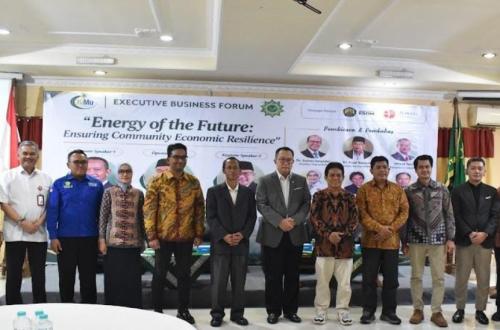
This message emerged at the National Executive Business Forum TV Muhammadiyah seminar, themed “The Challenges of a Just Energy Transition in Building the Economic Strength of Communities”, held at the Muhammadiyah Central Executive Board building in Jakarta on Wednesday (28 October 2026).
BRIN: Vast potential must become an economic strength
National Research and Innovation Agency (BRIN) head Prof Arif Satria said Indonesia had substantial renewable energy potential, including solar, geothermal, hydropower, wind and bioenergy. The challenge, he said, was to accelerate its use through technological innovation, investment and cross-sector collaboration.
Data from the Ministry of Energy and Mineral Resources show that renewables accounted for 15.75 per cent of Indonesia’s energy mix in 2025, with installed capacity of 15,630 MW. India, meanwhile, had renewable energy capacity of 250.52 GW in December 2025, according to International Renewable Energy Agency (IRENA) statistics. The comparison highlights how much ground Indonesia still has to make up.
Arif also outlined opportunities for energy technologies based on domestic resources. Palm oil mill effluent (POME), for instance, could generate about 1.73 GW of energy. Combined with the use of empty fruit bunches from oil palm, the potential is estimated at 3.9 GW. BRIN is also developing renewable natural gas, gas-storage technology, battery energy storage systems (BESS), biofuels and waste-to-energy conversion.
Arif said the energy transition was an important part of Indonesia’s development agenda as it seeks to become a developed country. The government needs partners capable of connecting research, innovation and technology with practical implementation.
Addressing Muhammadiyah, Arif said the energy transition was not solely the government’s responsibility. With its network of universities, hospitals, schools, Islamic boarding schools and charitable enterprises, Muhammadiyah had significant potential to become a strategic partner in renewable energy development, applied research and workforce training.
Policy critique: Energy must deliver economic justice
From an economic and policy perspective, Dr Mukhaer Pakkana stressed that the success of the energy transition should be measured by the benefits it brings to society. Investment and growth in the energy industry must not produce gains only for particular sectors while leaving public welfare and environmental sustainability behind.
Putra Adhiguna, managing director of the Energy Shift Institute (ESI), warned of a gap between policy and implementation. Energy, he said, had not yet been fully treated as an integral part of the national macroeconomic structure, even though it shapes industrial competitiveness, productivity, investment and economic growth.
Putra also urged participants to scrutinise the structure of electricity-sector management, including PLN’s dominance, to improve governance, value creation and the sector’s contribution to the national economy. Such steps, he said, were important for promoting transparency and efficiency in the energy sector.
Source: jawawa.id (https://jawawa.id/newsitem/brin-urges-muhammadiyah-to-become-a-partner-in-the-energy-transition-1793371902)
Originally published by Republika (https://ekonomi.republika.co.id/berita/tnq4vf423/brin-dorong-muhammadiyah-jadi-mitra-transisi-energi), translated from Indonesian