
BRIN strengthens export fruit irradiation standards using 'phantom' method
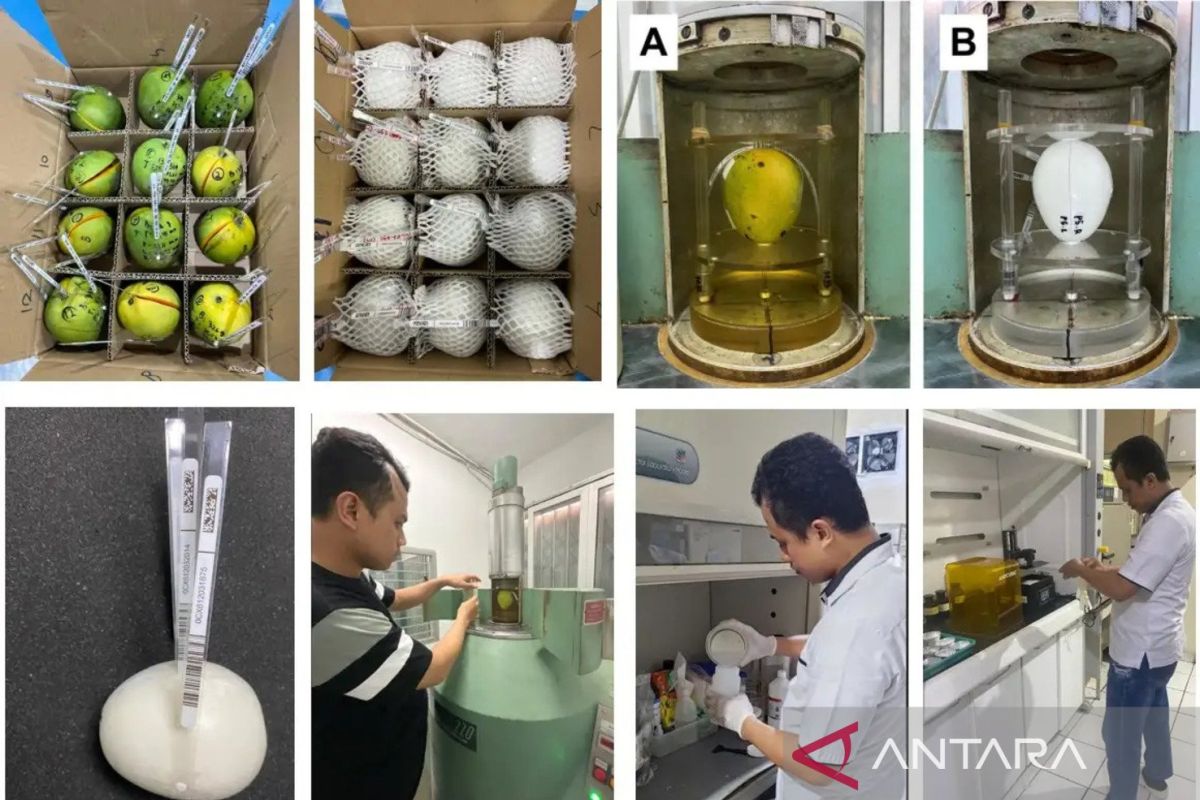
The Centre for Nuclear Safety, Metrology and Quality Technology Research (PR-TKMMN) under the National Research and Innovation Agency (BRIN) has developed a phantom-based irradiation method, using fruit-substitute materials to support the phytosanitary irradiation process for Gedong mango varieties.
BRIN researcher Okky Agassy Firmansaya explained in Jakarta on Tuesday that the development of the mango phantom serves as a representative medium for measuring radiation doses during pre-irradiation stages and quality control. “This phantom is an artificial fruit designed to have radiation absorption characteristics closely resembling real mangoes. This allows auditing, dose mapping, and irradiation testing at facilities to continue even when fresh fruit is unavailable, particularly during non-harvest seasons,” said Okky.
Okky noted that phytosanitary irradiation is a quarantine method used to ensure export fruits are free from plant pests (OPT), such as fruit flies, mango seed weevils, red-banded mango caterpillars, and mealybugs. Export destination countries enforce strict requirements to prevent pests from origin countries from entering and disrupting their domestic agricultural sectors. This innovation is expected to strengthen the quality assurance system for Indonesian fruit exports, particularly in meeting the requirements of destination countries for fresh products, such as Australia.
To ensure accurate dose distribution, the research team performs measurements at three representative points within the fruit: the surface, the middle, and the bottom. This measurement is crucial as certain insect types only reside on the surface, while seed borers can develop deep within the fruit.
The mango phantom was developed using liquid resin material based on 3D printing technology. The development approach adapts medical physics principles, using the equivalence of radiation interaction characteristics between the phantom material and real fruit.
“Test results show that the difference in dosimetry results between real Gedong mangoes and the phantom is only about 2 per cent under gamma irradiation. This value remains within the acceptable range, meaning the phantom can be used as a representation of real mangoes for dose testing,” Okky stated.
The research findings have been published in the journal Radiation Physics and Chemistry, titled “Development and characterisation of a 3D-printed Gedong mango phantom for dose measurement in gamma ray phytosanitary irradiation”. Additionally, the mango phantom innovation has obtained Intellectual Property (HKI) protection under registration number 000845287. Moving forward, research development will continue with testing on other radiation modalities, such as electron beams, as radiation interaction characteristics differ between gamma and electron radiation.