
BRIN States Anak Krakatau Eruption is Still a Long Way Off
Passengers were awakened by the loud commotion of voices.
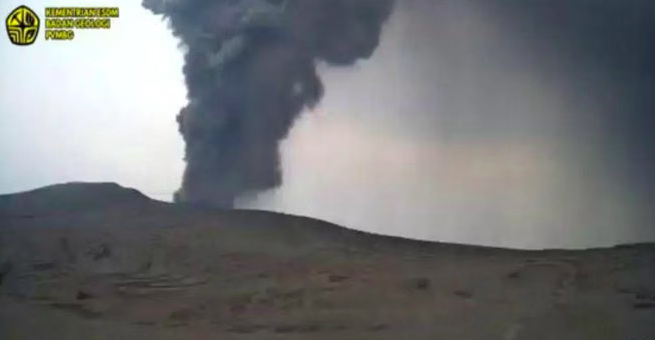
Aditya Pratama, a researcher from the Geological Disaster Research Centre of the National Research and Innovation Agency (BRIN), stated that Mount Anak Krakatau is currently in an incubation phase, meaning the potential for a massive eruption that forms a caldera is still quite far off.
“Regarding Mount Anak Krakatau, it is estimated to still be in the incubation phase. It is still quite far from reaching the fermentation phase before a caldera-forming eruption occurs,” Aditya said during a disaster discussion held online in Jakarta on Monday (14/9).
He explained that the volcanic system in the Sunda Strait is historically divided into three main periods: Old Krakatoa, Young Krakatoa, and Anak Krakatau, which emerged gradually following the 1883 eruption.
The eruption pattern that forms a caldera generally begins with stages of incubation, maturation, and fermentation, culminating in the large caldera-forming eruption itself.
Aditya explained that, based on recent research published in the journal Frontiers in Earth Science, the magma chamber of Anak Krakatau has been identified at depths ranging from 7.4 to 26.6 kilometres.
According to him, this condition is the complete opposite of Old Krakatoa and Young Krakatoa, which were proven to have large magma chambers at very shallow depths leading up to their destruction.
“At the very least, there have been two cycles of caldera formation in the 5th, 4th, and 6th centuries, and in 1883,” Aditya said, providing historical context for major eruptions.
Through petrographic and geochemical analysis of dozens of rock samples, the research team also found that the magma characteristics of Anak Krakatau are continuously evolving, distinguishing it from previous periods.
Aditya also noted that the presence of olivine minerals in Anak Krakatau samples reinforces the indication that the current magma chamber conditions have a fundamentally different chemical composition.
While the potential for a large eruption remains over time, these findings provide a sense of relief for the public, as the maturation process is predicted to take a very long time.
Aditya expressed hope that a deep understanding of the magma chamber and this polycyclic volcanic cycle will serve as a valuable reference for the government to continuously refine disaster mitigation strategies.