
BRIN reveals chronology and cause of meteor boom that crossed Java
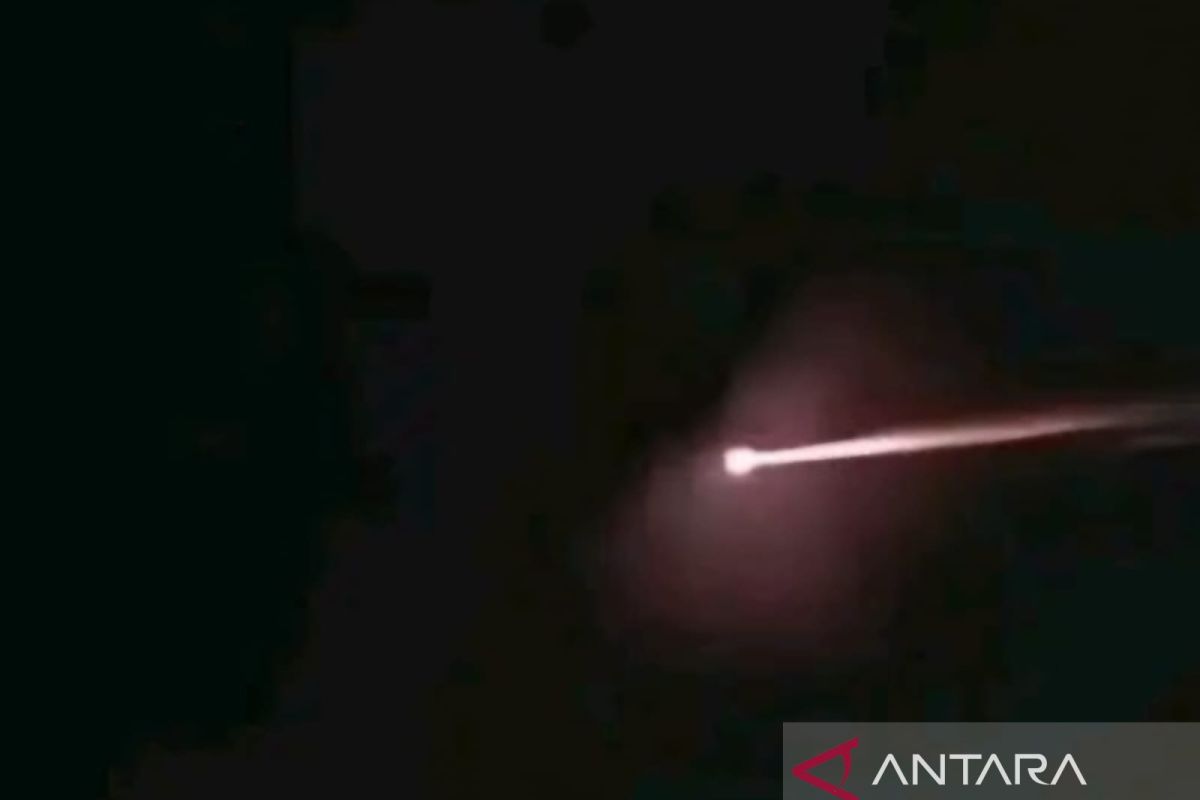
Jakarta (ANTARA) — Professor of Astronomy at the National Research and Innovation Agency (BRIN), Thomas Djamaluddin, has explained that the bright celestial object seen crossing Java on Saturday night (11 July) was a large meteor entering Earth’s atmosphere.
Speaking in Jakarta on Monday, Thomas said the meteor was first detected above the Java Sea before being seen from the Bekasi area at around 21.22.35 Western Indonesia Time (WIB). At that point it was still at a considerable altitude, appearing as a relatively small, white glowing object.
“A meteor comes from space rock orbiting the Sun. When its path crosses Earth’s orbit, the rock enters the atmosphere at very high speed. Friction with the atmosphere causes its surface to heat up until it glows, making it visible as a meteor,” he said.
At that stage, the rock begins to undergo ablation, or erosion, due to the extremely high temperatures, producing a bright light visible from the Earth’s surface.
Based on an analysis of its trajectory, Thomas said the meteor moved south-eastwards across parts of Java. As it entered denser atmosphere, the object grew brighter and began displaying different colours at various observation points.
In the eastern part of West Java, several residents of Cirebon and Kuningan reported hearing a bang some time after the meteor passed. Thomas explained that the sound did not come from a surface explosion, but from a shock wave (sonic boom) formed as the meteor travelled at very high speed through the lower atmosphere.
“The bang occurred because the meteor was moving much faster than the speed of sound. The shock wave was only heard some time after the meteor passed because sound takes time to reach the surface,” he said.
In Majalengka, Thomas added, the meteor was reported to appear blue. The same object was then seen in the Nagreg area at around 21.23.37 WIB and in Tasikmalaya as a bright light that occasionally illuminated the clouds. Such colour variation is a common phenomenon in meteors, influenced by the mineral composition of the rock and the atmospheric conditions it passes through.
When it crossed the Yogyakarta area at around 21.23.57 WIB, several residents saw the meteor emitting a very bright green light.
According to Thomas, the green colour came from magnesium contained in the space rock, which gives off a characteristic light when burned at extremely high temperatures due to friction with the atmosphere.
From the series of observations collected, BRIN estimates the meteor continued moving south-eastwards until it finally lost speed, most likely ending in the Indian Ocean south of East Java or Bali.
“This phenomenon is a fascinating natural event and a reminder that Earth constantly interacts with its space environment. As long as a meteor burns up in the atmosphere or falls in an uninhabited area, there is no need for the public to worry. What matters is understanding the phenomenon scientifically so that people are not easily misled by false information,” said Thomas Djamaluddin.