
BRIN Researcher: Sugar Palm Has Potential as National Bioethanol Source
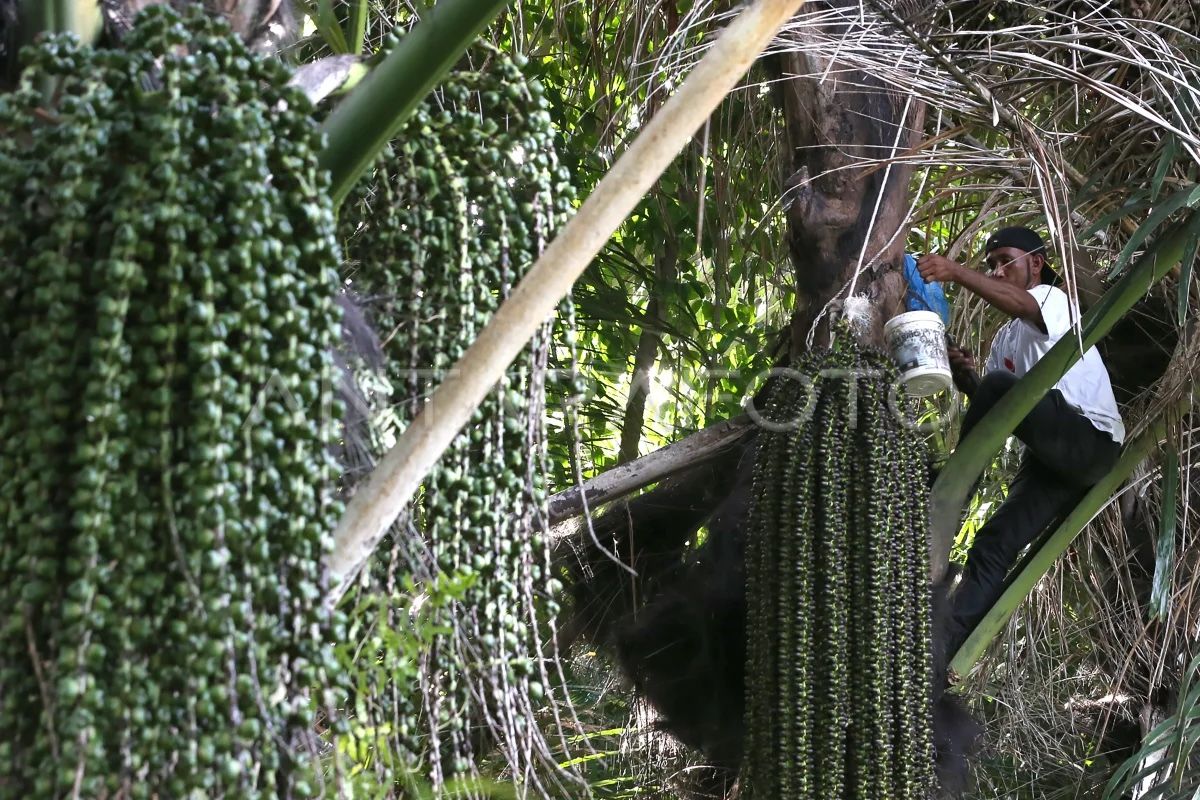
Jakarta (ANTARA) - Saptadi Darmawan, a researcher at the Centre for Biomass and Bioproduct Research of the National Research and Innovation Agency (BRIN), believes that sugar palm plants have the potential to become a national bioethanol source because they are easy to process, possess sustainable productivity, and can grow on marginal lands.
During a discussion with journalists at the Centre for Sustainable Forest Development in Bogor, West Java, on Friday, Saptadi stated that sugar palm sap is a relatively easy bioethanol feedstock to process because it contains high levels of sucrose, glucose, and fructose.
Unlike bioethanol derived from starch or woody biomass, which requires more complex processing, bioethanol from sugar palm sap can be produced simply through fermentation and distillation processes.
Furthermore, he noted that sugar palm-based bioethanol has an octane rating of approximately 108, which is higher than high-octane petrol.
Sugar palm trees can produce sap for up to about 20 years, making them a sustainable source of renewable energy feedstock.
“The economic value is quite good. It is also renewable,” he said.
Saptability explained that sugar palm can be developed on marginal or less productive agricultural land, ensuring it does not compete with food commodities.
On the other hand, the plant also contributes to conservation as its root system helps maintain soil and water, reduces erosion risks, and produces nectar as a food source for bees.
Despite its great potential, the development of sugar palm bioethanol still faces several challenges.
According to Saptadi, the quality of the raw materials and the bioethanol production process still need further standardisation. Additionally, in several regions, sugar palm sap competes with its use as a raw material for traditional alcoholic beverages, which holds a higher economic value.
He believes that the development of sugar palm for bioethanol needs to be distinguished from its use for food to avoid competition for raw materials.
In his view, sugar palm management for food purposes can continue to be carried out by local communities, whereas the development of sugar palm as an energy source requires cultivation areas at an economically viable scale to ensure a sustainable sap supply.
“For its development, we must create two clusters: sugar palm for food and sugar palm for energy. If they are not separated, development will not proceed smoothly,” he said.
From an economic perspective, Saptadi assesses that sugar palm bioethanol ventures are viable for development at both cooperative and small-scale industrial levels.
Based on his team’s research, the production cost (HPP) of sugar palm bioethanol ranges from Rp8,500 to Rp10,000 per litre, while the selling price is estimated to reach Rp14,000 to Rp16,000 per litre, with an estimated gross margin of 35-45 percent.
He added that the development of the bioethanol industry should also support the utilisation of all parts of the sugar palm plant to generate greater added value.
In addition to sap as a bioethanol feedstock, the fruit can be processed into candied palm fruit (kolang-kaling), the fibre (ijuk) can be used for various industrial needs, and the waste can be processed into bio-pellets or bio-briquettes.
Data from the Central Bureau of Statistics (BPS) shows that sugar palm plants are widespread across various regions of Indonesia. West Java is the province with the largest sugar palm area, followed by North Sumatra and South Sulawesi, which also possess significant development potential.
Saptadi also highlighted a trend of shrinking sugar palm areas in Indonesia. According to BPS data, the area of sugar palm cultivation decreased slightly from 64,544 hectares in 2019 to 60,557 hectares in 2023.
Production also fell from a peak of 107,415 tonnes in 2021 to 100,273 tonnes in 2023, while productivity declined from 2.8 tonnes per hectare to 2.7 tonnes per hectare during the same period.
According to Saptadi, these conditions require serious attention if sugar palm is to be developed as a national bioethanol source.
As part of the development of sugar palm-based bioenergy, the Ministry of Forestry inaugurated a Sugar Palm Bioethanol Pilot Project in December 2025 within the Pertamina Geothermal Energy (PGE) Kamojang area, Garut, West Java.
During the inauguration, Minister of Forestry Raja Juli Antoni stated that the project is a significant milestone in accelerating the development of green bioenergy based on sugar palm, aligning with the government’s energy transition agenda.
According to Raja Juli, sugar palm is a commodity with the potential to support national bioethanol needs because it can grow well in forested areas and on sloping lands.
The pilot project utilises sugar palm sap supplied by the Baru Bojong Social Forestry Business Group (KUPS) in Bojong Village, Garut. The facility has a production capacity of approximately 300 litres of bioethanol per day, requiring 300-500 kilograms of sugar palm sap per day.
The Ministry of Forestry estimates that one hectare of sugar palm can produce approximately 24,000 litres of bioethanol per year.