
BRIN Researcher Encourages Social Science Research Collaboration with China
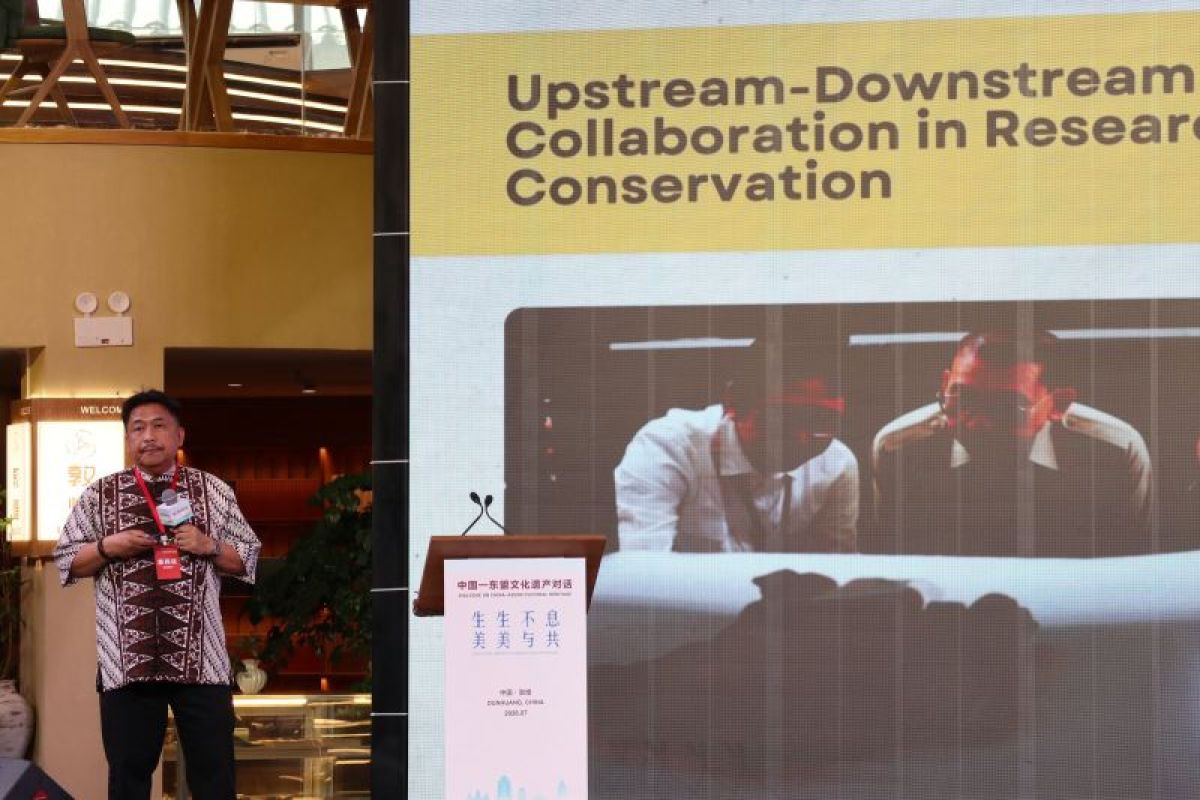
Dunhuang (ANTARA) - The Head of the Archaeology, Language, and Literature Research Organisation of the National Research and Innovation Agency (BRIN), Herry Jogaswara, is encouraging research collaboration between his institution and similar organisations in China, specifically in the field of social sciences.
“We certainly highly encourage collaboration. All platforms within our research organisation are open platforms, meaning you can propose cooperation at any time. We are very enthusiastic about conducting collaborative research and can also provide support in terms of facilities,” said Herper in Dunhuang, Gansu province, on Thursday.
He made these remarks during the “Dialogue on China-ASEAN Cultural Heritage” event, organised by the China International Communications Group (CICG) in conjunction with the Gansu municipal government. The event was attended by approximately 150 participants, including researchers, policymakers, media representatives, and content creators from China, Malaysia, Indonesia, Vietnam, the Philippines, and Cambodia.
“We also recognise the challenges compared to the STEM approach—science, technology, engineering, and mathematics—because there are usually many established research patterns in those fields. However, in social science research like ours, I believe research is still very limited,” stated Herry.
As part of the SHAPE cluster (social sciences, humanities, arts, religion, and economy), Herry noted that BRIN researchers are attempting to find ways to develop research into something new for industry.
“One of our products is what we call ‘101 Ideas for the Creative Industry’. In this product, we compile various types of research into a single book, which is currently available as a free digital book,” explained Herry.
According to Herry, the book serves as an effort to utilise a storytelling approach in research and to demonstrate how research findings can be developed into creative products.
“In reality, this is not easy. As we know, research involves ethics, while on the other hand, the creative economy is subject to various other regulations. However, we are doing our best to connect research with matters related to the economy,” he clarified.
Furthermore, Herry stated that BRIN offers joint funding with academics through a cooperation model known as “no money cross borders.”
“Under the ‘no money cross borders’ concept, BRIN or Indonesia provides several grants for Indonesian researchers within Indonesia. Meanwhile, other costs and arrangements are handled through different mechanisms,” he said.
According to Herry, BRIN continues to invest in research infrastructure and is developing more research platforms.
“We have begun having a memorandum of understanding with Shandong University to establish what we call ‘sister laboratories,’ meaning we can exchange laboratory access to conduct research related to archaeology, language, and literature,” he added.
He also expressed hope that the event would encourage more dialogue between Southeast Asian nations and China.
Meanwhile, the Chairman of the Southeast Asian Cultural Heritage Alliance, Ivan Anthony Henares, stated that China is a vital partner in preserving cultural heritage.
“There is much we can learn from China’s experience, ranging from scientific conservation and digital innovation to the interpretation of science. At the same time, Southeast Asia offers valuable experience in civil society-led conservation and the management of culturally diverse landscapes,” said Ivan.
His organisation is an association of civil society groups dedicated to cultural preservation from nine Southeast Asian countries (excluding Brunei).
“Ultimately, heritage is not just about preserving monuments or traditions,” Ivan added.
Yu Yingfu, Deputy Director of the China International Communications Group, noted that 2026 marks five years of the comprehensive strategic partnership between China and ASEAN.
“Cooperation between both parties across various sectors continues to increase, while people-to-people and cultural exchanges are becoming closer. Within this, cultural heritage serves as an important link connecting the past and the future to strengthen our friendship,” said Yifung.
In his explanation, he proposed three suggestions: first, to build a consensus for cooperation and strengthen a shared foundation within cultural heritage networks.
“The world is currently undergoing unprecedented changes. Exchanges and dialogues between civilisations also face new opportunities and challenges. Therefore, we need to actively encourage actions to protect Asian cultural heritage so that it continues to develop deeply,” said Yifung.
Second, to explore the contemporary value contained within cultural heritage to open new pathways for industrial cooperation, and to promote the connectivity between cultural heritage, technology, media, and the cultural industry.
Third, to encourage youth to communicate through international cultural exchanges.
“During this event, a programme to enhance cultural heritage dissemination capabilities will be officially launched, primarily targeting ASEAN youth. We invite youth from various countries to directly experience cultural heritage protection efforts in China,” added Yifung.
The programme invites youth, young academics, media, and students from China and ASEAN to participate in both online and offline training on how to create creative products from cultural heritage, manage businesses, and connect them to the industry.
Source: jawawa.id (https://jawawa.id/newsitem/brin-researcher-encourages-social-science-research-collaboration-with-china-1782982459)
Originally published by Antara (Indonesian) (https://www.antaranews.com/berita/5632143/peneliti-brin-dorong-kolaborasi-penelitian-ilmu-sosial-dengan-china), translated from Indonesian