
BRIN Identifies New Rhododendron Species in Central Sulawesi
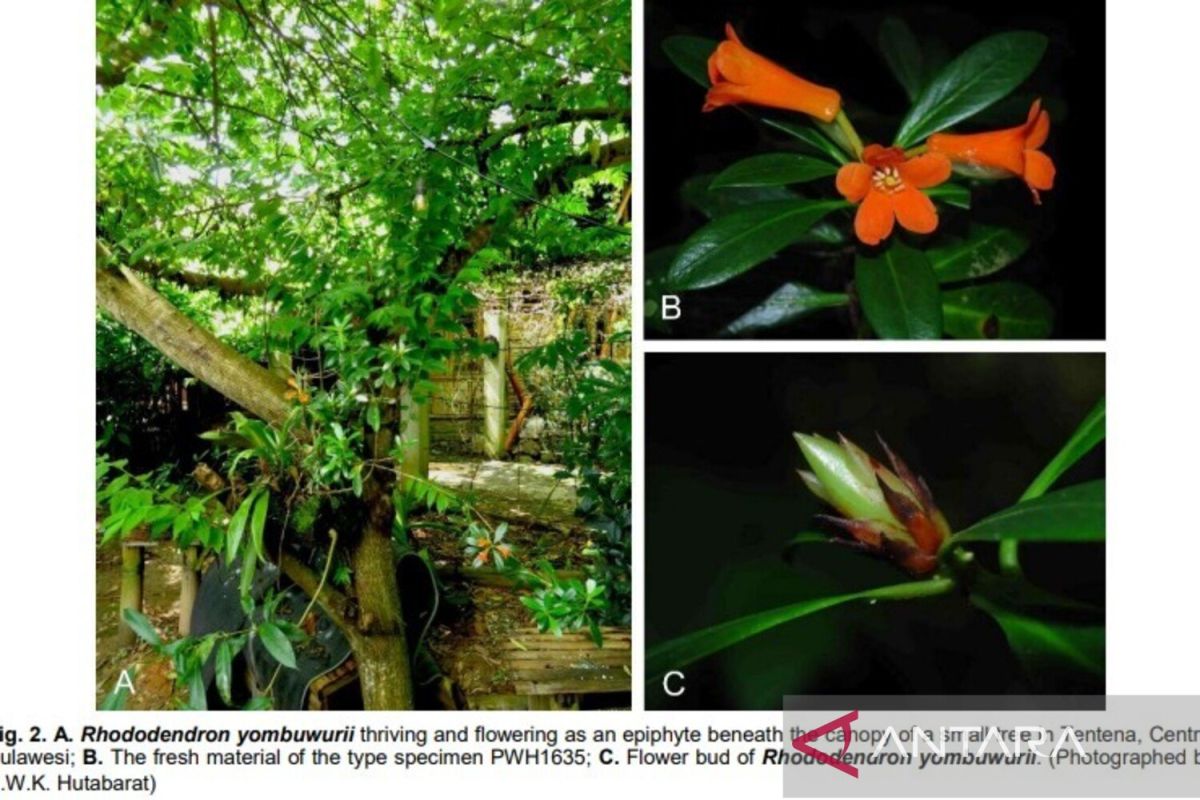
Jakarta (ANTARA) - Researchers from the National Research and Innovation Agency (BRIN) together with a cross-institutional team have successfully revealed the discovery of a new ornamental plant species from the genus Rhododendron subgenus Vireya, originating from Central Sulawesi. The new species, which has bright orange flowers, has been officially named Rhododendron yombuwurii Hutabarat, Bandjolu & Zulfadli, and was published in the reputable international journal Taiwania Volume 71 Number 2 of 2026, with the title ‘Rhododendron yombuwurii (Ericaceae), a new orange-flowered species of subgenus Vireya from Central Sulawesi, Indonesia’. Prima Wahyu Kusuma Hutabarat, a researcher at BRIN’s Biosystematics and Evolution Research Centre, explained in Jakarta on Friday that morphologically, Rhododendron yombuwurii has distinctive characteristics as a slender epiphytic shrub with bright orange, narrow funnel-shaped flowers that grow semi-erect or horizontally. Morphologically, it is most closely related to Rhododendron celebicum. ‘However, Rhododendron yombuwurii has very clear differences, including smaller leaf size, semi-erect rather than hanging flower arrangement, and much smaller, bright orange flowers, unlike R. celebicum which has large, pink to red flowers,’ Prima clarified. The species was first encountered as a living plant being cared for around the Saluopa Waterfall tourist area in Tenten, Central Sulawesi, in June 2023. Further investigation revealed that this epiphytic specimen originally came from the mountain forests of the Tokorondo Mountains, west of Tentena and Lake Poso, at an altitude of about 1000–1800 metres above sea level, before it fell and was rescued by local residents. Microscopic structural imaging of the leaves was carried out using a Focused Ion Beam Scanning Electron Microscope (FIB-SEM) Aquilos 2 at the BRIN Cibinong genomics laboratory to identify the specific shape of the scales on the leaves. In addition, an integrative approach based on DNA molecular analysis of the nuclear ribosomal Internal Transcribed Spacer (ITS) region was also conducted to confirm that this plant represents a separate lineage and is valid as a new species. ‘The epithet name yombuwurii was chosen as a tribute to the late Reverend Yombu Wuri, a religious and traditional leader from the Pamona tribe who was known for his tireless efforts in advocating for biodiversity preservation and conservation in the Poso region,’ said Rifqi. Ecologically, the Tokorondo Mountains region where this species originates has very high biodiversity potential but has historically been minimally explored due to limited access. Based on an initial conservation assessment according to the International Union for Conservation of Nature (IUCN) criteria, this new species is categorised as ‘Data Deficient’ (DD). This is because its population has never been directly observed in its original habitat in the interior forest, necessitating further systematic field surveys in the future.