
BRIN Identifies Chinese Rocket Debris That Fell on a Kalimantan Palm Oil Plantation
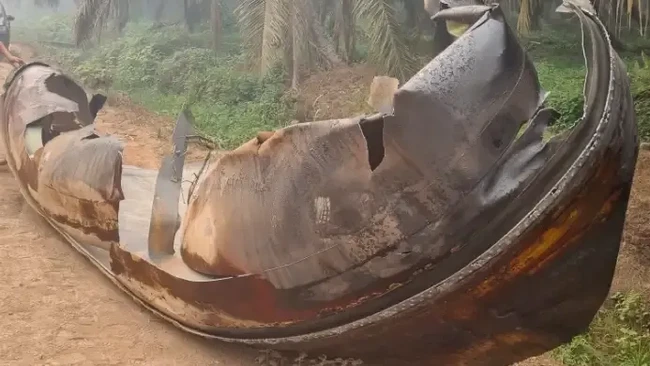
Jakarta, CNBC Indonesia – A large, unidentified metal object was found on an oil palm plantation in Sampit, East Kotawaringin regency, Central Kalimantan. The mystery surrounding the object is beginning to be solved.
Orbital trajectory analysis strongly suggests that it is space debris from a Chinese ZhuQue-2E (ZQ-2E) rocket that re-entered Earth’s atmosphere on Sunday, 18 October 2026.
Thomas Djamaluddin, principal researcher in astronomy and astrophysics at the National Research and Innovation Agency (BRIN), said the initial identification was made by tracing the orbital data of space objects estimated to have passed over Kalimantan at the time of the incident.
Residents had earlier reported hearing a rumble in the sky at around 5.30pm local time on Sunday, 18 October. The following morning, plantation workers found a large, torn piece of metal on the oil palm plantation.
A subsequent investigation found that the ZhuQue-2E rocket body’s trajectory travelled from north to south over Kalimantan on 18 October 2026.
At around 5.36pm local time, its trajectory was near Sampit, close to the time residents reported hearing the rumble.
“According to the orbital data we traced, the ZhuQue-2E rocket body passed from north to south over Kalimantan on 18 October 2026. At around 5.36pm local time, its trajectory was near Sampit,” Thomas said, as quoted in an official statement on Tuesday, 20 October 2026.
“This timing matches residents’ reports of hearing a rumble that afternoon,” he added.
Thomas said the match between the timing of the event and the rocket’s trajectory was an important clue in identifying the origin of the object found by residents.
The investigation also showed that this was the rocket body’s final orbital pass before it re-entered Earth’s atmosphere and was no longer in orbit. The data indicate that this was its last orbit before re-entry.
“The consistency between the timing of the pass and residents’ reports provides a strong basis for suspecting that the object found in Sampit is part of ZhuQue-2E space debris,” he said.
ZhuQue-2E is a satellite launch vehicle developed by Chinese commercial space company LandSpace. It uses liquid methane and liquid oxygen propellants, a technology known as liquid oxygen-liquid methane, or methalox. This is one of the approaches being developed by the space industry to improve launch-system efficiency.
The two-stage rocket is an upgraded version of the ZhuQue-2 family. It is designed to carry satellites into low Earth orbit and Sun-synchronous orbit.
According to launch information published by Xinhua, the ZhuQue-2E Y4 rocket lifted off from the Dongfeng launch area in China on 14 October 2026 carrying ten satellites. The mission was declared successful after all the satellites were placed in their designated orbits.
However, a successful satellite launch does not mean every part of the rocket remains in space. “After completing its task, an unused rocket stage may remain in orbit around Earth for a time. Gradually, atmospheric drag lowers its orbital altitude until it re-enters Earth’s atmosphere,” he explained.
Why rocket debris falls to Earth
In the ZhuQue-2E case, the rocket body suspected of being the source of the fragments in Sampit is listed under NORAD identification number 101070 and international designator 2026-234L.
So how does space debris fall to Earth?
Thomas explained that space debris consists of human-made objects in space that are no longer functioning. It can include inactive satellites, rocket parts and fragments of spacecraft components.
When an object re-enters the atmosphere, its very high speed causes extreme heating as it interacts with the air. Most of its material may burn up, melt or break into smaller pieces.
“This process can sometimes produce bright light visible from the Earth’s surface, and may also be accompanied by a bang or rumble when shock waves form in the atmosphere,” Thomas said.
However, not every part of a spacecraft is necessarily destroyed in the process. Some more heat-resistant materials can survive their passage through the atmosphere and reach the Earth’s surface.
“This phenomenon is one possible explanation for the discovery of a large piece of metal on the Sampit oil palm plantation,” he said.
Although orbital analysis provides strong clues, physical examination remains important to confirm the identity of the component found, including whether its shape, material and markings match the rocket’s technical information.
Source: jawawa.id (https://jawawa.id/newsitem/brin-identifies-chinese-rocket-debris-that-fell-on-a-kalimantan-palm-oil-plantation-1792486275)
Originally published by CNBC Indonesia (https://www.cnbcindonesia.com/tech/20261020140726-37-777858/brin-ungkap-identitas-roket-china-yang-jatuh-di-kebun-sawit-kalimantan), translated from Indonesian