
BRIN Explains the Use of Dry Ice to Tackle Haze from Forest and Land Fires
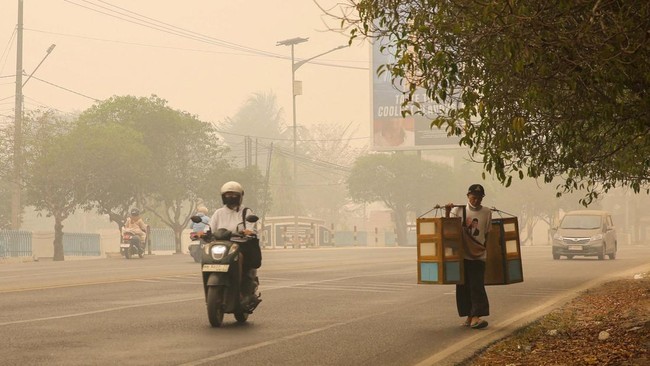
Jakarta, CNBC Indonesia — One approach being tested by the National Research and Innovation Agency (BRIN) to tackle haze through weather-modification operations is seeding with dry ice.
The technology is being trialled and evaluated to determine its ability to affect the stability of atmospheric layers that impede the movement of smoke and the formation of rain clouds.
Florentinus Heru Widodo, Principal Engineer at BRIN’s Centre for Limnology and Water Resources Research, said atmospheric conditions in areas affected by forest and land fires currently pose particular challenges for weather modification.
He said that under normal atmospheric conditions, air temperature generally falls as altitude increases. This allows warm air near the surface to rise through convection and supports cloud development.
During a temperature inversion, however, a layer of warmer air sits above cooler air. This layer inhibits vertical air movement, making cloud growth more difficult and potentially causing smoke to accumulate close to the surface.
“This inversion layer can be likened to a lid that prevents air from moving upwards. As a result, smoke from fires struggles to disperse vertically and becomes more concentrated near the surface,” Heru said in an official BRIN statement, cited on Tuesday (20 October 2026).
He added that stable atmospheric conditions also hinder the development of rain clouds.
Unlike cloud seeding, which aims to increase the likelihood of rainfall from clouds that meet the required conditions, dry ice is being used in this context to test whether thermal conditions in an inversion layer can be changed.
Dry ice has a temperature of around minus 78.5 degrees Celsius. When released into the atmosphere, it sublimates—that is, it changes from a solid directly into a gas—while absorbing heat from its surroundings.
In theory, the resulting local cooling is expected to affect differences in temperature and air density, trigger local air movement and increase the likelihood of vertical air mixing.
If the changes are sufficiently large and atmospheric conditions are favourable, the inversion layer could weaken, allowing air to move more freely and creating better prospects for cloud development.
Heru said dry ice is expected to create local cooling and affect the stability of air in the inversion layer.
He emphasised that this mechanism remains a scientific hypothesis. BRIN still needs to test whether any resulting changes are sufficient to weaken the inversion and support cloud development.
Heru cautioned that inversion layers can cover extensive areas and vary in stability. Therefore, a temperature disturbance at one location may not be enough to alter the atmosphere as a whole.
He said the method’s success cannot be concluded from estimates of the cooling mechanism alone; it must be demonstrated through atmospheric observations and data analysis.
Data analysis
To support the operation, Heru said BRIN can conduct analysis using atmospheric observation data collected by the agencies carrying out the operation and by the Meteorology, Climatology and Geophysics Agency (BMKG).
The data include vertical air-temperature profiles, humidity, the altitude and thickness of inversion layers, and atmospheric stability parameters.
Measurements can use radiosonde data. A radiosonde is an atmospheric observation instrument that provides information on temperature, humidity and meteorological conditions at various altitudes.
Temperature readings taken during flights can also be used to identify inversion layers and estimate their thickness.
Observations before, during and after seeding need to be conducted systematically so that changes in air conditions can be documented and compared.
Heru said this approach is important because the effectiveness of any weather-modification technology depends greatly on atmospheric conditions at the time of the operation.
“We want to ensure that every technology used in disaster response has a strong scientific basis,” he said.
“Observation data are key to determining whether the treatment really affects the inversion layer, or whether changes in conditions are also influenced by other weather dynamics,” he concluded.
Source: jawawa.id (https://jawawa.id/newsitem/brin-explains-the-use-of-dry-ice-to-tackle-haze-from-forest-and-land-fires-1792504229)
Originally published by CNBC Indonesia (https://www.cnbcindonesia.com/tech/20261020125404-37-777822/brin-jelaskan-fungsi-pakai-dry-ice-atasi-asap-karhutla), translated from Indonesian