
BRIN Develops Autonomous Three-Wheeled Electric Vehicle, Appearance Surprises
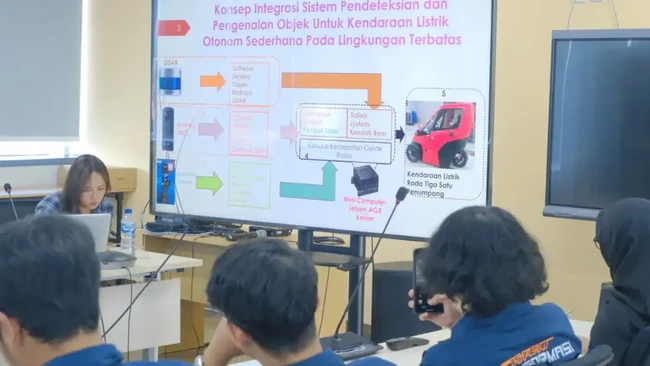
The National Research and Innovation Agency (BRIN) is continuing to develop an autonomous electric vehicle by integrating object detection and recognition systems. This development aims to support safe and efficient mobility in restricted environments. Arief Suryadi Satyawan, an Expert Researcher at BRIN’s Telecommunications Research Centre, explained that the research focuses on developing systems, communications, and transportation technology. He revealed that the development of the autonomous electric vehicle began in the 2021-2022 period through research funding. The vehicle being developed is a three-wheeled electric vehicle with a capacity of one passenger and low speed. It is designed to operate in limited areas, such as campus environments, offices, and airports.
The vehicle utilises the integration of various sensors, such as LiDAR, 360-degree cameras, radar, thermal cameras, and visual cameras. All sensors work in an integrated manner to detect and recognise objects around the vehicle, which are then processed through an embedded computing system so that the vehicle can navigate and move independently. Arief noted that a challenge still being developed is the communication system, especially when the vehicle uses a centralised data collection base. A reliable communication system is needed so that the vehicle’s movements and behaviour can be monitored in real-time.
He added that technological and infrastructure support are important factors in accelerating the development of autonomous electric vehicles. According to him, the utilisation of vehicles in industrial areas and production facilities requires attention to vehicle quality and operational systems. In addition, the financing model also needs to be adapted to user needs. The developed vehicle has the potential to increase energy efficiency through more stable and smooth operation. According to him, this needs to be supported by a locally based construction system so that the design and production process is more adaptive to field needs.
From a design perspective, the vehicle still considers aspects of strength, compact size, and flexibility of use. This opens up opportunities for vehicle utilisation, including supporting distribution systems and goods delivery in certain areas. Furthermore, he and the research team are also developing supporting technology in the form of super resolution to improve image quality from limited visual data. This technology is expected to help the monitoring process and the transmission of visual information with better quality.
After approximately two and a half years of development, Arief and the research team have successfully produced a fourth-version prototype of the autonomous electric vehicle. The prototype has been able to perform simple manoeuvres stably. This capability is supported by the integration of sensor data reception systems, data processing, steering control, and navigation that work in an integrated manner. All vehicle components have been integrated into an embedded computing system so that the vehicle can respond to environmental conditions automatically. This achievement contributes to the development of human resources in the research field. To date, the research has involved around 45 students. The activity has also produced one doctoral graduate who completed their studies through the topic of autonomous electric vehicle development. The research team will continue to refine the autonomous electric vehicle system from various aspects of performance, reliability, and implementation readiness. Thus, this vehicle can be utilised more widely in various sectors and provide real benefits to the community.